
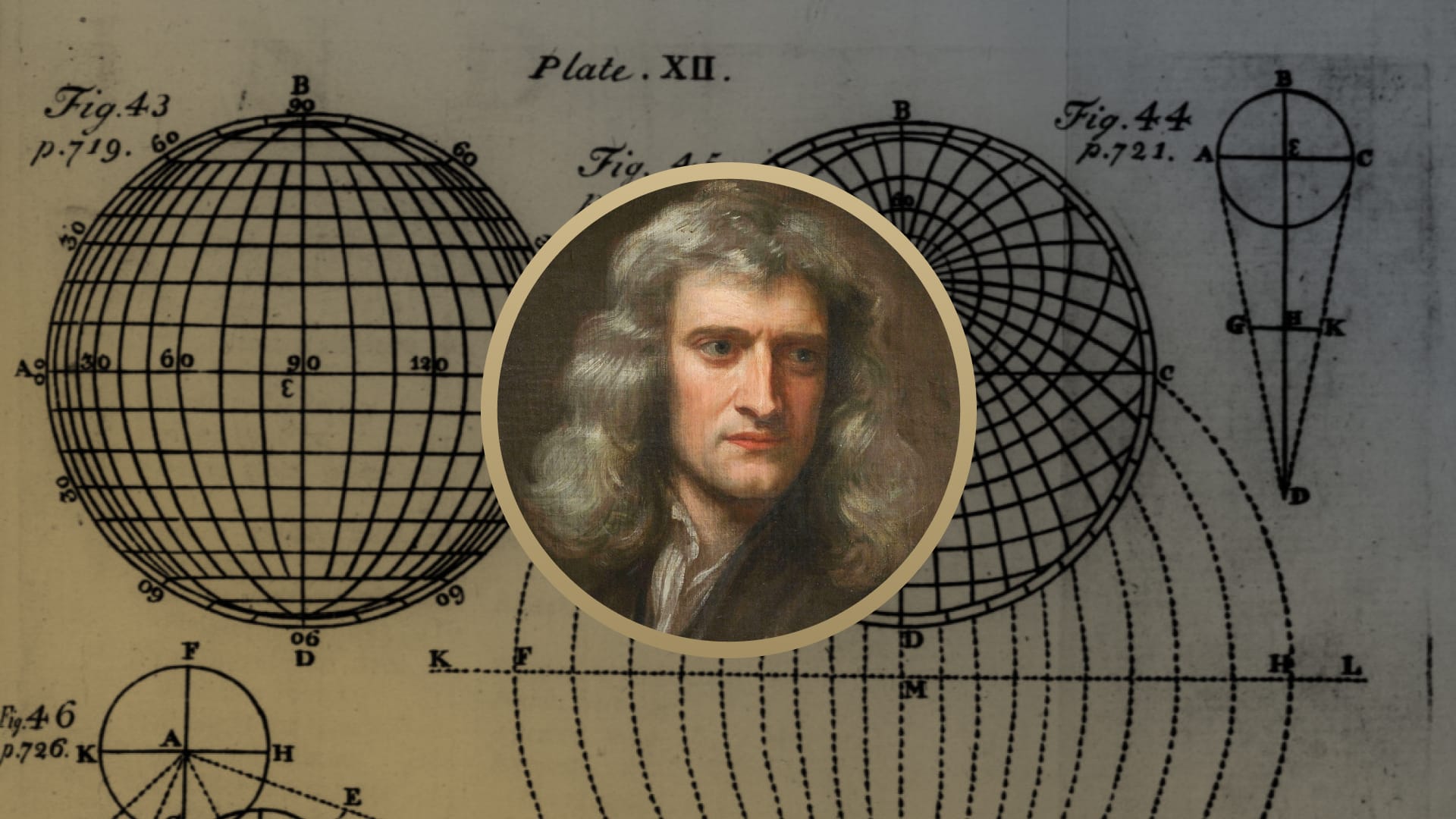
On Christmas Day of 1642, a premature baby was born at Woolsthorpe Manor in Lincolnshire, England. In the seventeenth century, premature babies rarely lived. The boy’s mother clung to her precious gift as a memory of her dead husband, naming him for his father, Isaac Newton.
Few could have guessed that this premature baby would grow up and be regarded as the greatest scientist in history, the father of optics, the proponent of infinitesimal calculus, the chief authority on astronomy, the calculator of the speed of sound, the advocate of Biblical chronology, the defender of the heliocentric universe, the formulator of the laws of motion, and the author of the laws of universal gravitation.
Most importantly, Isaac Newton became the great defender of the eternal truth of God revealed in Scripture and demonstrated in Creation. His mother would never have believed that her fatherless premature baby would one day be buried in Westminster Abby and be given the immortal title of knighthood as Sir Isaac Newton.
Because that young baby lived, curiosities of nature that had long been a mystery to mankind would no longer be a mystery. That baby, Isaac Newton, lived and his work explained the paths of comets, the fall of objects toward the earth, the rise and fall of tides, the orbit of the earth and planets around the sun, and the reason for the colors of the rainbow. Newton showed that mysteries could be cleared up when the light of God’s truth was shed upon the darkness of ignorance and superstition.
Isaac Newton had a difficult childhood. Although his mother loved him, he was often neglected in her second marriage. He was raised mostly by his maternal grandmother, who loved him sincerely but could not fulfill the place of father and mother. The boy was never strong in body, and his premature birth had a permanent influence on his physical condition. While Newton was very weak physically, he was strong intellectually. While the other boys were outside playing in the schoolyard, he spent his free time building sundials and windmills.
At the age of seventeen, he had risen to the top of his class and had learned all that his schoolmaster could teach him. His mother could not pay for advanced schooling, so she took him out of school to be a farmer. But his weak body could not stand the constant physical strain, and his mind needed more engaging challenges. His schoolmaster persuaded the mother to seek higher education for her son, and through the interest of a kind schoolmaster and his maternal uncle, he was admitted to Trinity College at Cambridge University.
His early days at Cambridge were difficult, as Newton had to work in order to pay for his own schooling. In his precious free time, while others played sports and engaged in the social whirl associated with college life, Newton began reading the astronomical writings of Galileo and Kepler, and the mathematical speculations of Descartes. He began writing questions in a notebook, where he noted what he liked about Descartes’s mathematics and Kepler’s astronomy, as well as noting how he differed from these great men on certain points. Isaac Newton, when praised for his great discoveries, humbly commented, “If I have seen further, it is by standing on the shoulders of giants.”
While still working on his bachelor’s degree, he began to develop his binomial theorem and to play with calculus. A short time later, while he was working on his master’s degree, the University of Cambridge closed because of the threat of the Great Plague.
Shut up in his own home in the English countryside for two years, Newton studied on his own, without the aid of the doctors and professors at Cambridge. On pleasant days, he would take his walks out in the garden and orchard. It was there one autumn day that he watched ripe apples fall from the trees. While it is probably apocryphal that an apple actually fell and hit his head, Sir Isaac Newton himself often told the story of walking in the orchard and noting the fall of the apples.
Watching the apples fall from the trees produced a lingering consideration; the idea developed into a growing conviction that the same unseen force that made the apple fall to the ground was the force that bound the universe together. This same force also kept the earth on its orbital course and explained the orbit of the moon, the lunar cycle, and the rise and fall of tides. Newton’s gravitational theory was not the inspiration of a moment, but the conviction of a lifetime of studying God’s truth.
It was also during this two-year break that Newton played with the beams of light that came through his window. He noticed with amazement that he could create his own rainbow by taking a prism and dividing the light into its component colors. The colors of the rainbow were not a mystery; rather, they were a manifestation of the optic spectrum created by God and demonstrated to Noah after the Flood as a sign of His covenantal promise.
When the University reopened, Isaac Newton returned to his formal studies. He obtained his Master’s degree at the age of twenty-seven. His peers as well as his professors all acknowledged him to be excellent in every department of learning. Newton was made the Master of Trinity College before he was thirty years old and was soon elected to be a Fellow of the Royal Society. He was knighted by Queen Ann as Sir Isaac Newton.
He spent the most productive years of his life writing, teaching, lecturing, and discussing his theories with other scientists. His most famous works were Principia, Mathematica, and Opticks, but he also wrote many articles, essays, discussions, and even some theological works in his free time. Although he had some unorthodox speculations concerning the Trinity, he never openly questioned church teaching and remained a humble Christian all his life.
Although Isaac Newton was a deep thinker, he was also a very practical man who applied truth to the reality of everyday life. He used his principles of optics to develop a refracting telescope that allowed man to gaze into the heavens with new clarity.
He was a member of Parliament and represented Cambridge University there. He also took the post of Master of the Royal Mint and held this position for the final thirty years of his life—even while he continued to teach, write, and study. As Master of the Mint, Sir Isaac Newton used his scientific ability to study a sample of coins in circulation. He estimated that fully 20 percent of coins in British circulation were counterfeit. During his time in office, he successfully prosecuted 28 counterfeiters. He also served as Justice of the Peace.
As a defender of the authority of Scripture and the revealed truth of God to man, Sir Isaac Newton had no equal. His articulation of certain eternal absolute truths such as gravity, planetary motion, the laws of mathematics, and the rules of optics showed a skeptical world that the God of the Bible was the only source of light and truth.
Sir Isaac Newton died in his sleep in London. The fatherless baby who was born prematurely had explained the light of truth to the world. He was buried in Westminster Abbey. The inscription written on his grave is as follows:
Here is buried Isaac Newton, Knight, who by a strength of
mind almost divine, and mathematical principles peculiarly
his own, explored the course and figures of the planets, the
paths of comets, the tides of the sea, the dissimilarities in rays
of light, and, what no other scholar has previously imagined,
the properties of the colours thus produced. Diligent, sagacious
and faithful, in his expositions of nature, antiquity and the holy
Scriptures, he vindicated by his philosophy the majesty of God
mighty and good, and expressed the simplicity of the Gospel in
his manners. Mortals rejoice that there has existed such and so
great an ornament of the human race!
Sources and Further Reference:
Christianson, Gale E. In the Presence of the Creator: Isaac Newton and His Times. London, UK: Macmillan Publishers, 1985.


 21:37
21:37