

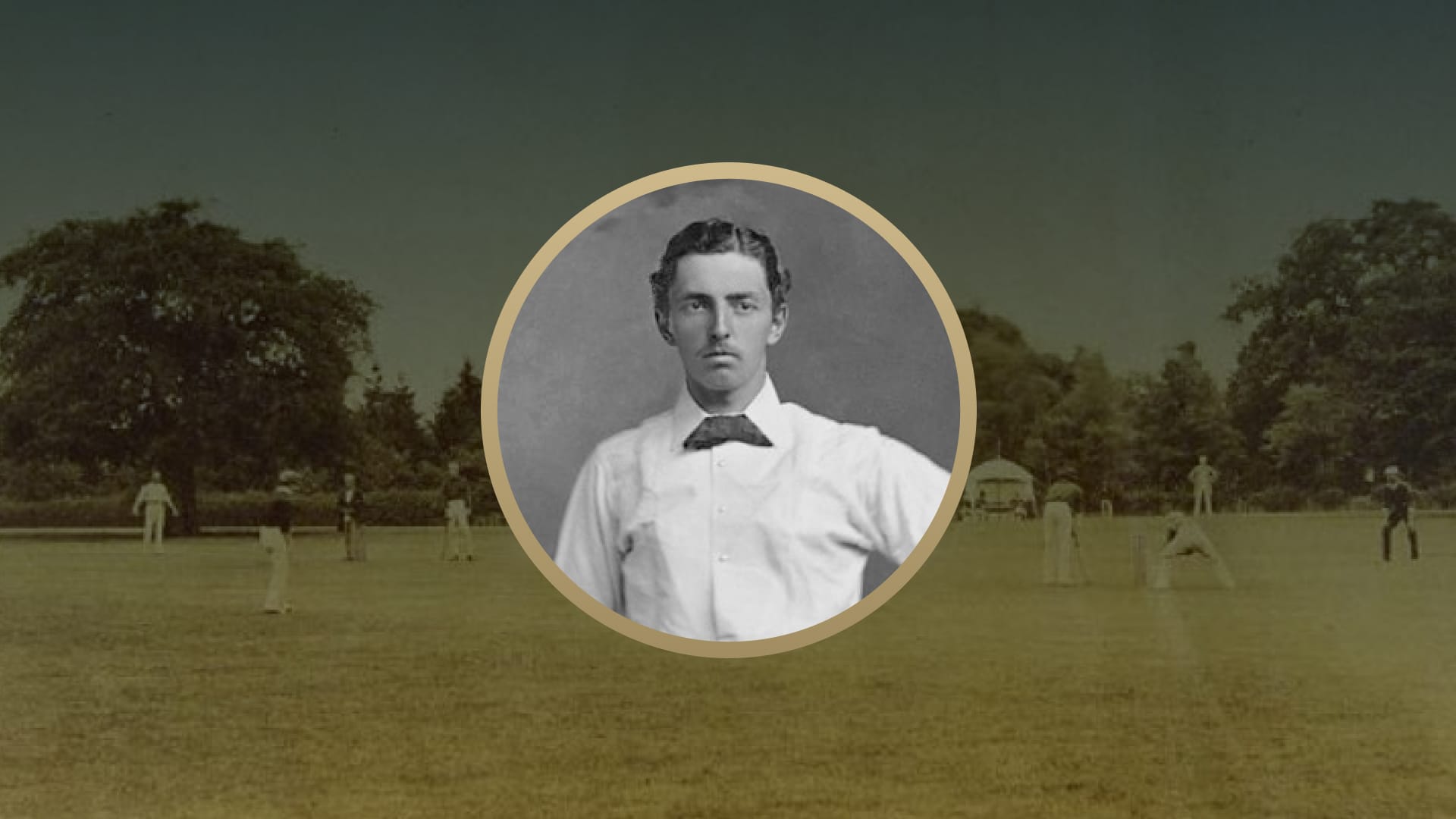
No one in England ever would have guessed that C. T. Studd would become a missionary. Why? He was the most famous cricket player in England! His name was a household word known throughout England and the entire English-speaking world wherever the sport of cricket was followed. When the young athlete announced that he was going to China as a missionary, the news took the world by storm.
Charles Thomas Studd was born on December 2, 1860, in Northamptonshire, England. His father was a successful merchant who had made a fortune in India. Charles was one of six Studd boys. Better known by his initials, C. T. and his brothers enjoyed the best education that money could buy. As a teenager, C. T. was already known as an exceptional cricket player destined for fame and success. He attended Eton College at Cambridge and became captain of his team at the age of nineteen.
Life for the Studd family changed forever when Edward Studd, the father, attended a meeting led by D. L. Moody and Ira Sankey. After the father’s salvation, he encouraged his boys to listen to Moody’s preaching. They did. The concerned father also invited a visiting minister of the Gospel into his home to talk with his boys face-to-face about the state of their souls.
As a result, C. T. Studd got down on his knees and simply said “Thank you” to God for the gift of salvation that Christ provided on the bloody cross of Calvary. He later testified of that moment, “Right then and there joy and peace came into my soul. I knew then what it was to be ‘born again,’ and the Bible which had been so dry to me before, became everything.”
As Studd advanced in his schooling and his successful pursuit of cricket, he became more and more dissatisfied. Even as his fame and popularity grew, he began to be impressed with the futility of earthly fame and wealth. He said, “I know that cricket would not last, and honour would not last, and nothing in this world would last, but it was worthwhile living for the world to come.”
Eventually Studd announced that he would be giving up cricket and going to China as a missionary. He was laying aside his bat and ball to take up instead the yoke of the Lord Jesus Christ. He became one of a group of successful young men—merchants, military officers, and college students—who were known as the “Cambridge Seven.” These seven young men, attracted by the claims of the China Inland Mission, volunteered to go to take the Gospel to the interior of China.
C. T. Studd and the other young men traveled throughout England, speaking passionately to large groups about the needs of the unevangelized across the globe. Their efforts were blessed by the Lord; hearts were stirred and the fires of revival were kindled.
In the spring of 1885, Studd arrived in China. He was only twenty-five years old. While in China, he gave instruction that his inheritance, which amounted to over 25,000 English pounds, should be given away for the advancement of the Gospel. Some funds went to George Mueller and his orphanage. Some of the money was given to the Salvation Army. A good portion also went to the China Inland Mission. Studd took literally our Lord’s command to sell everything and give to the poor.
While in China, C. T. Studd married Miss Priscilla Livingstone Stewart, a young lady who had also devoted herself to the work of missionary evangelism. C. T. and Priscilla were blessed with four daughters and one son, although their son lived only a day and was received into the arms of the Lord.
C. T. and Priscilla Studd followed the advice of Hudson Taylor and dressed as the Chinese did. Studd grew his hair long, dyed it black, and pulled it back into a queue in the manner of the Chinese men. He and his wife wore Chinese clothing, ate Chinese food, and spoke Chinese, even at home. Their four daughters grew up knowing only Chinese; they were not able to speak English until visiting England later in life. With no sons and four daughters, the Studds rejoiced that they could teach the Chinese people the value of little girls in a culture where girls were often unwanted.
After serving faithfully for many years in China, C. T. Studd returned with his family to England. He was broken in health, and his family needed to recuperate. Studd traveled widely in England and also in the United States, raising awareness about the needs of foreign missions. God had chosen men to accomplish the work of evangelism, and C. T. Studd sought to press upon young men and women the personal obligation to take the Gospel to the unreached. He said, “Some wish to live within the sound of church or chapel bell; I want to run a rescue shop within a yard of hell.”
By the turn of the century, C. T. Studd was ready to return to the field. This time, he felt called to go to India, the place where his father had made his fortune. He pastored a church in southern India for seven years and ministered among British colonial officials as well as the local population.
In 1910, Studd turned his attention to the vast interior of Africa. Already having served in China and India, he had become increasingly concerned about the needs of the “Dark Continent.” One day the Lord impressed upon his heart that if he was so concerned about Africa, why should he not go himself?
He was now fifty years old, broken in health, and suffering from the lasting effects of asthma, malaria, cholera, and other tropical diseases. The doctors all advised him not to go to the Congo. But if God said “Go,” C. T. Studd would go—the difficulties notwithstanding. Few are aware that the famous lines, “Only one life, ’twill soon be past, only what’s done for Christ will last” are part of a longer poem written by C. T. Studd. The following are a few stanzas (with emphasis added) from that lengthy poem.
Only one life, a few brief years,
Each with its burdens, hopes, and fears;
Each with its days I must fulfill.
Living for self or in His will;
Only one life, ’twill soon be past,
Only what’s done for Christ will last.
When this bright world would tempt me sore,
When Satan would a victory score;
When self would seek to have its way,
Then help me, Lord, with joy to say.
“Only one life, ’twill soon be past,
Only what’s done for Christ will last.”
Give me, Father, a purpose deep,
In joy or sorrow Thy word to keep;
Faithful and true what e’er the strife,
Pleasing Thee in my daily life;
Only one life, ’twill soon be past,
Only what’s done for Christ will last.
Charles Thomas Studd spent the remainder of his life in Africa, taking only a few brief trips back to England to visit his wife Priscilla, who had stayed behind to mobilize the cause of missions on the home front. Together, the couple started a mission organization called Heart of Africa Mission, later expanding it into the Worldwide Evangelization Crusade (WEC). Studd was joined by his daughter, Pauline, and her husband, author and biographer Norman Grubb, who lived on to advance the work of Christ in the Congo.
C. T. Studd experienced several heart attacks in his final days. He declined to leave Africa for medical help and continued to press on to the end. On July 16, 1931, at the age of seventy, C. T. Studd died. He was buried at Ibambi in the Congo Basin. The organization he started continues still as Worldwide Evangelism for Christ (WEC International). Truly, what is done for Christ will last for all eternity!
Sources and Further Reference:
Grubb, Norman. C. T. Studd: Cricketer and Pioneer. Fort Washington, PA: CLC Publications, 1982.