
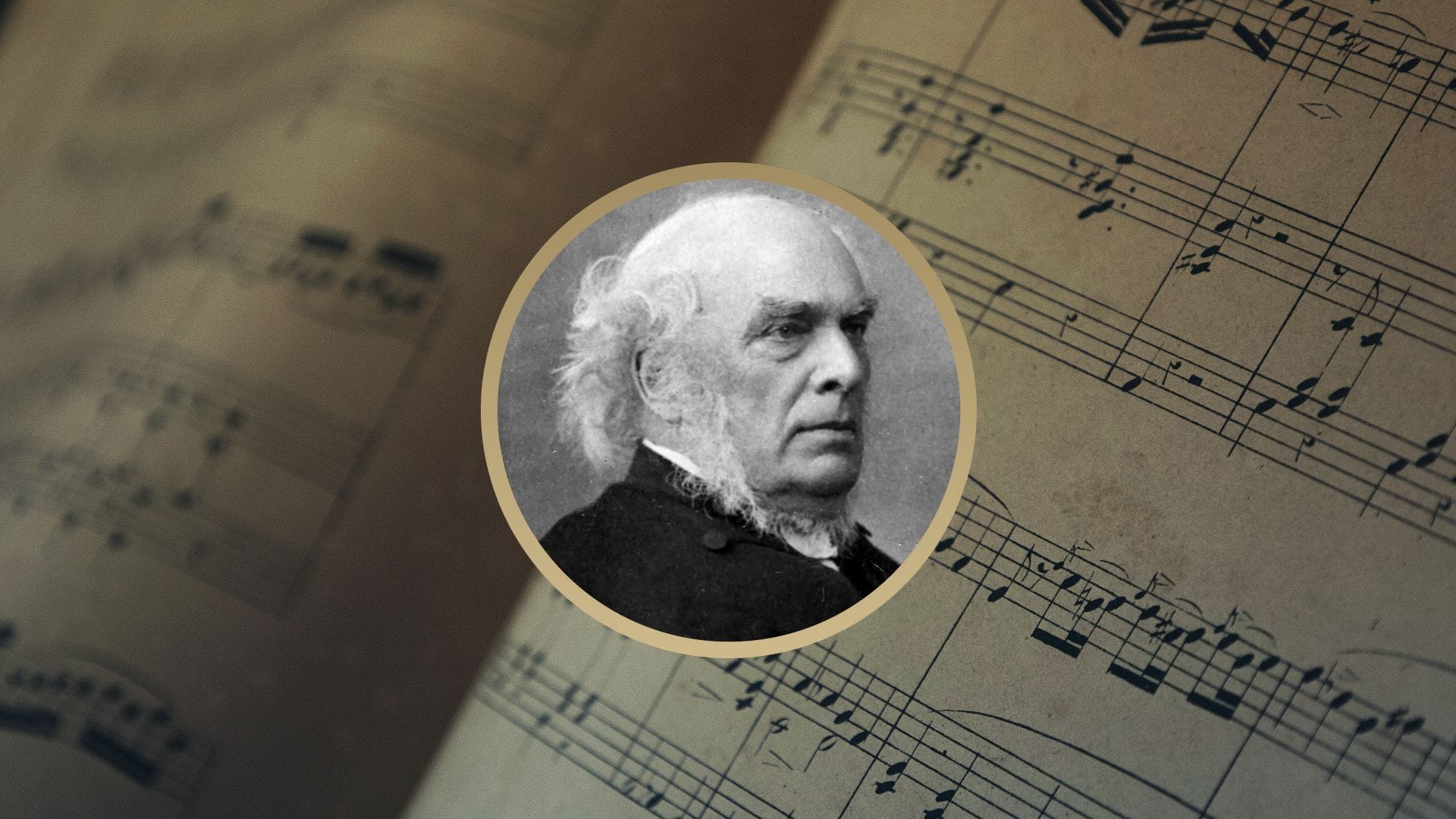
Horatius Bonar was born on December 19, 1808. By the grace of God, he was born into a Godly Scottish family who lived in Edinburgh. Many of his ancestors were ministers of the Gospel who had served for a total of almost 400 years as shepherds of God’s flock.
Horatius was one of eleven children. Two of his brothers, John James and Andrew, also became pastors in the Church of Scotland. Their father, James Bonar, was a public servant who held the title “Solicitor of Excise.” His job was to oversee the collection of excise taxes on luxury goods. It was an office of public trust.
One day, James Bonar entered his office after hours. There he discovered an armed burglary in progress! His vigilance and prompt action helped to bring a ring of criminals to justice.
The mother of Horatius, Marjory Maitland, was a Godly woman who also came from a line of faithful servants of God. She was a pious mother whose tender prayers and careful instruction had a lifelong influence upon her children.
Horatius attended the University of Edinburgh and studied Divinity. He was ordained as a minister in the Church of Scotland in 1838 and began serving in Kelso, a town in southern Scotland that sits on the River Tweed. He became known as a faithful expositor of Scripture, a caring pastor, and a true shepherd of the flock.
These were tumultuous years for the Church of Scotland. A long dispute over the issue of patronage had led to a rift among the ministers. The Right of Patronage allowed patrons of local parishes to install pastors of their own choice to the local pulpits. Rich landowners and barons were thus allowed to select ministers according to their own interests. Sometimes their choices were good, worthy men; however, sometimes they chose men who were mere “hirelings” and not true, faithful shepherds.
Conservative elements in the church protested against patronage. They asserted that only Christ was Lord of His Church, and that the spiritual jurisdiction could not be infringed upon by leaders in government positions. Just as civil magistrates had their own proper spheres of government, so also ministers of the Gospel had their own proper sphere of authority in spiritual matters.
In what became known as the “Disruption of 1843,” 450 ministers of the Gospel parted ways with the Church of Scotland to form what they called the Free Church of Scotland. Their leader was Thomas Chalmers.
Young Horatius Bonar gave up his salary in order to follow what he believed was the right course of duty. He was one of the “Disruption ministers” who walked away from their pulpits and salaries to give their allegiance to Christ alone.
That same year, in the summer of 1843, Horatius Bonar was united in marriage to Miss Jane Lundie, the daughter of a faithful pastor. The Lord blessed the couple with nine children, although even this blessing was not without sorrow. Over the course of their marriage, they lost five of their offspring to childhood diseases.
In addition to his pulpit ministry, Dr. Horatius Bonar was a prolific author of many helpful and practical works. He wrote a popular book, titled Words to Winners of Souls, that encouraged men and women in the necessity of personal evangelism. He also wrote on God’s holiness, on practical Christian living, and some insightful commentaries on Acts and on Revelation. A book titled Night of Weeping was written, drawn from his own personal experiences of losing his children.
The passage of time has not dimmed the scope of Bonar’s writings. Many of his books have been printed and reprinted numerous times by many different Christian publishers around the world.
Yet with all these published works, Horatius Bonar is best known as an author of hymns. He wrote approximately 150 hymns, including “I Heard the Voice of Jesus Say,” “Thy Way, Not Mine, O Lord,” and “I Was a Wandering Sheep.”
Although Bonar’s denomination was known for its adherence to the exclusive use of the Psalms in public worship, he saw a need and a place for the composing and singing of devotional hymns that expressed the fullness of God’s revelation in the New Testament.
One of his best known and most beloved hymns is “Here, O My Lord, I See Thee Face to Face.” In this hymn, Bonar testifies to the wonder of experiencing the living reality of a transcendent yet knowable God. His words resonate with any Christian who has ever experienced the delight of divine communion. Although Bonar is specifically writing about the union with Christ in the taking of the elements of the Lord’s Supper, his words apply to any occasion when the human heart is touched by the living reality of Christ’s presence.
Here are the first, second, and final stanzas of that particular hymn:
Here, O my Lord, I see Thee face to face;
Here would we touch and handle things unseen;
Here grasp with firmer hand eternal grace
And all my weariness upon Thee lean.
Here would I feed upon the bread of God,
Here drink with Thee the royal wine of heav’n;
Here would I lay aside each earthly load,
Here taste afresh the calm of sin forgiv’n.
Feast after feast thus comes, and passes by;
Yet passing, points to the glad feast above;
Giving sweet foretaste of the festal joy,
The Lamb’s great bridal feast of bliss and love.
In their later years, Horatius Bonar and his wife Jane rejoiced to have one of their daughters who was widowed move back into their home along with her young children. Thus, the sunset years of the Bonars were gladdened with the pitter-patter of little feet. Bonar loved nothing better than to have his grandchildren climb up into his lap to hear him tell them again the stories of the Lord Jesus and His goodness. One of Bonar’s sons followed him into the Gospel ministry. This same son brought many of his father’s hymns to light and published a collection of previously unknown poems.
After a long life of faithful ministry, Horatius Bonar was granted the privilege of experiencing that “festal joy” in the presence of the Lamb. He died on July 31, 1889, in Edinburgh, leaving behind a rich treasury for those who delight in the presence of the Lord Jesus.
Sources and Further Reference:
Johnson, Guye. Treasury of Great Hymns and Their Stories. Greenville, SC: Bob Jones University Press, 1986.
Morgan, Robert. Then Sings My Soul. Nashville, TN: Thomas Nelson Publishers, 2003.