
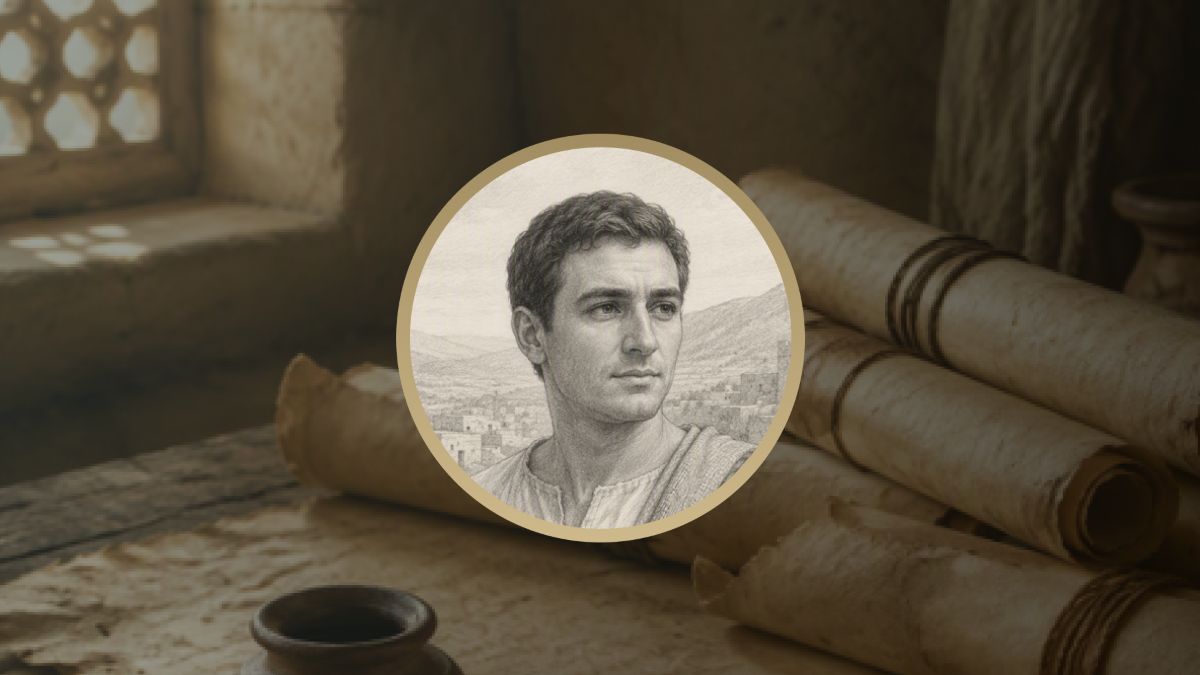
In Scripture, along with the more famous Timothy and Titus stands another man whose name began with the letter T. Many Christians know very little about this man, whose name was Tychicus. Tychicus is mentioned often in the New Testament, but he lived quietly in the background, carrying letters for others and giving reports. Faithful in that which is least, he was faithful also in much.
So much of the Christian life is lived in the ordinary sphere of duty: prayer, fellowship, giving thanks, breaking bread with other believers, and giving words of encouragement. These were the ordinary duties of life in which Tychicus was faithful.
Tychicus appears five times in Scripture. Each time he was traveling on a mission for the Apostle Paul.
The first mention of this man is in relation to Paul’s third missionary journey. It seems like Tychicus was perhaps not saved until later in Paul’s ministry as he does not appear in the record until Acts 20:4, “And there accompanied him into Asia Sopater of Berea; and of the Thessalonians, Aristarchus and Secundus; and Gaius of Derbe, and Timotheus; and of Asia, Tychicus and Trophimus.” From this verse, we learn that he was a native of Asia Minor, probably from the Ephesus area where Paul had spent three years on his third journey.
Tychicus is a Greek name and means “fortunate.” Probably Tychicus was a pagan when Paul entered Ephesus. Many Bible scholars believe that the man was saved during Paul’s ministry there. After a relatively short time, Tychicus was already serving in the ministry. When he is mentioned in Acts 20, he had probably been saved only a very short time. Yet, he was so faithful that he was selected by his church to accompany Paul to Jerusalem to minister to the needs of the persecuted saints there. Tychicus is first mentioned as a companion.
After this trip to Jerusalem with Paul, Tychicus’s name disappears from the record for four years. When Paul was arrested in Jerusalem, Tychicus was likely there then. The record shows that Trophimus was, but the name of Tychicus is not mentioned.
During those four years, much happened to the Apostle Paul. Delivered from the hands of the men who plotted to take his life, he was held in prison in Caesarea for two years. Having appealed to Caesar, Paul was transported by sea to Rome and suffered shipwreck on the way. But while Paul was in Rome, during his first imprisonment under house arrest, the name of Tychicus suddenly pops up again. Paul wrote four letters during his first imprisonment. They are called his “Prison Epistles”: Ephesians, Philippians, Colossians, and Philemon.
In his letter to the Ephesians, Paul mentioned Tychicus by name. “But that ye also may know my affairs, and how I do, Tychicus, a beloved brother and faithful minister in the Lord, shall make known to you all things: Whom I have sent unto you for the same purpose, that ye might know our affairs, and that he might comfort your hearts (Ephesians 6:21–22).
Tychicus served as Paul’s courier. Paul was in bonds, but he had relative liberty. He dwelt in his own hired house, with Roman guards posted there. During those years, Paul’s heart was burdened to write to the churches of Asia. He composed three companion letters—one to the Ephesians, one to the Colossians, and one to a Colossian believer named Philemon. All three letters were entrusted to Tychicus. The fourth Prison Epistle to the Philippians was probably sent by other hands at a different time.
The journey to deliver the letters was difficult and long. Tychicus journeyed from Rome, down the Tyrrhenian Sea through the straits at Sicily, across the open Mediterranean Sea, and then across the Aegean Sea, probably landing at Ephesus, and then he traveled up the Lycus River valley to Colosse. While the journey is easy to trace on a map, it was not so easy to cross by ship and foot in the first century. The travel could be treacherous, considering storms, shoals and sandbars, reefs and rocky coasts at sea. On land, other dangers included highway robbers, mountain passes, precipices, and many weary miles of mountainous roads. Plus, in all the hard travel, one could easily fall ill or catch a dreaded disease. All these troubles Tychicus endured willingly.
Paul wrote a similar greeting to the Colossians as the one he sent to the Ephesians. “All my state shall Tychicus declare unto you, who is a beloved brother, and a faithful minister and fellowservant in the Lord: Whom I have sent unto you for the same purpose, that he might know your estate, and comfort your hearts” (Colossians 4:7–8).
Paul gave Tychicus some worthy titles in those verses. First, Paul called Tychicus “a beloved brother.” This title shows Paul’s personal love and brotherly affection for Tychicus. Second, Paul referred to Tychicus as “a faithful minister.” This title shows Tychicus in relation to his work. “Minister” is the same Greek word that is often translated “deacon.” Third, Paul called Tychicus his “fellowservant.” “Fellowservant” is an even stronger word than deacon, and it indicated the relationship of Tychicus to his Master, the Lord Jesus Christ. The Greek word is δοῦλος (doulos), meaning a “bondslave.”
By God’s grace, the letters were delivered. Tychicus faithfully declared Paul’s state to the believers of Asia. He comforted their hearts. This word comfort does not mean that the people were sad. Rather, it is the same word used in the exhortation of Barnabas, who was the paraklesis, or “encouragement” of the saints. Paraklesis is the same word that Jesus used to describe the “Comforter” (John 14:16) whom He would send. The word means to “come alongside and help.”
Tychicus also delivered a personal letter from Paul to one of the leaders of the Colossian church, a believer by the name of Philemon.
After Paul’s first imprisonment, it is believed that Paul was freed for at least a few months. Paul was somewhere on the west side of Greece, near Nicopolis where he planned to winter, when he wrote a letter to Titus, who was serving as a pastor on the island of Crete. Tychicus is mentioned in the letter to Titus: “When I shall send Artemas unto thee, or Tychicus, be diligent to come unto me to Nicopolis: for I have determined there to winter” (Titus 3:12).
Delivering this letter was a difficult assignment indeed, and such a responsibility reveals Paul’s growing regard for Tychicus. No longer was Tychicus just a companion; no longer was he simply a courier.
Paul called the Cretans the same as one of their own prophets had said: “liars, evil beasts, slow bellies” (Titus 1:12). The church on the island of Crete was plagued with false doctrine, Jewish fables, and carnality. Paul was apparently contemplating sending Tychicus there. Did he send Tychicus with the letter to Titus? We will have to wait until we get to Heaven to find out. However, Paul’s mentioning Tychicus as a possible courier shows the apostle’s regard for the spiritual capabilities of Tychicus.
Tychicus is mentioned one more time in Scripture. Paul was again in prison, this time in the dungeons of Nero. He wrote one final letter of encouragement to Timothy. Who carried that letter? According to II Timothy 4:9–12, “Do thy diligence to come shortly unto me: For Demas hath forsaken me, having loved this present world, and is departed unto Thessalonica; Crescens to Galatia, Titus unto Dalmatia. Only Luke is with me. Take Mark, and bring him with thee: for he is profitable to me for the ministry. And Tychicus have I sent to Ephesus.”
The verb “sent” was written in what is called the “epistolary aorist tense,” which sounds like a past tense. The message was past tense to the reader, Timothy. But as Paul wrote the letter, the message was present tense to himself. Essentially, Paul was saying that he was sending Tychicus to Ephesus to replace Timothy, the letter’s recipient.
If Tychicus, the converted pagan, became the pastor of the church of Ephesus for a time, then he joined the ranks of a very special group of men—Timothy and John the Apostle. Under their pastoral care and teaching ministry were vibrant saints, such as Aquila and Priscilla.
Tychicus was first a companion, then a courier, then a fellow-servant, and then a pastor. When Timothy left to be with Paul, it was under Tychicus’s care that the saints at Ephesus met to worship, sing, pray, observe the Lord’s Supper, and hear the teaching of God’s Word. Tychicus had been faithful in what was least. As such, he proved that he could be faithful also in much.
 23:49