
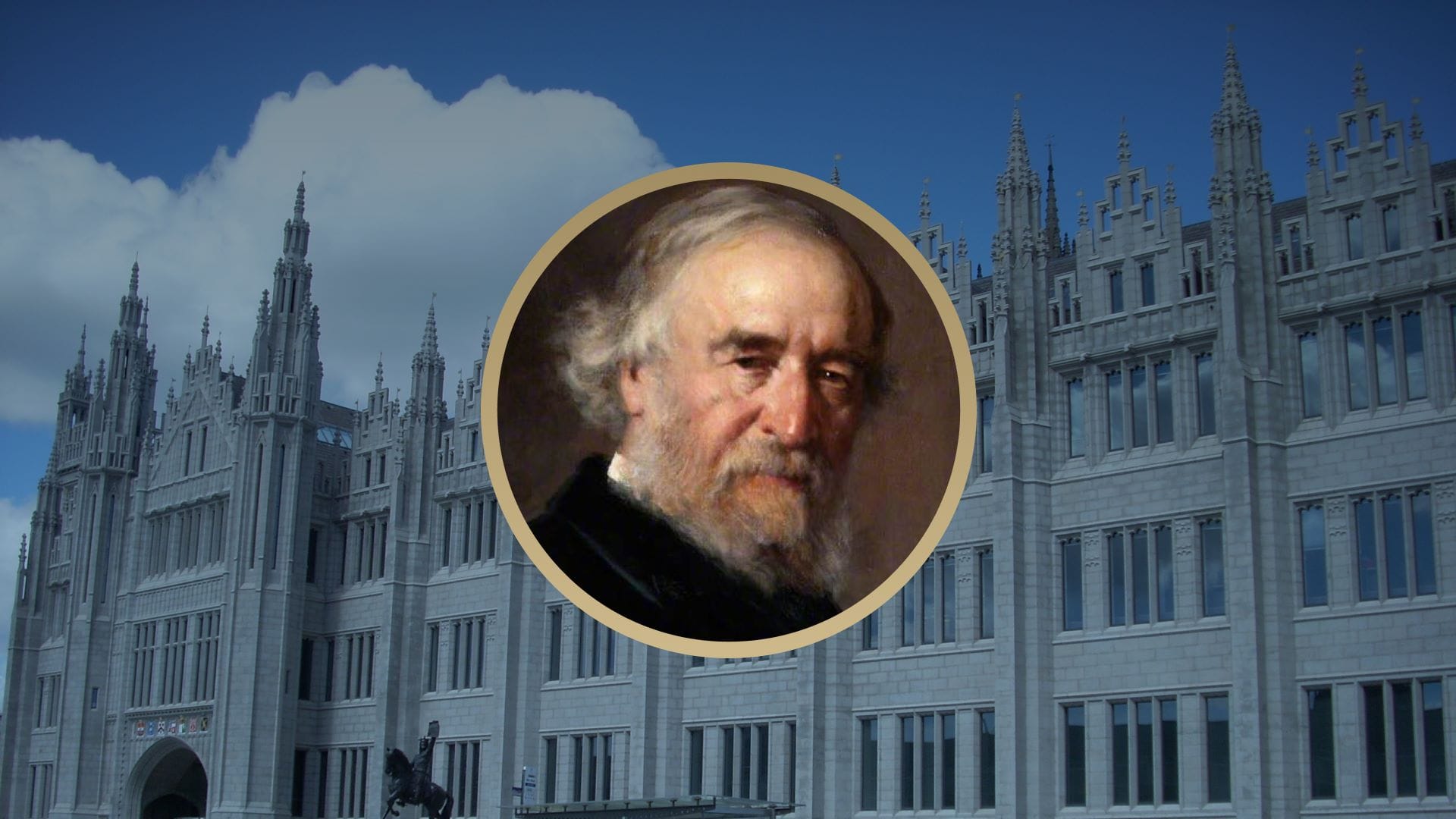
Walter Smith is best known for his famous hymn which has earned a lasting place in almost all Protestant hymnals. That glorious hymn is “Immortal, Invisible, God Only Wise.” The man was a faithful preacher of the Gospel who loved and ministered to God’s people in humble spheres of service throughout Scotland.
On December 5, 1824, Walter Chalmers Smith was born. His birthplace was Aberdeen, an ancient town on the coast of northeastern Scotland. His parents were Walter and Barbara Smith. Walter Smith Sr. was a cabinetmaker by trade.
Young Walter the son expressed an early interest in law. With that goal in view, he attended Marischal College in his hometown and graduated in 1841. But the Lord and His Word gripped the heart of the young law student. He was influenced strongly by Dr. Thomas Chalmers, the leader of the Free Church of Scotland.
With college completed, Smith reconsidered the course of his life. He resolved to stand in the pulpit rather than before the legal bar. Thus, Smith became a student at the New College in Edinburgh in order to prepare himself for the ministry of the Gospel.
In 1850, he was ordained as a pastor and installed at a Free Church in London. In England, he labored faithfully for three years before returning home to his native Scotland. In his native land, he served as a pastor in a small town near Perth. In the same year, 1853, Smith was united in marriage to Agnes Monteith. She was a faithful wife who supported her husband in his labors as a pastor and writer.
Walter Smith had a true shepherd’s heart. He ministered for many years at the Free High Church in Edinburgh, where he served for over two decades. The former church building is now the library building for the University of Edinburgh and can be visited by the public.
Although Smith was involved in several controversial matters in the church, his gracious spirit and faithful ministry made him loved and respected by all sides. Questions about the proper observance of the Sabbath, the critical study of the manuscripts, the use of hymns in public worship, and many other questions were swirling during Smith’s ministry. He sought to handle these matters Biblically, humbly, and in harmony with his brethren in the faith.
Walter Smith had a unique gift as a writer of poems. He sometimes wrote under pseudonyms, two of which were “Orwell” and “Herman Knott.” His poetry was deep and thoughtful and contributed much to Scottish literature. His poems are still regarded highly today and remind some scholars of the poetry of the more famous Robert Burns.
Of his many poems and other writings, one hymn has stood out far above all other productions from the pen of Walter Smith. It was a hymn drawn from the doxology of the Apostle Paul in I Timothy 1:17, “Now unto the King eternal, immortal, invisible, the only wise God, be honour and glory for ever and ever. Amen.”
The hymn first appeared in a collection of hymns titled Hymns of Christ and the Christian Life. Like Horatius Bonar, a fellow Scottish pastor, Smith served in a denomination that did not regularly use hymns in public worship on the Lord’s Day. The Free Church of Scotland believed that psalms only should be used in congregational worship.
But Walter Smith believed that there were truths revealed by God in the whole counsel of Scripture that needed to be known and sung. His hymn has earned a lasting place around the world. The hymn is special in that it is a catalogue of the attributes of God set to poetic meter. These truths can be sung by God’s children in praise of Who He is.
Immortal, invisible, God only wise,
in light inaccessible hid from our eyes,
most blessed, most glorious, the Ancient of Days,
almighty, victorious, thy great name we praise.
Unresting, unhasting, and silent as light,
nor wanting, nor wasting, thou rulest in might;
thy justice like mountains high soaring above
thy clouds, which are fountains of goodness and love.
To all life thou givest, to both great and small;
in all life thou livest, the true life of all;
we blossom and flourish as leaves on the tree,
and wither and perish but naught changeth thee.
Great Father of glory, pure Father of light,
thine angels adore thee, all veiling their sight;
all praise we would render, O help us to see
’tis only the splendor of light hideth thee.
In 1893, Walter Chalmers Smith was honored by his church when he was elected Moderator of the General Assembly of the Free Church of Scotland. He spent the last few years of his life in retirement, studying, writing, praying, and preaching on occasion. Faithful to the last, he died in September 1908 and is buried in Edinburgh.
Sources and Further Reference:
Johnson, Guye. Treasury of Great Hymns and Their Stories. Greenville, SC: Bob Jones University Press, 1986.
Morgan, Robert. Then Sings My Soul. Nashville, TN: Thomas Nelson Publishers, 2003.