
One hot summer day in 1881, a young man walked into Tuskegee, a small town in rural Alabama. The district was one of the poorest in the entire country. This was cotton country, and the area had been devastated by the War Between the States.
Spanish moss hung on the trees in the empty yards as though the trees themselves were draped in mourning. Empty coat sleeves gave evidence of amputations of the grim war that had been fought. Hard times had come “a-knockin” at every door, both at the doors of the large plantation homes as well as those of the tiny log cabins.
Although this rural district had been spared the worst of the animosity, a general feeling of distrust and suspicion still existed between whites and blacks. Prejudices ran deep. Misunderstanding and fear abounded on both sides. Outsiders, businessmen, preachers, carpetbaggers, scalawags—everyone seemed to have had a solution for the problems, at least, as reported in the newspapers. But opinions from the outside could not fix the deep problems facing the post-war South.
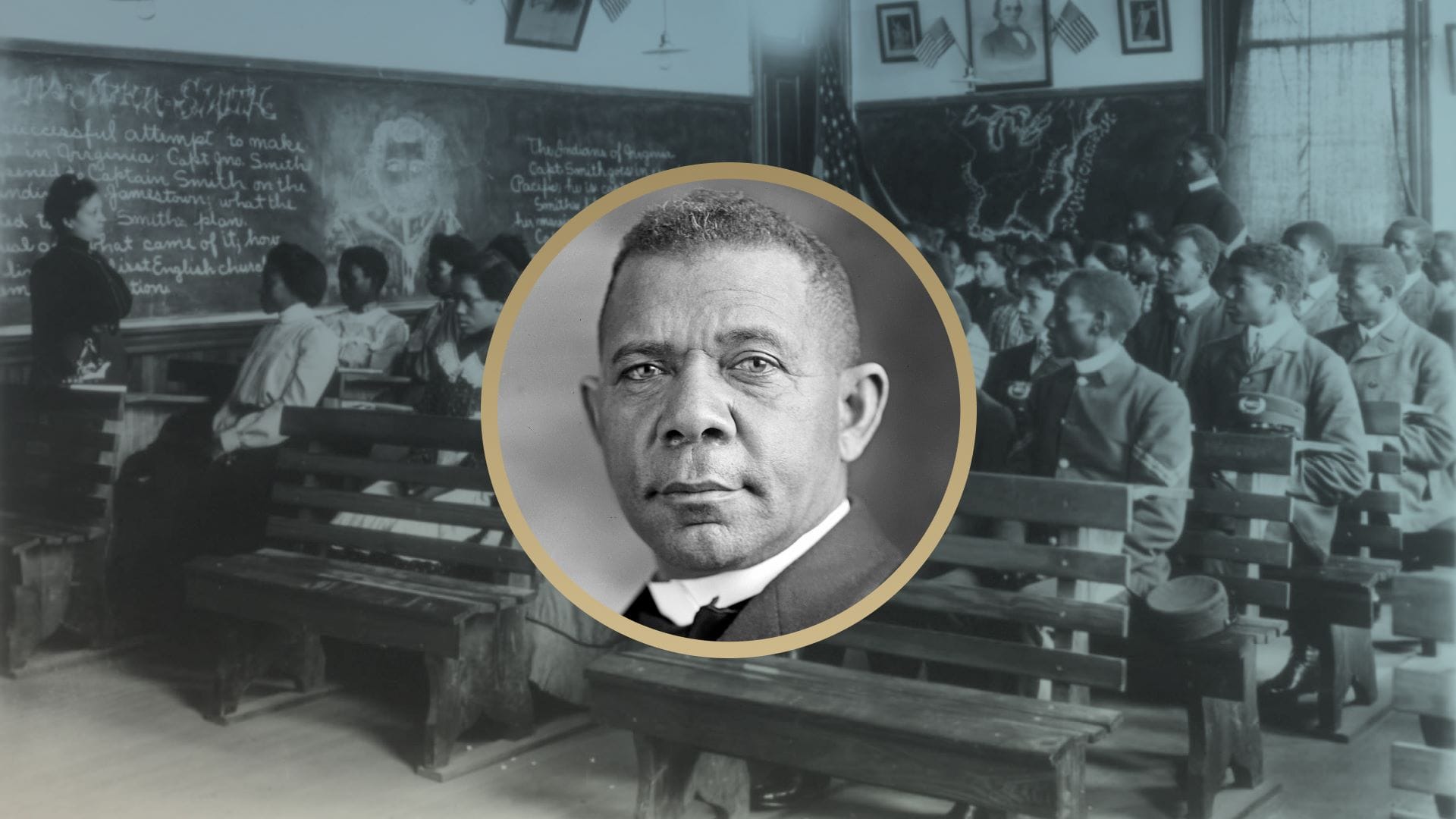
Into this situation walked a young schoolmaster that day. Where most would have seen only poverty in this area, this young man saw potential. He himself had been born in a small slave cabin in Virginia. He never knew the identity of his father nor his birthday. He had only a first name, Booker; it was the name his mother had always called him.
Booker’s mother was a hardworking woman, and she did her best to care for her little boy and his siblings. During most of the day she had duties in the “big house,” but at night she would come home to her “young’uns” and do her best to love and care for them.
Life was hard for slaves, even on the best of plantations and under the kindest of masters. During the days of war, food was scarce for the rich as well as the poor. Booker grew up eating cornbread and bacon. His only bed was a mat of rags spread out on the cabin’s dirt floor.
After the war, he had been educated in West Virginia, where he learned to have a deep desire to serve his fellowman. One school day at the opening of classes, Booker had noticed that other students always had at least two names. It seemed to him such a great extravagance that some students even took it upon themselves to have three names! He decided that it simply would not do for him to have just one name any longer. When asked his name, he added the name Washington. He learned that his mother had used the name Taliaferro, so he later went by the name Booker T. Washington.
In 1881, Booker came to Tuskegee to take over a new school for young black students. He had been selected for this position by mail, and assumed that the gentlemen that had invited him here to teach school had a school in which he could teach.
He found nothing at all that he was expecting! There was no school. There was no salary. However, there were students! Booker later noted in his autobiography: “To my disappointment, I found nothing of the kind. I did find, though, that which no costly building and apparatus can supply—hundreds of hungry, earnest souls who wanted to secure knowledge.”
Booker T. Washington set up his school in a dilapidated shanty near the Methodist church, using the church itself as a classroom. When the heavy winter rains came to south central Alabama, one of Booker’s students would stand beside him while he was teaching, holding an umbrella over the teacher’s head to catch the many drips that fell from the ruined ceiling.
As Booker got to know the people of the countryside, both white and black, he began to understand their basic problems. Their value system was misplaced. They overvalued some things to the neglect of others. He recalled eating a meal in the home of one family where there was only one fork to be shared among the five people at the table. But in the corner of this cabin was an organ for which the family was paying sixty dollars in monthly installments. Another family he encountered had bought a fancy clock to put in their cabin, but they did not have enough food for their children. These expensive items were status symbols to these people, and they could not be convinced to part with them.
He also noted that these poor families, in an effort to make as much money as possible, would plant cotton right up to the door of their cabins! Booker realized that the very same soil growing cotton could instead grow a yield-worthy garden of vegetables. But the people were so intent on making more money that they missed the real value of a food-producing garden.
Pride was another challenge for the poor folk. This pride was seen in poor decisions and overlooked obligations. For example, one eager student in Booker’s school had decided that, in order to be a cultured man, he needed to learn French. The schoolmaster observed that the determined student would sit in his dilapidated home that was surrounded by a weedy yard, intently studying his book of French grammar.
To address this matter of pride and unwise decisions, Booker began to slowly and painfully teach his students the meaning of true value. True value is not to be had in mere book learning, nor in fancy clocks, “king” cotton, or musical instruments. Rather, true value was found in happy homes, productive farms, abundant gardens, and smiling children who loved God and their neighbors.
Booker T. Washington taught his students to work hard, and he set an example by working hard himself. When the school began to grow, he acquired a burned-down plantation home in which to hold classes. As more and more students came, Booker incorporated additional space for classes in a stable and in a henhouse! Often, before class in the springtime, he would lead the students to the fields with a hoe over his shoulder in order to plant a crop of sweet potatoes on the school grounds.
The message of his life was summed up by the title of an address for which he became famous, “Put Down Your Bucket Where You Are.” This simple message called upon all men to value what was at hand. Instead of hiring help from afar, Booker T. Washington called upon local white businessmen and craftsmen to employ their black neighbors.
If the transcendent God of the universe was willing to stoop low to make Himself known to mortal man, then surely His children, both black and white, could lay aside their prejudices and strive together for the good of all. Education, but especially Biblical education, could give the South what it needed most. Just as God spoke to Job long ago and revealed many mysteries, so also Booker T. Washington wanted to teach Southern children the will and ways of God.
Eventually, Booker had such men as George Washington Carver added to his faculty. Carver was a man who shared Booker’s desire to teach practical skills, hard work, and virtue to a new generation. Slowly, the work at Tuskegee began to draw attention from all sides.
It was a rewarding moment when a white landowner, a former slaveholder from the upper crust of society, appreciated the work that Booker T. Washington was doing. To show his appreciation, the man offered Booker all the lumber he wanted in order to build a new building. Other white men from near and far sent gifts that were astonishing amounts at that time; some of the gifts were in the thousands of dollars!
One day an elderly black woman came up to Booker T. Washington and handed him six eggs. She said, “Mr. Washington, God knows I spent the bes’ days of my life in slavery. God knows I’s ignorant and poor . . . but I knows you is tryin’ to make better men an’ better women. I ain’t got no money, but I wants you to take dese six eggs, what I’s been savin’ up, an’ I wants you to put dese six eggs into the eddication of dese boys an gals.”
Booker T. Washington later noted, “Since my work at Tuskegee started, it has been my privilege to receive many gifts for the benefit of the institution, but never any, I think, that touched me so deeply as this one.” This simple gift told Booker T. Washington that the message of his life was being received.
Booker T. Washington went home to his eternal reward on November 14, 1915. His lasting legacy encourages young people of all backgrounds to develop Godly character as the foundation for advancement. No man is entitled to anything based on the color of his skin. Privileges are earned, not demanded. Diligence, honesty, humility, and integrity: these are the virtues that lead to true success as God defines it.
Sources and Further Reference:
Washington, Booker T. Up from Slavery. Garden City, NY: Dover Publications, 1995.