
The ruddy light of early dawn began to streak through the barred window and softly fell upon the face of a sleeping man. The man was John Hus. Despite that almost all of Christendom was arrayed against him and this was the dawn of his last day on earth, Jan Hus slept peacefully. The heavy, grated window barred him from the outside world and partially obscured the beautiful scenery of the lake and mountains.
Soon the sun appeared and began to rise over the eastern Alps. The day was July 6, 1415. On this day, at the Council of Constance, John Hus, whose name means “goose” in Bohemian, was to be “roasted.” Hus had come to this city as a free man, of his own volition, to answer certain questions that the Church of Rome had against his teachings. Over the course of several weeks, he had been betrayed by the emperor who had granted him safe conduct. Hus had been seized, imprisoned, and was now condemned to die as a heretic.
John Hus was born in 1369 in the small Czech village of Husinec. His parents were very poor, and young John had earned his education the hard way—by the sweat of his brow. He eventually became a public teacher at the University of Prague. By 1402, he was recognized as a skilled teacher, a man who knew and understood peasants, and one who could effectively communicate God’s truth.
Hus was appointed to preach at the Bethlehem Chapel, a unique church where the Gospel was preached in the vernacular language. This preaching was very rare in the medieval church as the services were typically held in Latin, and the Bible was essentially a closed book to the common man. Believing that an immanent God sought to draw near to His people, Hus opened God’s Word and from it spent his life teaching the men, women, and children of Bohemia.
This was a momentous time in Europe. Christendom was in an uproar. For many years, there had been two men contending for the crown of the pope. Both a French cardinal and an Italian one claimed the highest bishopric in the world, asserting their right to the “keys of Saint Peter” and the headship of the Roman church. To settle this controversy, a church council had been called. The council had decreed that neither of the two popes was the correct one, and they appointed a third. Now there were three popes!
In the midst of all this hubbub, it became very clear to the lesser nobles—the knights, mayors, craftsmen, and dukes of Europe—that the Roman church had become internally corrupt. These noblemen, along with many of the common people, began to drink at the pure fountain of the Word of God. John Hus taught them that the God of the Bible desired fellowship with them!
In the northwestern part of Europe, across the channel in the land of England, followers of John Wycliffe, known as “the Lollards,” taught similar truths. In the southern part of Europe, centered in the Piedmont region of the Alps, the area on the border of Switzerland, France, and Italy, another group of pious men and women called the “Waldenses” also held fast to the simple truth of Scripture. For centuries they had been reading a Bible in the vernacular language of their Alpine valleys. They held to a simple, Biblical form of worship, without the trappings of Roman Catholic dogmas and traditions.
Now, at the third corner of Europe, far to the east in Bohemia, the Lord had raised up John Hus. Hus proclaimed to his flock at the Bethlehem Chapel that Christ alone is the head of His Church and that there is only one mediator between God and man, the man Christ Jesus. He preached that only the Holy Scriptures were of binding authority; he taught the Scriptures in the language of the common man. As with the Lord Jesus, the “common people heard him gladly.” However, the religious establishment hated and feared this preacher. Hus was summoned to the city of Constance, near the border between the Swiss cantons and the Germanic states, to answer charges of heresy.
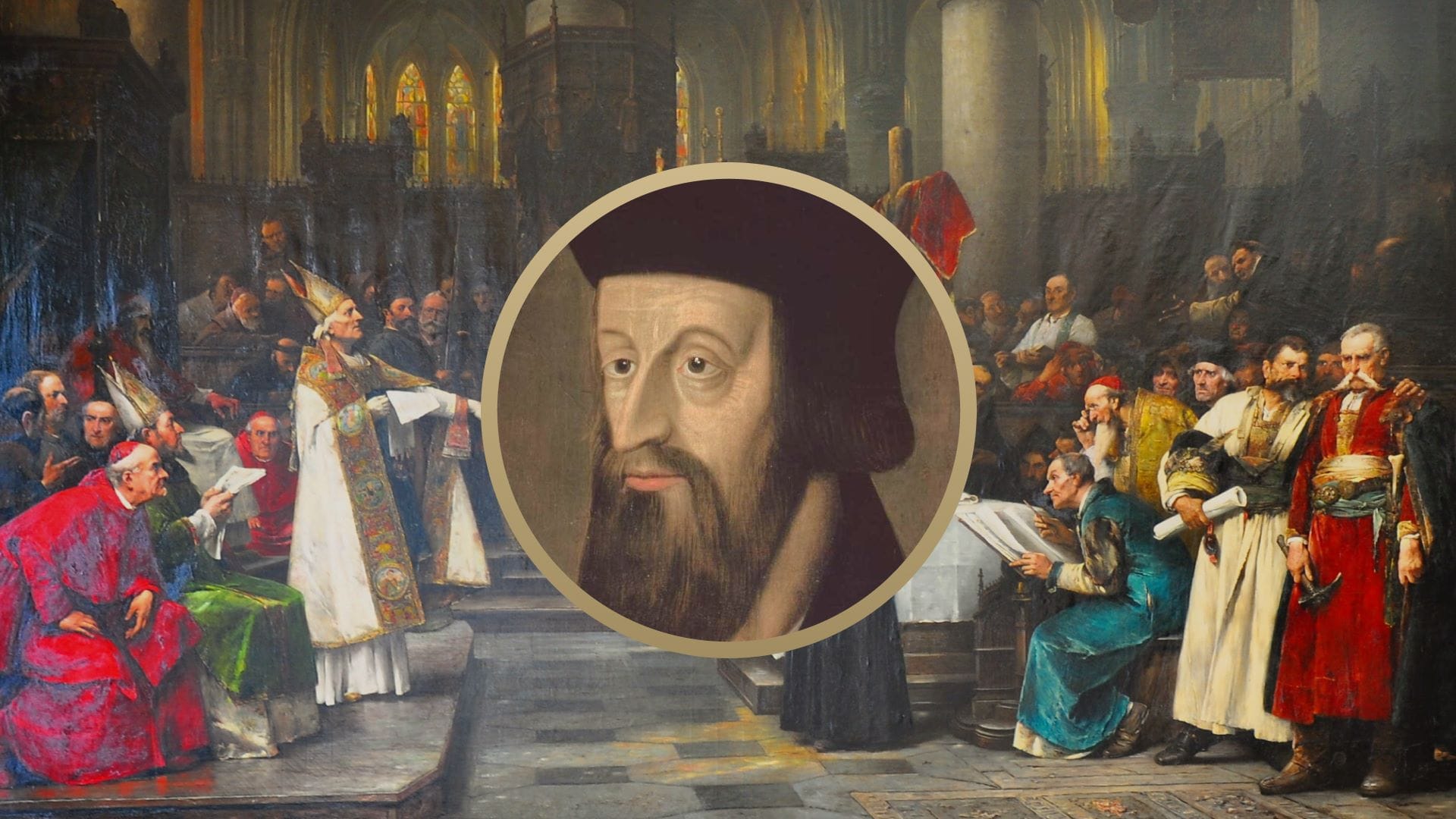
Hus was promised safe conduct to Constance to explain his teachings, but this promise had been violated. What had started as a friendly meeting turned into an interrogation. Before long, Hus found himself in chains and imprisoned in a dungeon. His enemies invented many charges against him. They twisted his words, misquoted his writings, and delivered contrived, slanderous accusations. Called upon to recant all his writings and submit to the authority of the pope, John Hus refused to deny the truth of God.
Early on the morning of July 6, 1415, Hus was rudely awakened in his cell. He was called to the chamber where he was to be publicly excommunicated, degraded from the office of preacher, and then committed to the fire.
Hus stood boldly before his enemies. The bishops dressed him in all the priestly vestments and then began to strip them off solemnly, with many curses. Finally, they took heavy shears and cut off the shaven crown of his head, removing skin and all. On the top of his bloodied head, the bishops placed a paper hat painted with a horrible image of demons dancing in a fire. The hat bore the inscription, “A Ringleader of Heretics.”
Bleeding and in pain from the cruel torture, Hus said, “For my sake, my Lord Jesus wore a crown of thorns, so for His sake should I not wear this light crown, even though it is a shameful thing?” His cruel tormenters placed a chalice in his hands and then slowly pulled it away while pronouncing this curse of excommunication, “We take from thee, accursed Judas, the cup of salvation.”
These terrifying words hung in the air, but only for a moment. Then Hus replied, with unwavering calmness and faith, “I trust in God, my Almighty Father, that He will not take from me the cup of His salvation, and I have a steadfast hope that I shall yet today drink it in His kingdom.”
The religious ceremony finished, the bishops intoned, “Now we give over thy soul to the devil.” Hus replied immediately with uplifted eyes, “But I commend to Thee, O Jesus Christ, the soul which Thou hast redeemed.”
John Hus was then led out from the city, placed upon a stake, and a chain was wrapped around his body to secure him there until his living flesh was consumed in the flames. As the masked executioner stepped forward with a lighted faggot, the courageous martyr met him with calm resolve. Weeks earlier, Hus had written a letter from his dungeon which expressed his remarkable faith in the triumph of the Gospel, “You are going to burn a goose, but in a century you will have a swan which you can neither roast nor boil.”
The Bohemian word for “goose” is the word “Hus,” the surname of this dying martyr, John Hus of Bohemia. Is it not a remarkable providence of God that the swan is on the family crest of the German name Luther? Almost exactly 100 years from the date of Hus’ burning at the stake, Martin Luther nailed his 95 Theses to the door of the Wittenberg Church!
The pile of wood was lit, the flames sprang upward, and the crowd watched the spectacle of a living man being consumed by fire. Some watched in horror, some with sympathy, some in vengeful delight. Those who witnessed the death of John Hus affirmed that he died with these words on his lips, “O Christ, Son of the Living God, have mercy upon me.”
Sources and Further Reference:
Foxe, John. Foxe’s Book of Martyrs. Peabody, MA: Hendrickson Publishers, 2011.