
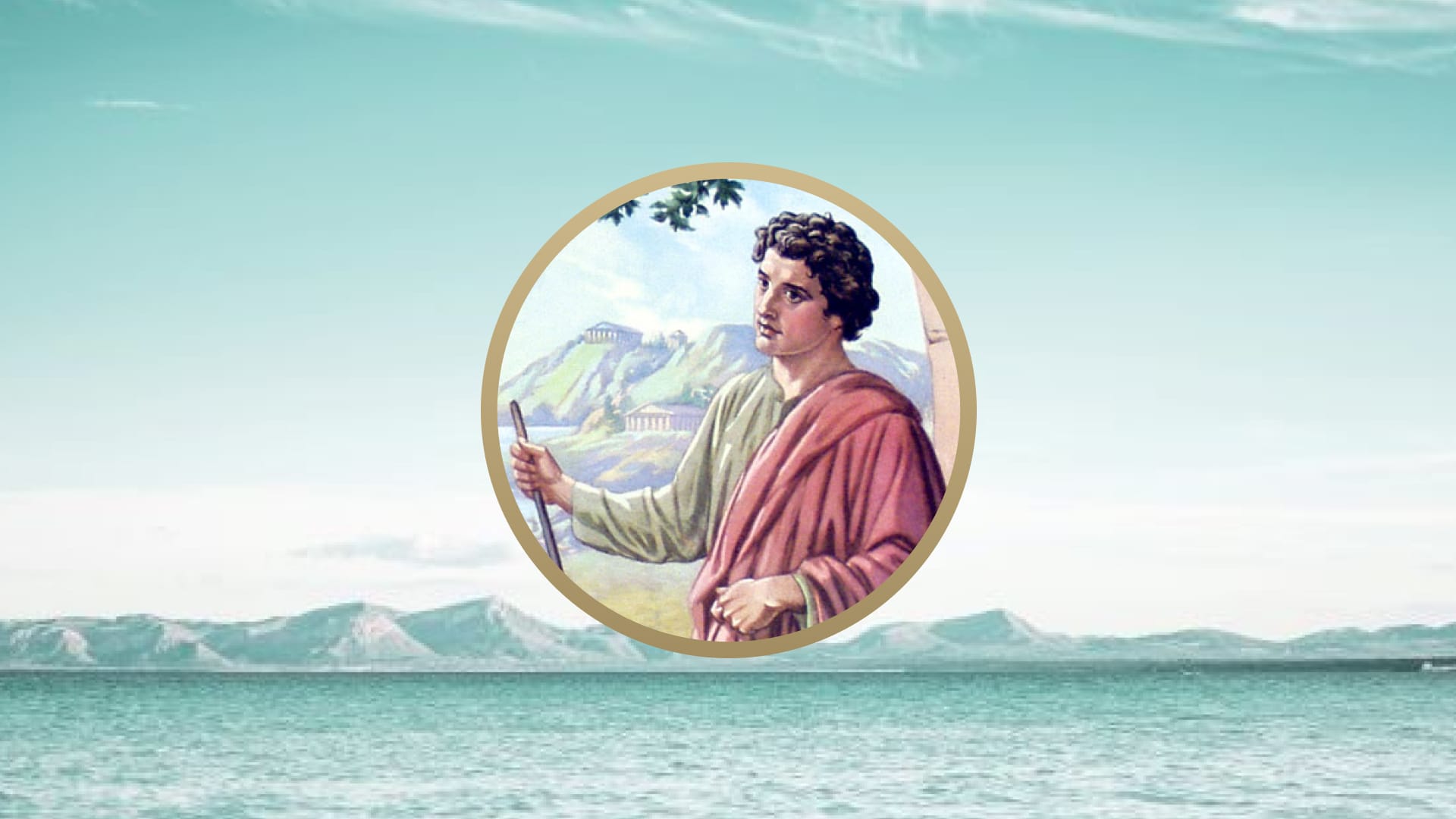
Many people are familiar with the Epistle to Titus, but it is surprising how little is known about Titus the man. Typically, in common thought, Titus is often associated with Timothy. However, the two young men had very different backgrounds! Unlike Timothy, Titus was a Gentile. He carried a Roman name and probably came from a pagan background. Yet, Titus is a splendid example of a young man serving the Lord in a difficult mission on the island of Crete, “denying ungodliness and worldly lusts,” and living “soberly, righteously, and godly, in this present world” (Titus 2:12).
This young preacher was most likely a convert of Paul’s. In his epistle to Titus, Paul addressed him as, “Titus, mine own son after the common faith” (Titus 1:4).
While Titus is not mentioned at all in the Book of Acts, it is evident from Paul’s letter to the Galatians (see Galatians 2:1) that Titus was at the Council of Jerusalem as a major participant. We learn from Paul’s letters to the church at Corinth that Titus was a vital part of the third missionary journey; he served with Paul at Ephesus and then acted as Paul’s personal emissary to the Corinthian church during its troubled years.
Yet, for all this activity acknowledged by Paul in his epistles, still Titus is not once mentioned in Acts. Perhaps there is a reason for this omission. One other man is not mentioned by name in the Book of Acts, and that is the author of the record, Luke the Physician. For modesty and humility, Luke declined to ever mention his own name. It is an intriguing possibility that Luke was the brother of Titus. Both men seem to have originated from Antioch of Syria. Both seem to have been Gentiles. Both had Roman names.
This practice of not mentioning family members is found elsewhere in the New Testament as well. John, in his account of the Gospel, never mentioned his name or that of his brother James. In a similar way, Luke perhaps avoided mentioning himself and Titus, leaving their names out of the record of Acts. Despite this omission of Titus’s name from the record of Acts, enough reference to Titus is present in the epistles to the Galatians and Corinthians to piece together a narrative of this fine Christian.
Titus is first mentioned by name in reference to the Council of Jerusalem, which occurred shortly after Paul and Barnabas returned from their first missionary journey. A debate had arisen in the church over a vitally important question: Did a Gentile need circumcision in order to be saved?
In Galatians 2:1, Paul recounted to the Galatian believers about this visit to Jerusalem and mentioned Titus. He wrote, “Then fourteen years after I went up again to Jerusalem with Barnabas, and took Titus with me also.” Paul brought young Titus as a living testimony of a Gentile Christian, uncircumcised, who was exhibiting the fruit of the Spirit. The Judaizers preached that Gentiles needed circumcision for salvation, but they could not deny the fact that Titus was a changed man, filled with the Holy Spirit.
Paul mentioned Titus again in the same epistle. “But neither Titus, who was with me, being a Greek, was compelled to be circumcised” (Galatians 2:3). Some Judaizers urged Paul to circumcise the young man. But he was not compelled to do so. The testimony of the Gospel was at stake. If Titus had been circumcised, the truth of salvation by grace alone would have been compromised.
Following the Council of Jerusalem, we lose contact with Titus for a period of about eight years. He was not mentioned again until Paul was on his third missionary journey. The year was A.D. 56. During this missionary journey, Paul stayed for three years at Ephesus. It was at that time that he wrote at least two letters to the troubled church at Corinth.
In II Corinthians 8:23, we find a striking commendation of Titus. “Whether any do enquire of Titus, he is my partner and fellowhelper concerning you: or our brethren be enquired of, they are the messengers of the churches, and the glory of Christ.” It seems from the frequent references to Titus in the Corinthian epistles that Paul used Titus as his chief emissary to Corinth. According to II Corinthians 8:16, Paul wrote, “But thanks be to God, which put the same earnest care into the heart of Titus for you.”
During those years, some deep-rooted problems arose in the Corinthian church: factions among the people, confusion over the gift of tongues, immorality in one of the members, debates over the Lord’s Supper, and hostility toward Paul’s authority. These problems would baffle the most experienced church leader! But who did Paul send into this hornet’s nest of problems? He sent Titus.
This fact alone is a remarkable glimpse of the confidence Paul had in Titus. On several occasions while Paul was in the city of Ephesus across the Aegean Sea, he sent Titus to check on the Corinthian situation and give counsel. Titus traveled back and forth at least three times across the Aegean. Of such vital importance to the ministry was Titus that he is mentioned by name eight times in Paul’s two epistles to the believers in Corinth.
After his service to the Corinthians, we lose sight again of Titus for about eight more years. Only in eternity will we know what Titus was doing in those traveling years.
During that interval of silence in the New Testament witness, Paul ended his third missionary journey. He was arrested in Jerusalem in A.D. 57, and imprisoned at Caesarea for two years. He stood trial before kings Felix, Festus, and Agrippa. Then, Paul was transported by ship to Rome; along the way, he suffered shipwreck on the island of Malta.
Finally in Rome, Paul wrote the prison epistles of Ephesians, Philippians, and Colossians, as well as a personal letter to Philemon, a believer at Colosse. Following this period of house arrest, Paul stood trial before Caesar. He was apparently acquitted. Paul was then released for a short season and, during that season, apparently made another missionary tour.
Not much information is known about this period of time. However, we do know from comments in Paul’s letter to Titus that Paul traveled and labored on the island of Crete. After ministering with Titus there, Paul apparently left Titus behind for a time to strengthen the work. “For this cause left I thee in Crete, that thou shouldest set in order the things that are wanting, and ordain elders in every city, as I had appointed thee” (Titus 1:5).
Once again, Titus was trusted for a most difficult mission. According to Titus 1:10–11, Paul described the difficulties on the island of Crete: “For there are many unruly and vain talkers and deceivers, specially they of the circumcision: Whose mouths must be stopped, who subvert whole houses, teaching things which they ought not, for filthy lucre’s sake.”
In Titus 2:1–15, Paul shared with the young pastor some warm, fatherly advice on how to nourish a young church and edify the people of God. The heart of the epistle is found in verses 11–15, where Paul moved from theological truth to practical truth. He wrote, “For the grace of God that bringeth salvation hath appeared to all men, Teaching us that, denying ungodliness and worldly lusts, we should live soberly, righteously, and godly, in this present world; Looking for that blessed hope, and the glorious appearing of the great God and our Saviour Jesus Christ; Who gave himself for us, that he might redeem us from all iniquity, and purify unto himself a peculiar people, zealous of good works. These things speak, and exhort, and rebuke with all authority. Let no man despise thee.”
These verses show that Paul had great confidence in the ability of Titus to organize, equip, train, instruct, and ordain elders who would carry the work in Crete faithfully into the future. Out of all his companions, Titus was the one whom Paul selected for this important task. As Paul closed his letter, he gave Titus instruction as to where to meet him next. “When I shall send Artemas unto thee, or Tychicus, be diligent to come unto me to Nicopolis: for I have determined there to winter” (Titus 3:12).
Later, in Paul’s final writing, Titus is mentioned. In the now-aged apostle’s last epistle, written to another pastor, Timothy, we have a parting glimpse of Titus. Paul wrote to Timothy, “Do thy diligence to come shortly unto me: For Demas hath forsaken me, having loved this present world, and is departed unto Thessalonica; Crescens to Galatia, Titus unto Dalmatia” (II Timothy 4:9–10). Dalmatia is a region in the Balkans that roughly corresponds to the modern countries of Bosnia, Croatia, Serbia, and Slovenia.
On that brief but intriguing note, the record of Titus ends. May God give us the grace to follow the example of Titus. May we live as he lived—soberly, righteously, and Godly in this present world.