
Just after Simeon finished his prophecy of the purpose and destiny of the Christ child in the Temple, we are introduced to another remarkable character. Her name was Anna. Not much is recorded about this remarkable lady. In Scripture, only three verses give a glimpse into her life. Yet, those three verses provide much that we can admire and emulate.
“And there was one Anna, a prophetess, the daughter of Phanuel, of the tribe of Aser: she was of a great age, and had lived with an husband seven years from her virginity. And she was a widow of about fourscore and four years, which departed not from the temple, but served God with fastings and prayers night and day. And she coming in that instant gave thanks likewise unto the Lord, and spake of him to all them that looked for redemption in Jerusalem” (Luke 2:36–38).
Each of the characters in the story of Christ’s infancy gave something to the young Christ child. Joseph gave his home and his labors. Mary gave her body and her reputation. The shepherds gave their voice in the spreading of the Good News. The wise men gave their treasures of gold, frankincense, and myrrh. Simeon gave his devotion. So here, Anna gave her time and service.
First, consider her identity. Anna’s name is derived from the Hebrew name Hannah, which means “grace.” Anna is identified first by the Scripture as a prophetess. Several other women in the Bible have held this same title. Miriam, the sister of Moses and Aaron, was called a prophetess in Exodus 15:20. According to Judges 4:4, the judge Deborah was also called a prophetess. In another reference, Josiah the king sent his servants to visit “Huldah the prophetess” (II Kings 22:14). The prophet Isaiah referred to his own wife as a prophetess in Isaiah 8:3. While none of these ladies had what today is called a “preaching ministry,” they did testify of the truth in their God-given roles.
Recorded in Luke 2:36 is a brief family sketch of Anna. That verse notes that she was the daughter of a man named Phanuel, whose Hebrew name means “face of God” or “presence of God.” Her father was of the tribe of Asher. A noteworthy point is that Asher is one of the tribes commonly called “the ten lost tribes.”
In 722 B.C., the northern kingdom, which comprised ten tribes of Israel, was conquered by the Assyrian Empire. For more than 700 years, the northern kingdom did not exist. The land was depopulated of Israelites, and foreign groups were intermingled into the region to intermarry and produce a mixed race. The mixed race became known as Samaritans.
However, this insight into Anna’s family origin testifies to the fact that Anna’s family could trace themselves back to the tribe of Asher. Thus, the “ten lost tribes” were not entirely lost! They were and still are perfectly known to God.
As a daughter of the tribe of Asher, Anna was not at all required to be serving in the Temple. She was not a Levite. Her service was entirely voluntary, and she served out of love.
What can you give the Lord? Perhaps you don’t have gold, frankincense, or myrrh. However, you can give what you do have. Anna had no gold to give Christ. Instead, she gave Him her time, and she dedicated the better part of a lifetime to humble service in the Temple area.
Next, the Scripture yields an interesting comment as to her age. According to Luke 2:36–37, “She was of a great age, and had lived with an husband seven years from her virginity. And she was a widow of about fourscore and four years.” These words have generated a good deal of discussion. One way to understand them is that Luke simply gave her age as eighty-four years old.
Yet, Luke’s wording of Anna’s age could imply more. Some understand that the eighty-four years are numbered from the time that she was widowed. Thus, with that understanding, the text would read that she was more than one hundred years old! Even if Anna was married to her husband at the young age of fifteen and lived as his wife for seven years, her age would have been 106 years old at the time she saw the infant Christ.
To be sure, Anna had not taken a vow of chastity. Nothing is more holy in a woman than to desire to be a wife and a mother. God’s created order and purpose for which He formed Eve was to be a help meet, or a perfect complement, for Adam. Anna was married for seven years, and then her husband died. According to Scripture, Anna was free to remarry. So what did she do?
This faithful widow apparently chose voluntarily to give herself entirely to the service of God in the Temple. This was not a life she imposed on others. Anna, for eighty-four long years—longer than most people even live—served God in the Temple complex.
In those three verses about Anna, her lifetime of service is noted: “she departed not from the temple, but served God with fastings and prayers night and day.” Consider what kind of service this might have been. Women were allowed to go only so far into the Temple complex. In the second Temple, the one that Ezra had overseen and Herod the Great had renovated and beautified, there were a series of courts.
At the farthest extremity from the inner sanctuary was the Court of the Gentiles. Anyone could enter this area, and it was a place of general concourse. Inside the Court of the Gentiles was a low dividing wall called the soreg. Only Israelites could go beyond the soreg, further into the Temple complex.
Once past the low dividing wall, people would ascend a series of steps up to the chel, which was the platform on which the actual structure was built. From the east, the worshipper would then enter the Beautiful Gate into the Court of the Women. This large, broad court was where many events of the New Testament took place. In the Court of the Women, the lights were lit at the end of the Feast of Tabernacles. This event was also when Jesus proclaimed Himself as the “Light of the World.”
Around the Court of the Women, under colonnades, there were a variety of meeting rooms and storage rooms. Storage areas were needed for items such as lamp oil and wood. The lepers had a small courtyard at the corner. In this general area of the Temple would have been where Anna spent her eighty-four years of service.
With her time spent in fasting and prayer, sweeping and cleaning floors dirtied by animals, storing oil for lamps and also lighting them, and polishing metal so that it would reflect the glowing lamplight, Anna accomplished more than mighty empires or the prideful religion of the Pharisees and Sadducees. Her lifetime of genuine piety stands recorded in the pages of Scripture.
During her long years of serving in the Temple, Anna would have greeted the dawn of a new day of service more than 30,000 times. But one memorable day, her routine of washing, cleaning, sweeping, and refilling oil was interrupted by a singular event!
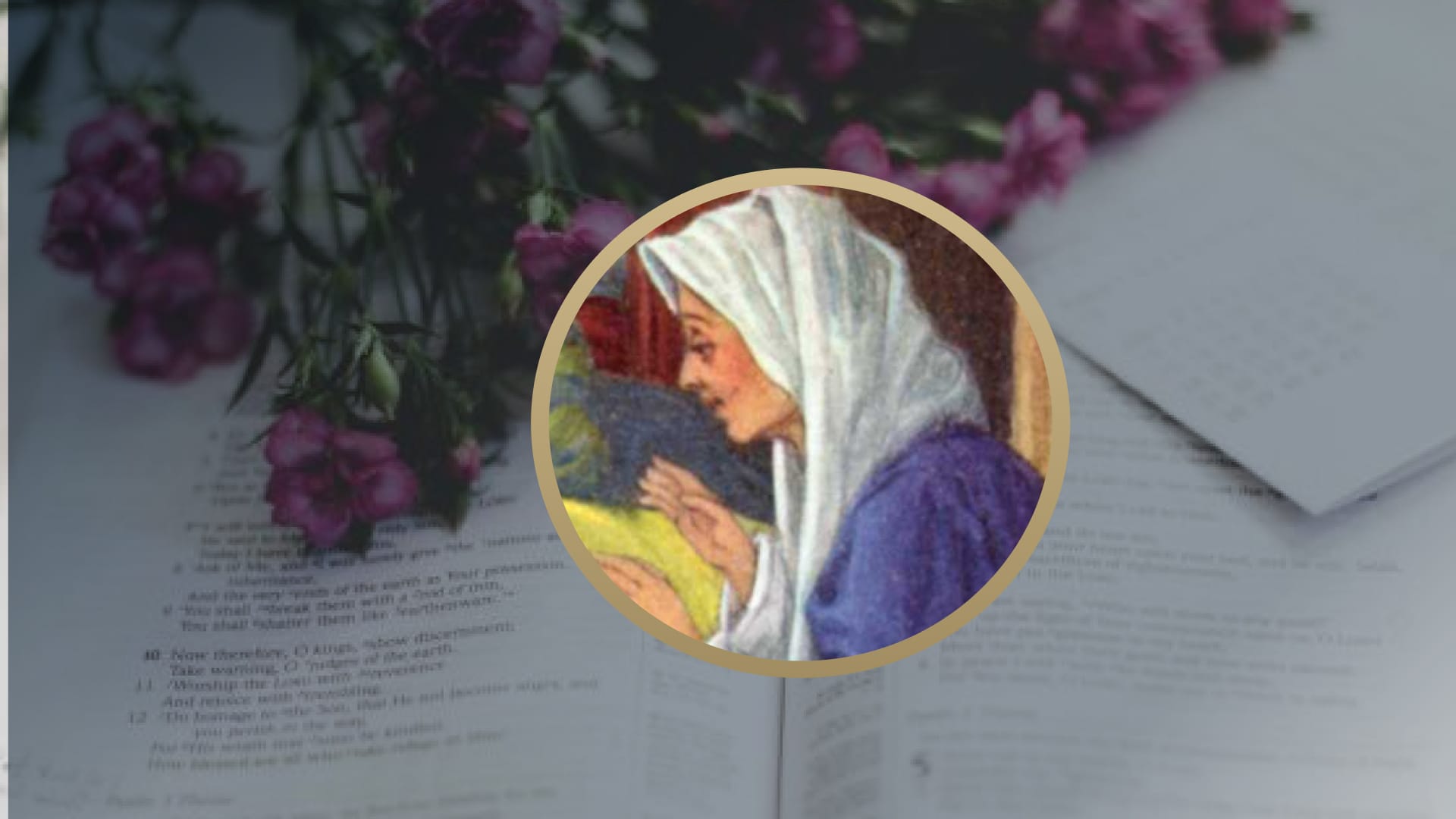
Pausing in her service, she observed an infant boy in the arms of His mother. In so many years of service, she had seen thousands of babies in the Temple. Parents from Jerusalem and the surrounding villages of Judea came daily into the Court of Women to dedicate their children to the Lord. But this baby was like none other. Anna, with the Holy Spirit’s gift of prophecy, knew that this infant was the long-awaited One!
Apparently, she had stood quietly in the background as her friend, Simeon the rabbi, uttered his glowing prophecy regarding this Child. Only when Simeon’s lips were still did she speak. “And she coming in that instant gave thanks likewise unto the Lord, and spake of him to all them that looked for redemption in Jerusalem” (Luke 2:38). The ministry of Anna did not end at the age of 106. Rather, her real ministry only started then.
Her response to the Gospel, the Good News of the Messiah, is twofold and should be the pattern for every Christian. First, Anna gave thanks to God. Few pause to do this. Of the ten Samaritan lepers whom Jesus cleansed, only one returned to give thanks. As God extends His hand to us in grace, the only proper response for us is to give God thanks publicly. This Anna did.
Second, she “spake of him to all them that looked for redemption in Jerusalem.” To God, Anna gave thanks. To men, Anna gave witness of the Messiah she had seen. According to Isaiah 52:7, “How beautiful upon the mountains are the feet of him that bringeth good tidings, that publisheth peace; that bringeth good tidings of good, that publisheth salvation; that saith unto Zion, Thy God reigneth!”
Anna’s aged feet probably did not bear testimony to any outward beauty. In all likelihood, they were old, misshapen, scarred, and afflicted with the common ailments of age. But those feet were beautiful in the eyes of God because Anna, in spite of her advanced age and years of past service, was willing to take one more step, to fulfill one more task, and to tell one more person that Jesus Christ, the promised Messiah, was born to bring redemption to His people.