
Mary had the unique privilege of being the mother of Jesus Christ, the Son of God and Savior of the world. The Messiah of Israel was sheltered in her womb, nourished at her breast, and warmed in her bosom. On the human side, their lives were intertwined, and yet on the divine side, she depended upon the One she had held in her arms for her salvation.
Jesus was Mary’s Creator, God, and Savior. But He was also her son. Thus, while she honored Him, He also honored her. The virgin birth of the Lord Jesus is one of the foundational doctrines of the Bible. Without the virgin birth of Christ, Christ is not divine. If He is not divine, then there can be no atonement, no redemption, no resurrection, and no hope for sinful man.
We are introduced to Mary in the first chapter of Luke’s Gospel. When the fullness of time had come, God sent forth His Son. Four hundred years of silence from Heaven were broken by a flutter of angelic activity! The archangel Gabriel appeared to the priest Zacharias as he stood at the altar of incense. The angel announced to Zacharias that he and his wife Elisabeth would bear a son—John the Baptist—who would be the forerunner of the Messiah.
Six months later, the Heavenly messenger Gabriel was dispatched again, this time to the farming village of Nazareth, located in the hills of southern Galilee. “And in the sixth month the angel Gabriel was sent from God unto a city of Galilee, named Nazareth, To a virgin espoused to a man whose name was Joseph, of the house of David; and the virgin’s name was Mary. And the angel came in unto her, and said, Hail, thou that art highly favoured, the Lord is with thee: blessed art thou among women” (Luke 1:26–28).
“And when she saw him, she was troubled at his saying, and cast in her mind what manner of salutation this should be” (Luke 1:29). Mary probably had heard about angels visiting men such as Abraham and Jacob, and possibly even Zacharias. But now, an angel was standing in her room with a message of earth-shattering importance!
The angel saw her fright and confusion. Again he spoke, reassuring her with these kind words from the throne room of Heaven, “Fear not, Mary: for thou hast found favour with God. And, behold, thou shalt conceive in thy womb, and bring forth a son, and shalt call his name JESUS” (Luke 1:30).
The angel Gabriel continued. According to Luke 1:32–33, he imparted to her a few things about her divine Son. “He shall be great, and shall be called the Son of the Highest: and the Lord God shall give unto him the throne of his father David: And he shall reign over the house of Jacob for ever; and of his kingdom there shall be no end.”
The wonder of this message would be difficult for a Hebrew maiden to even comprehend. Her son? The Son of the Highest? The throne of David? A kingdom without end?
We have the advantage of two thousand years of Christian history and dramatic proof that Jesus Christ is all that He claims to be. Mary had none of these advantages. She had to believe the angel’s message on the basis of hundreds of years of prophetic proclamation of the promise of a coming Redeemer. She responded to the angel’s startling announcement by asking, “How shall this be, seeing I know not a man?” (Luke 1:34).
In beautiful language, the archangel Gabriel then unfolded the mystery of the divine incarnation and the virgin birth—the wondrous truth that Jesus the Messiah would be both fully man and fully God. “And the angel answered and said unto her, The Holy Ghost shall come upon thee, and the power of the Highest shall overshadow thee: therefore also that holy thing which shall be born of thee shall be called the Son of God” (Luke 1:35).
According to Luke 1:36–37, the angel also assured Mary regarding this miracle to occur. “And, behold, thy cousin Elisabeth, she hath also conceived a son in her old age: and this is the sixth month with her, who was called barren. For with God nothing shall be impossible.”
God had spoken. How would Mary respond? We have the advantage of centuries of proof that Christ is all that the angel said He would be. Christ has been subjected to two thousand years of the closest scrutiny. Innumerable multitudes of saved souls, every good work, every deed of kindness, every worthwhile institution, every changed life give us continuing proof that the impossible is true and Christ is all that He claims to be.
However, Mary had none of these advantages. She had the knowledge of the promises of a coming Redeemer, but we have the advantage of seeing those promises fulfilled. She did not.
The message delivered, the angel was soon to depart. How would she respond to his news? Her life, her future, and her reputation were all staked upon her answer. Humbly and with simple faith, she submitted to God’s will: “Behold the handmaid of the Lord; be it unto me according to thy word” (Luke 1:38).
Mary learned not to fear. Trusting God’s promise to do the impossible, she journeyed to visit her cousin, Elisabeth. Upon the two women seeing each other, Mary uttered words of praise and adoration to God, known as the beginning of the Magnificat: “My soul doth magnify the Lord, And my spirit hath rejoiced in God my Saviour” (Luke 1:46–47). In her song of praise to God, Mary quoted approximately a dozen passages of Old Testament Scripture, a testimony to how much Scripture she had committed to memory.
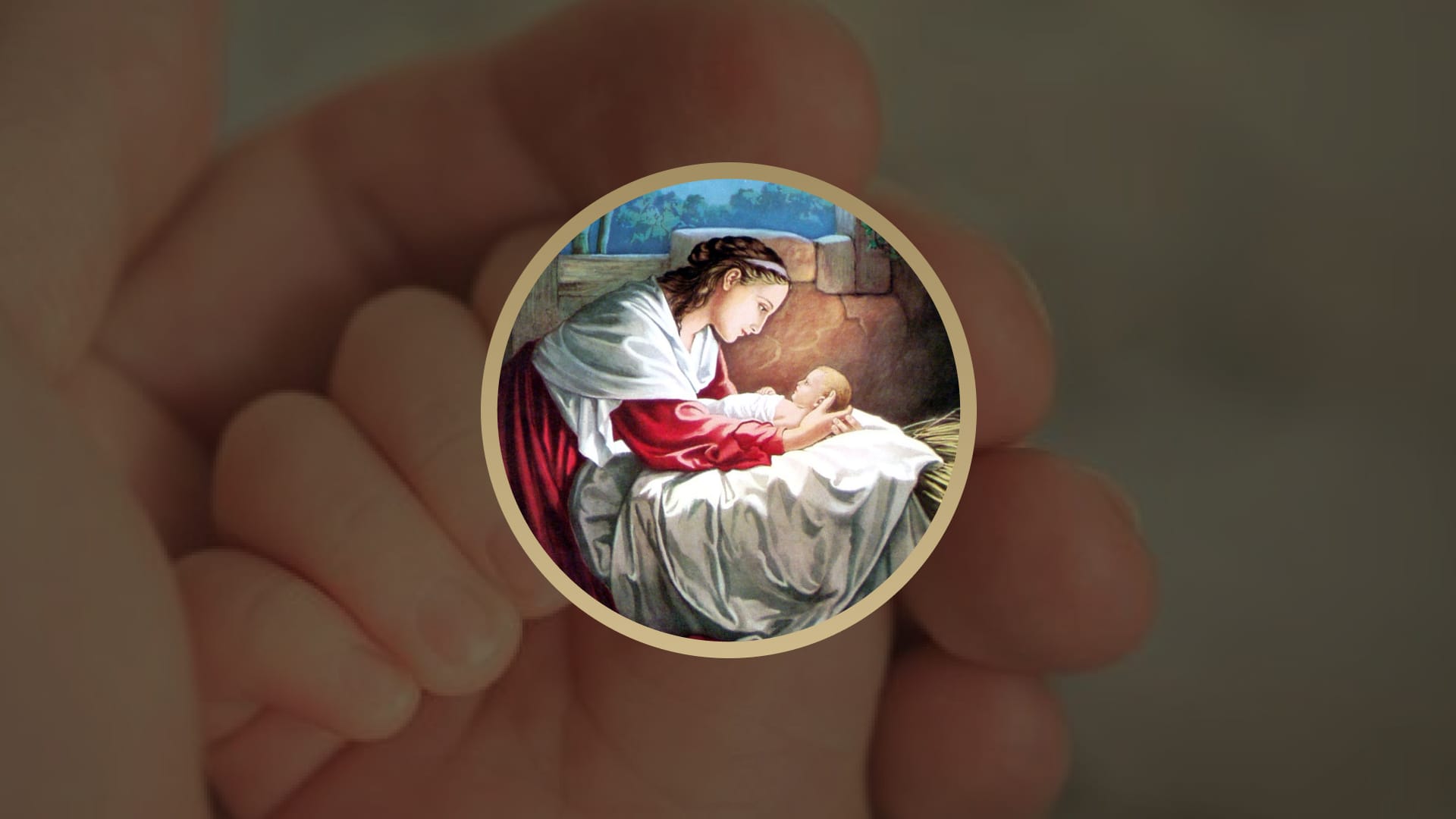
Mary learned she was not to fear when she returned to Nazareth, great with child and facing possible scorn and gossip of the townspeople of Nazareth. She followed her new husband Joseph to Bethlehem to be enrolled as his wife in the Roman census. Far from friends and family, in the quiet stillness of a stable, she gave birth to the Son of God and Savior of the world.
The young mother beheld the wonder of the shepherds who came to worship her newborn son. She heard the testimony of Simeon in the Temple regarding her son as well as his prophetic warning to her that “a sword shall piece through thy own soul also” (Luke 2:35).
Mary must have been awed at the rich gifts of the wise men from the East, as they bowed to honor her young son. Then, when danger was near, she had to trust her husband Joseph as he took her and the baby Jesus to faraway Egypt as Herod sought to take the boy’s life. How often the words of Gabriel must have come back to her: “Fear not, Mary.”
Later, when home again in Nazareth, Mary continued to observe and witness the blameless life of our Lord. According to Luke 2:19, she “kept all these things and pondered them in her heart.”
Finally, the day came for the Lord Jesus to be about His Father’s business. He left the safety and security of the carpenter’s shop and went out to face a cruel world. Joseph is not recorded as a speaker or an actor after Jesus was twelve years old; it is supposed that Mary was a widow by the time that Christ began His public ministry.
How Mary must have leaned upon Jesus as her eldest son! It was Mary who, expecting Him to reveal something of His mission, first pointed to her son at the wedding in Cana and told the servants, “Whatsoever he saith unto you, do it” (John 2:5).
All too soon, Mary would come to understand what Simeon was speaking of when he prophesied of a sword piercing her heart. After three tumultuous adult years, Jesus of Nazareth was despised by the people that He had come to save. He was not only Mary’s Savior. He was the Savior of the world.
When the Lord Jesus was nailed to a Roman cross, Mary was there. She had been present when He had entered the world, and she would be present when He left it. In Bethlehem, she had bled for Him at His birth. Now, in a much more profound and saving way, He shed His blood for her. Perhaps Mary remembered again the words of Gabriel: “Fear not, Mary.”
Ever the faithful Son, as the Lord Jesus looked out of eyes stinging and nearly blinded by sweat and blood from the crown of thorns, His eyes met those of Mary, His mother. Tenderly, He entrusted her into the care of John the Apostle. Long before, Mary had heard Jesus say, “I must be about my Father’s business” (Luke 2:49). Now, following intense hours of darkness, she heard His cry of victory, “It is finished!” He then said, “Father, into thy hands, I commend my spirit” (Luke 23:46).
Mary the mother of Jesus, was one of those women who tenderly prepared the broken body of her Son for burial. She had held Him in her arms at His birth, and now again at His death. On the third day, Christ rose from the dead. How fitting that the angel announced to the astonished women at the tomb, “Fear not ye, for I know that ye seek Jesus, which was crucified. He is not here: for he is risen, as he said” (Matthew 28:5–6).
The life and testimony of Mary, the mother of Jesus, teaches us to fear not but rather to trust God to do exactly what He promised to do, which was the impossible. Her confession of trust and submission is a fitting example for each of us to follow: “Behold the handmaid of the Lord; be it unto me according to thy word.”