

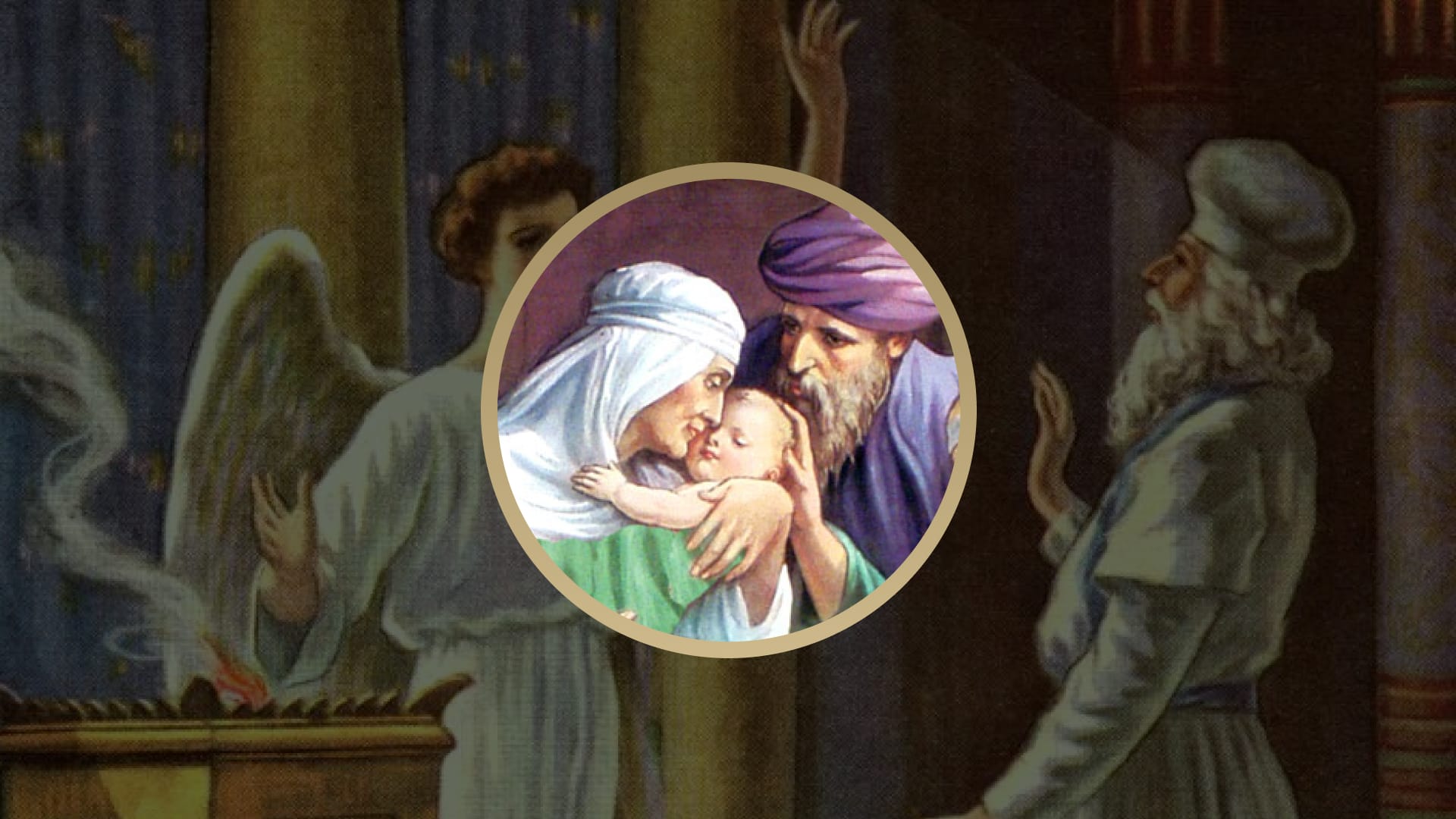
The chronological account of the New Testament dawns upon a Godly married couple named Zacharias and Elisabeth, who also were the parents of John the Baptist. There is much that we can learn from their marriage and home. According to Luke 1:5–6, “There was in the days of Herod, the king of Judaea, a certain priest named Zacharias, of the course of Abia: and his wife was of the daughters of Aaron, and her name was Elisabeth. And they were both righteous before God, walking in all the commandments and ordinances of the Lord blameless.”
Four hundred years had passed since mankind had received a definitive, inspired word from Heaven. From the days of the prophets Daniel and Malachi, as well as Queen Esther, God’s people had waited, watched, and prayed through centuries of war and conquest. Babylon had been replaced by Persia, Persia by Greece, and Greece by Rome. The children of God were in subjugation, longing for the promised Messiah.
Zacharias and Elisabeth were among those who believed God’s promises and trusted that the Deliverer was coming. According to Scripture, Zacharias and Elisabeth were “both righteous before God.” All too often, a man will try to serve God alone, apart from his wife. In other tragic examples, the wife will try to lead the home spiritually in the situation of an apathetic or backslidden husband. But in this marriage mentioned in Scripture, a Godly priest and his Godly wife walked together “in all the commandments and ordinances of the Lord blameless.”
However, even Godly marriages undergo sorrows and difficulties. God’s people should not expect or demand blessings merely because they are seeking to live obediently. In the case of this particular Godly couple, “And they had no child, because that Elisabeth was barren, and they both were now well stricken in years” (Luke 1:7). To be childless in Biblical times was a great sorrow. There would be no progeny to carry on the family priestly line. There would be no security of a son or daughter to care for Zacharias and Elisabeth in their old age and infirmity.
This longing and prayer were upon Zacharias’s heart when he was met by an angel beside the altar of incense in the Temple of the Lord. It was “while he executed the priest’s office before God” that the angel gave the special birth announcement. Not only would Elisabeth bear a son, but that son would be the special one promised in Malachi chapter 4 and Isaiah chapter 40: their son would be the forerunner of the Messiah!
The burning of incense in the sanctuary of the Holy Place was a great, exalted privilege for a priest. It has been estimated that a priest might hope to have this duty only once in his lifetime! Zacharias had the rare opportunity to enter the Temple sanctuary where the table of shewbread, the golden candlestick, and the altar of incense stood. The golden altar was in front of the curtain that separated the Holy Place from the Holy of Holies, the inner sanctuary where the Mercy Seat crowned the Ark of the Covenant. During those few moments of intercession, Zacharias was the one man on earth nearest to the Mercy Seat.
The priest listened in awe and wonder to the news from the Heavenly messenger. The angel proclaimed to him a promise that referenced the Messianic hope of Isaiah chapter 40 and Malachi chapter 4. “But the angel said unto him, Fear not, Zacharias: for thy prayer is heard; and thy wife Elisabeth shall bear thee a son, and thou shalt call his name John. And thou shalt have joy and gladness; and many shall rejoice at his birth” (Luke 1:13–14).
The angel continued his message. “For he shall be great in the sight of the Lord, and shall drink neither wine nor strong drink; and he shall be filled with the Holy Ghost, even from his mother’s womb. And many of the children of Israel shall he turn to the Lord their God. And he shall go before him in the spirit and power of Elias, to turn the hearts of the fathers to the children, and the disobedient to the wisdom of the just; to make ready a people prepared for the Lord” (Luke 1:15–17).
In response to this good news from Heaven, the amazed priest’s reply revealed his lack of faith in God’s promise. “And Zacharias said unto the angel, Whereby shall I know this? for I am an old man, and my wife well stricken in years” (Luke 1:18). Zecharias did not merely ask, as did Mary the mother of Jesus later in the same chapter: “How shall this be?” Mary believed first, and then sought an explanation. Zacharias, by contrast, sought an explanation before he was willing to believe. God’s ways often call for us as His people to exercise faith first, then later He will grant understanding.
“And the angel answering said unto him, I am Gabriel, that stand in the presence of God; and am sent to speak unto thee, and to shew thee these glad tidings. And, behold, thou shalt be dumb, and not able to speak, until the day that these things shall be performed, because thou believest not my words, which shall be fulfilled in their season” (Luke 1:19–20).
Following the time of this encounter and over the course of nine long months, the lips of the righteous priest were sealed from sharing the glad tidings. During that time of Zacharias’s silence, the angel Gabriel next appeared to Mary in Nazareth. Upon hearing the angel’s message about both her and her cousin Elisabeth, Mary traveled south into the mountains of Judea to visit her relative. The unborn child within Elisabeth reacted with a leap upon Mary’s greeting! Mary gave utterance to her song of faith. Throughout all this jubilation and exultation, Zacharias was silent.
At last, the days were fulfilled and the promised son was born to the God-fearing couple. When a controversy about the name of the child arose among the well-wishers gathered around the new mother and infant boy, the people turned and made signs to the father, asking for his input. The aged priest indicated to bring him a writing tablet. Then, upon it he wrote, “His name is John” (Luke 1:63).
Upon these words of faith and obedience, his lips were unsealed and all the joys and praises of the last nine months came flowing forth like a fountain! “And his mouth was opened immediately, and his tongue loosed, and he spake, and praised God. And fear came on all that dwelt round about them: and all these sayings were noised abroad throughout all the hill country of Judaea. And all they that heard them laid them up in their hearts, saying, What manner of child shall this be! And the hand of the Lord was with him” (Luke 1:64–66).
The words that Zacharias spoke next are known to church history as the Benedictus, or the Canticle (Song) of Zacharias. The word benedictus simply means “blessing” and is taken from the first word spoken by the priest at this moment in time. It is a song, prayer, praise, and prophecy all mingled into a joyful expression of thanksgiving for what God was doing in the world through the coming of the Messiah. The priest’s song is recorded in Luke 1:68–79.
Filled with the Holy Spirit, Zacharias prophesied aloud! “Blessed be the Lord God of Israel; for he hath visited and redeemed his people, And hath raised up an horn of salvation for us in the house of his servant David; As he spake by the mouth of his holy prophets, which have been since the world began: That we should be saved from our enemies, and from the hand of all that hate us;” (vv. 68–71).
The words continued to flow forth as his speech gave glory to God. “To perform the mercy promised to our fathers, and to remember his holy covenant; The oath which he sware to our father Abraham, That he would grant unto us, that we being delivered out of the hand of our enemies might serve him without fear, In holiness and righteousness before him, all the days of our life” (vv. 72–75).
He then concluded with exaltation of the coming Savior. “And thou, child, shalt be called the prophet of the Highest: for thou shalt go before the face of the Lord to prepare his ways; To give knowledge of salvation unto his people by the remission of their sins, Through the tender mercy of our God; whereby the dayspring from on high hath visited us, To give light to them that sit in darkness and in the shadow of death, to guide our feet into the way of peace” (vv. 76–79).
At the heart of his song, when Zacharias said, “to remember his holy covenant: the oath which he sware,” the priest was using the meaning of his own name, combined with the meaning of his wife’s name! Names have great significance in Scripture, as oftentimes they point to God’s character, the person’s character or destiny, etc. In this Benedictus of Zacharias, his name means “Jehovah remembers.” His wife Elisabeth’s name means “the oath of God.” Together, their marriage testified that “Jehovah remembers His promise.”
Just as Zacharias and Elisabeth lived at the dawn of the first coming of Christ, so we today live in expectation of the second coming of Christ. Also, just as this couple encouraged one another in their Godly marriage to keep on believing and keep on praising God, so husbands and wives today can honor marriage together as they await the day that our Lord Jesus Christ returns again in power and great glory!



 21:37
21:37