

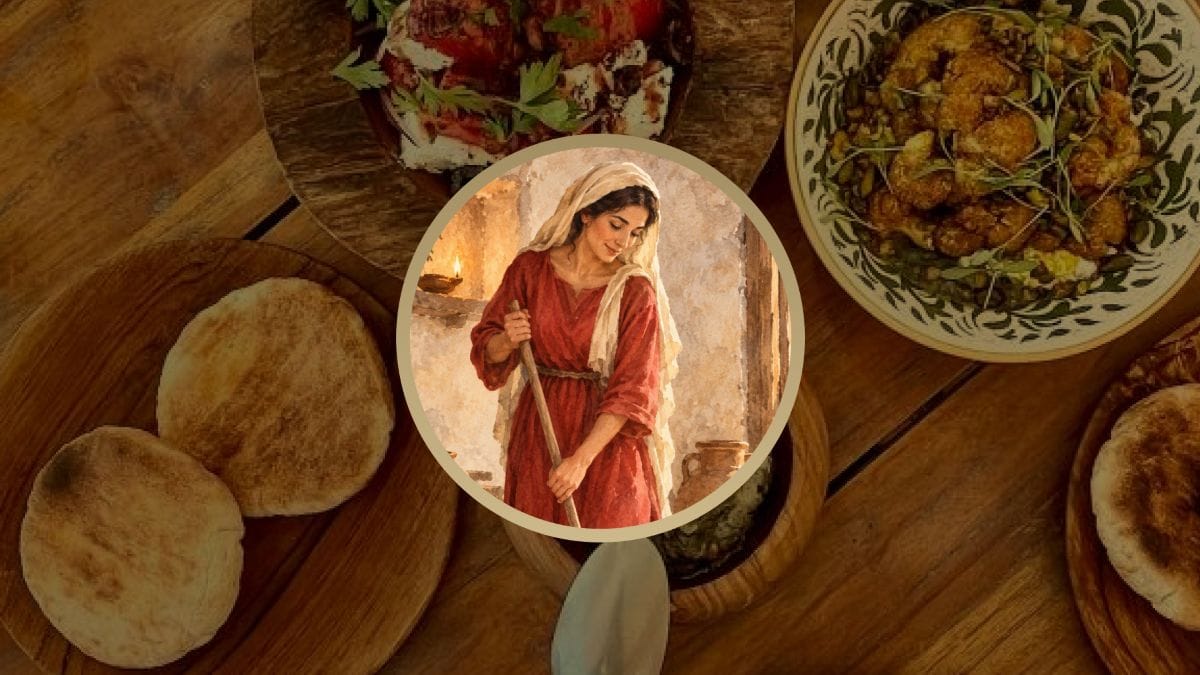
If Mary teaches us to love the Lord with all our heart, soul, mind, and strength, then her sister, Martha, teaches us the second great commandment in the Law: “thou shalt love thy neighbour as thyself: I am the LORD” (Leviticus 19:18). Both sisters were loved by the Lord Jesus. Previously, we focused on Mary. This time we turn our attention to Martha.
The family is introduced in Luke 10:38. “Now it came to pass, as they went, that he entered into a certain village: and a certain woman named Martha received him into her house.” Notice that the home is called “her house,” in relation to Martha.
Many Bible scholars believe that the parents of this family had died, and that the three adult siblings—Martha, Lazarus, and Mary—lived together in Martha’s house. It appears that Martha was the oldest of the three, and served as the head of the family. This may explain why Martha felt the burden of responsibility for hospitality.
While Mary was sitting at the feet of Jesus, Martha was “cumbered about much serving” (Luke 10:40). She was so burdened that she sought help.According to verse 40, Martha asked Jesus, “Lord, dost thou not care that my sister hath left me to serve alone? bid her therefore that she help me.”
Instead, Jesus pointed out to Martha the priority of sitting at His feet. Thus, some casual readers of this text have assumed that manual labor, hospitality, cooking, cleaning, and serving are not that important. But this is not at all what Jesus was saying. While we should never be so busy in serving that we neglect to worship our Lord, so also, we should never be so busy worshipping our Lord that we forget to serve Him and others! In loving God, we must also love our neighbor.
Thank God for the ladies and men and even the youth who, at a church picnic or fellowship meal, cook, serve, wipe tables, wash dishes, and even take out the trash so that others may be blessed! In this account, Martha’s busyness is often underappreciated by readers.
The next time that Martha is mentioned, it is evident that she had learned the lesson that Jesus taught her. In fact, in John 11, Martha made one of the most emphatic, faithful, and Christ-honoring declarations of His deity and Messianic authority.
The scene where this affirmation took place was at the tomb of Martha’s brother, some time after Jesus’ visit in their home, as recorded in Luke 10.
Previously, the focus was on Mary in this passage recorded in John 11. Now, we shift our focus to Martha and her conversation with Jesus. “Then Martha, as soon as she heard that Jesus was coming, went and met him: but Mary sat still in the house” (verse 20). This glimpse of the two sisters fits their character. Martha, a woman of action and service, ran outside and down the road to meet Christ. Mary quietly waited to be called.
“Then said Martha unto Jesus, Lord, if thou hadst been here, my brother had not died” (John 11:21). Notice that first, Martha called Jesus “Lord.” But she also stated her fears. She believed in His power to do a miracle. She believed He had the power to prevent her brother’s death. But she was not convinced that He had the power to restore life to a dead body.
In the next verse, though, Martha gave utterance of a spark of hope yet within her heart. She did not say directly that Jesus had the power to restore life. But she hinted at such a power: “But I know, that even now, whatsoever thou wilt ask of God, God will give it thee” (John 11:22).
Despite her misplaced priorities in Luke 10, Martha exhibits maturing faith in John 11. She uttered her hope and confidence in the Lord. Jesus, always seeking to stretch her faith, said to Martha, “Thy brother shall rise again.” Jesus called upon Martha not to believe merely in His miracle-working power but to believe that here—in this situation, in this instance—her own brother shall rise again!
“Martha saith unto him, I know that he shall rise again in the resurrection at the last day” (John 11:24). Martha was not yet ready to understand what Jesus wanted her to believe that He had the power to do. She believed in the final resurrection. She believed that saints, like her brother, would indeed rise from the dead.
But Christ wanted more. To Martha, in this private conversation, Jesus revealed the marvelous truth of John 11:25. “Jesus said unto her, I am the resurrection, and the life: he that believeth in me, though he were dead, yet shall he live,”
Christ called Martha to shift her gaze from doctrinal teachings, off of the present circumstances, and onto Himself. “I am the resurrection and the life.” Resurrection is not some vague future event. It is the living, dynamic presence of the Lord Jesus Christ in our lives today. “And whosoever liveth and believeth in me shall never die” (John 11:26).
Then, firmly but lovingly, Jesus asked Martha a penetrating question after His statement about belief in Him: “Believest thou this?” In the next verse recorded is Martha’s faithful answer. “She saith unto him, Yea, Lord: I believe that thou art the Christ, the Son of God, which should come into the world.”
This statement from Martha of Bethany is one of the clearest and best statements of Christ’s identity found in the Gospel record. “I believe” is the perfect tense in Greek, expressing a past action with continued results. Martha was saying, in essence, “Yes, Lord: I have believed and I am still believing now that You are the Christ, the Son of God.” With that statement, Martha quietly withdrew to call her sister.
Martha’s faith was placed in the person of the Lord Jesus. Not long afterward, she saw the “substance of things hoped for” when at her brother’s tomb, Christ called out, “Lazarus, come forth” (John 11:43).
In the opening verses of the very next chapter, John 12, Martha is mentioned again. In the first verse is the setting: “Then Jesus six days before the passover came to Bethany, where Lazarus was, which had been dead, whom he raised from the dead.” Matthew 26:6 recorded that this event took place “in the house of Simon the leper.”
There has been some discussion among Bible scholars as to how to interpret this seeming contradiction. Some say that Martha, Mary, and Lazarus were the children of a man named Simon, and the home is appropriately called Simon’s to honor their departed father. Others say no, this is another house, owned by a man named Simon, and that Martha, Mary, and Lazarus were there as guests.
Either way, according to John 12:2, “There they made him a supper; and Martha served.” How fitting! While often the focus is upon Mary in this passage and her gift of expensive ointment that she poured upon Christ’s feet, let us not forget to notice here also her sister, Martha.
“Martha served”! What better epitaph could be placed upon the life of a follower of Jesus? According to John 11, Martha believed, and in John 12 is recorded that Martha served the One in Whom she had believed. This is the last time that Martha is mentioned by name in Scripture.
Here in John 12, Christ gave Martha no rebuke. In her service that is recorded in Scripture, she was not neglecting that “good part.” Martha had learned from Mary, and perhaps Mary had learned a bit from Martha too!
Do you serve as Martha served in Luke 10 or as she served later in John 12? We all need to learn to appreciate the virtues and giftings of our brothers and sisters in the Lord. Martha learned to balance love for God and love for her neighbors. May God help us all to serve with a joyful and trusting heart the Master Who is “the resurrection and the life.”
 21:37