
God often delights in setting two virtues side by side so that we might learn the value of both. Two sisters named Mary and Martha who were very dear to the Lord Jesus, particularly in the last months of His earthly ministry, illustrate this observation. Mary teaches us to love the Lord with all our heart, soul, mind, and strength. Martha teaches us to love our neighbor as ourselves.
When Jesus was asked which was the greatest commandment in the Law, He answered by quoting two verses from the Old Testament, found in Deuteronomy 6:5 and Leviticus 19:18. “And he answering said, Thou shalt love the Lord thy God with all thy heart, and with all thy soul, and with all thy strength, and with all thy mind; and thy neighbour as thyself” (Luke 10:27). These two sisters are introduced later in this same chapter of Luke’s Gospel. From the very first, a beautiful glimpse of the special virtues is seen in each of these ladies.
This article will focus upon Mary of Bethany. The next article will focus upon her sister, Martha.
“Now it came to pass, as they went, that he entered into a certain village: and a certain woman named Martha received him into her house” (Luke 10:38). This event took place on one of Christ’s visits to Jerusalem, probably about one year before His crucifixion. The immediate context of Luke 10:38 is the very point described in the opening paragraph: loving God and loving our neighbor.
Luke the historian introduced Mary and Martha in his Gospel account. He called their town simply “a certain village,” but from other Bible passages we know that this was the village of Bethany. Bethany was located approximately three miles east of Jerusalem, just beyond the Mount of Olives. The name Bethany means “house of unripe figs.” This home became a haven for Jesus whenever He was near Jerusalem.
It is unknown as to when Martha and Mary became acquainted with the ministry of our Lord, but by this time, about a year before the crucifixion, already there was a warm friendship. The home of Lazarus, Martha, and Mary became a welcome refuge, a safe abode, and a quiet retreat from the bustle and hostility in Jerusalem.
Luke called the house “Martha’s house.” It seems that she, perhaps the eldest, lived here with her younger brother Lazarus and her younger sister Mary, who is mentioned in verse 39: “And she had a sister called Mary, which also sat at Jesus’ feet, and heard his word.”
According to Luke 10:40, “But Martha was cumbered about much serving, and came to him, and said, Lord, dost thou not care that my sister hath left me to serve alone? bid her therefore that she help me.”
Jesus pointed Martha to the “one thing” that was needful at the time. “And Jesus answered and said unto her, Martha, Martha, thou art careful and troubled about many things: But one thing is needful: and Mary hath chosen that good part, which shall not be taken away from her” (Luke 10:41–42).
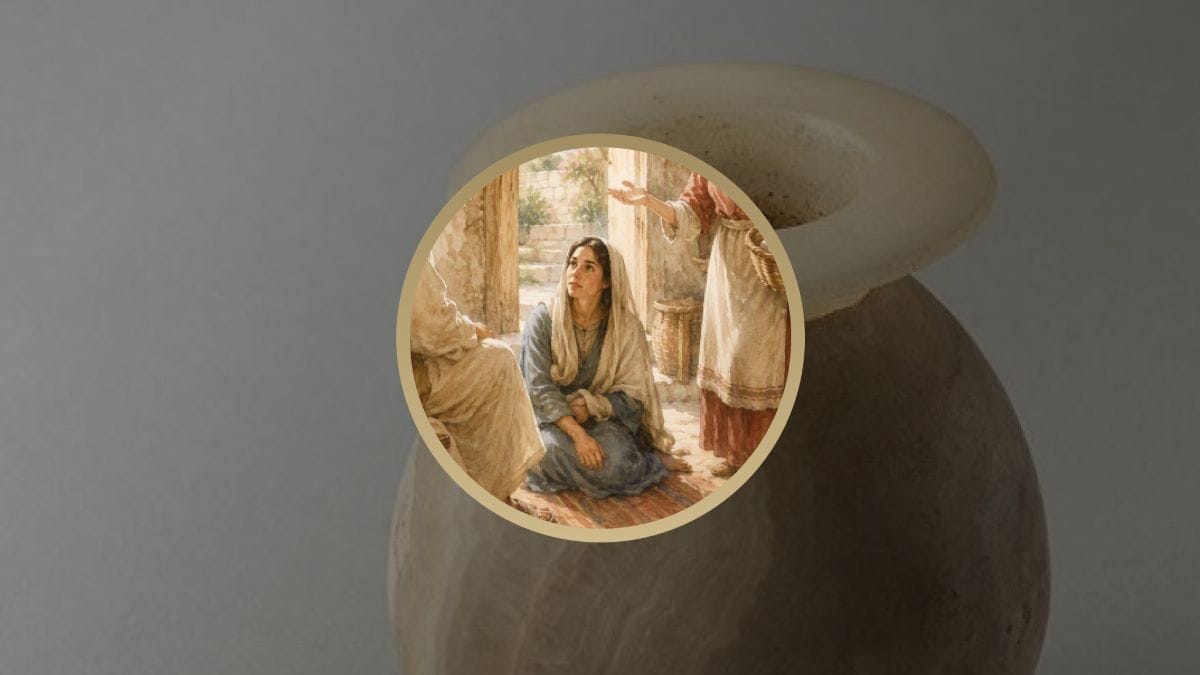
Martha’s sister, Mary of Bethany, illustrated that greatest commandment Jesus discussed earlier in the passage. In the midst of all the hustle and bustle of hospitality—preparing the meal, greeting the other guests, and other hostessing activities—she took the time to sit at the feet of Jesus. In fact, of the three times that Mary of Bethany is mentioned in the Gospel record, all three times she is at the feet of Jesus!
According to John 11, Jesus was again in the home of Mary and Martha, but under very different circumstances. The event, the death of Lazarus, took place almost a year after the events recorded in Luke 10. In the midst of their brother’s suffering and death, Mary and Martha had surely matured since the time they had seen Jesus previously.
“Now a certain man was sick, named Lazarus, of Bethany, the town of Mary and her sister Martha. (It was that Mary which anointed the Lord with ointment, and wiped his feet with her hair, whose brother Lazarus was sick.)” (John 11:1–2). This washing of Christ’s feet had not occurred yet, but John mentioned it to identify which Mary this was.
As soon as Lazarus fell sick, Martha and Mary did what was very proper: they summoned the Master. “Therefore his sisters sent unto him, saying, Lord, behold, he whom thou lovest is sick. When Jesus heard that, he said, This sickness is not unto death, but for the glory of God, that the Son of God might be glorified thereby” (John 11:3–4).
In verses 5 and 6, the close relationship between this family and the Lord Jesus is described. “Now Jesus loved Martha, and her sister, and Lazarus. When he had heard therefore that he was sick, he abode two days still in the same place where he was.”
Notice the important word in John 11:6—therefore. Jesus tarried two days because He loved them. The agonizing, fatal delay was a mark of His love! And so it is for you. When God delays, you should not question. He delays not merely in spite of the fact that He loves you. He delays because He loves you! And He desires that you love and trust Him more!
When Jesus finally arrived in Bethany, four days after the death of His friend, Mary and Martha both greeted Him with the same words. “Then Martha, as soon as she heard that Jesus was coming, went and met him: but Mary sat still in the house. Then said Martha unto Jesus, Lord, if thou hadst been here, my brother had not died” (John 11:21). Later, when Mary would come to Jesus, she also would greet Him with the same words: “ she fell down at his feet, saying unto him, Lord, if thou hadst been here, my brother had not died” (John 11:32).
Martha first met Jesus as He neared. After conversing with Jesus for a few moments on the nature of faith and the resurrection, she left to summon her sister, Mary. “And when she had so said, she went her way, and called Mary her sister secretly, saying, The Master is come, and calleth for thee. As soon as she heard that, she arose quickly, and came unto him. Now Jesus was not yet come into the town, but was in that place where Martha met him” (John 11:28–30). Jesus stayed in His place, on the road, waiting for Mary to arrive.
“The Jews then which were with her in the house, and comforted her, when they saw Mary, that she rose up hastily and went out, followed her, saying, She goeth unto the grave to weep there. Then when Mary was come where Jesus was, and saw him, she fell down at his feet, saying unto him, Lord, if thou hadst been here, my brother had not died” (John 11:31–32).
Previously, when Jesus was in their home, she was sitting quietly at the feet of Jesus, soaking in His teaching. Now, her eyes suffused with tears, she fell again at the place she loved to be—at the feet of Jesus, her Master.
Coming to the tomb of His friend, Jesus, the Lord of Life, astonished everyone, including Mary and Martha, when He directed that the stone be rolled away from the tomb’s opening! According to John 11:43, Jesus called out, “Lazarus, come forth.” Mary and Martha were amazed to see their brother come walking out of the tomb! Their faith was strengthened and deepened, just as Christ desires for all of those that He loves.
This family is mentioned one more time in the Gospel record. It is in the very next chapter, John 12. Once again, Mary was at the feet of Jesus, expressing her loving trust in her Messiah and Redeemer. “Then Jesus six days before the passover came to Bethany, where Lazarus was, which had been dead, whom he raised from the dead” (John 12:1).
As always, Jesus found a quiet refuge in Bethany. It is believed that even during the last week, Jesus went back every evening (except His final evening in Gethsemane) to stay in the home of Martha, Mary, and Lazarus. “There they made him a supper; and Martha served: but Lazarus was one of them that sat at the table with him. Then took Mary a pound of ointment of spikenard, very costly, and anointed the feet of Jesus, and wiped his feet with her hair: and the house was filled with the odour of the ointment” (John 12:2–3).
This was a separate event from the anointing that took place a few years earlier in Galilee, as recorded in Luke 7:36–38. This ointment of spikenard was, as John himself testified, very expensive. It was a precious, viscous liquid, flowing somewhat like honey, and it was extracted from the gum of an aromatic flowering plant root. The ointment would have been the treasure of a lifetime, but such was Mary of Bethany’s love for her Lord that she willingly broke open the alabaster box, according to Mark 14:3, and poured it on Jesus’ feet.
Mary’s action was quickly criticized by Judas Iscariot, but Jesus defended Mary with these words: “Let her alone: against the day of my burying hath she kept this. For the poor always ye have with you; but me ye have not always” (John 12:7–8). Mark, in his parallel account, added this commendation by Christ: “She hath done what she could: she is come aforehand to anoint my body to the burying. Verily I say unto you, Wheresoever this gospel shall be preached throughout the whole world, this also that she hath done shall be spoken of for a memorial of her” (Mark 14:8–9).
Here we are today, two thousand years after Mary’s act of loving devotion. While Judas Iscariot is held in contempt, this act of piety performed by Mary of Bethany is still remembered as a sacrificial gift of love to the Master.
With this commendation, Mary of Bethany fades quietly from the record of the New Testament. She is not mentioned specifically by name in the events around the crucifixion or the resurrection, although the ascension took place very near their home in Bethany. This family of three possibly witnessed the risen Lord ascending from earth to His Father’s throne. The life example of Mary of Bethany reminds us that the best place to be in the world is sitting, loving, and worshipping at the feet of Jesus.

 31:24
31:24