

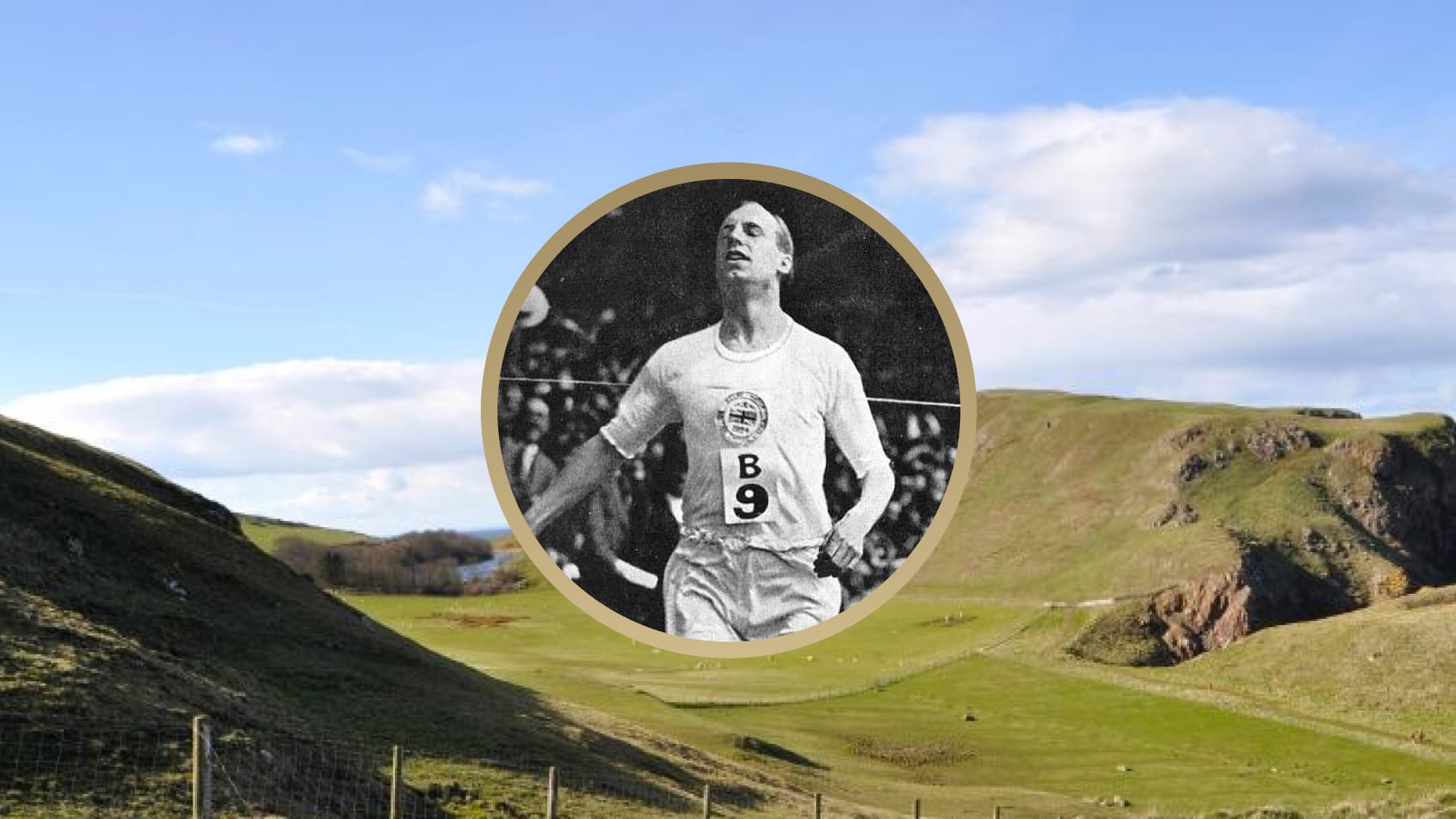
There are times in the life of every Christian man and woman when a decision must be made, a difficult one, and the choices are between honoring the Law of the Lord, or honoring one’s own desires, or gaining the praise of the world. For some, this decision is made quietly and in secret. For others, the decision must be made in the full glare of public limelight. At the 1924 Olympic Games in Paris, an athlete named Eric Liddell was forced to make his decision before a watching world.
Even by his rivals, Eric Liddell was widely seen as the clear winner for the gold medal at the 1924 Olympic Games in Paris. Great Britain had not won a gold in the 100-meter dash since the Olympic Games had been revived in 1896. Expectations were high for Liddell, the Scotsman who was a member of the British Olympic team! In spite of his awkward running style of pumping his knees almost up to his chest and gazing into the sky as he neared the tape, Eric Liddell had won race after race, setting record after record. But the qualifying heats were to be held on the Lord’s Day. After a brief inward struggle, Liddell made his decision and refused to run.
Friends condescendingly pointed out to him that the qualifying heats were in the afternoon. Thus, Liddell could attend church in the morning and then run in the afternoon. But the question was settled in Eric Liddell’s mind. The Bible that he loved said, “Remember the sabbath day, to keep it holy.”
Because of his decision not to run on Sunday, it was decided that Liddell would be entered into a different race. Instead of the shorter 100-meter race in which he was expected to win and had its trial heat on Sunday afternoon, Liddell was entered in the 200-meter run, as well as the 400-meter run whose heats were on other days. However, Eric Liddell was considered a poor contestant for these longer races. Yet, on the day that the 200-meter run was held at the Olympics in Paris, Liddell came in third after two Americans to take the bronze medal. Eric Liddell and his bold stand to honor God’s Law was all but forgotten.
As the day of the 400-meter run approached, Liddell barely managed to qualify. A Swiss runner named Josef Imbach was favored to win. In the qualifying heats, Imbach had set a new world record at 48.0 seconds! Another British runner, Guy Butler, was considered a solid contender for the gold. A celebrated American named Horatio Fitch was also expected to do well. Eric Liddell was considered too much of a sprinter for the longer 400-meter. Thus, the other runners took little notice of him.
As Liddell was leaving his hotel on the morning of the 400-meter race, his masseur handed him a slip of paper. On the paper was a simple note: “In the old book it says, ‘He that honors me I will honor.’ Wishing you the best of success always.”
Few noticed when Eric Liddell took his runner’s place in the outside lane, the worst spot in the lineup. At the crack of the pistol, Liddell was off! He sprinted forward into a three-meter lead right away. People who understood running smiled. His move was that of a typical sprinter! They were sure Liddell could not keep it up. But he did! Onward the famous sprinter ran, never letting up. One of the Americans, Fitch, passed Guy Butler, the British favorite, and inched toward Eric Liddell for a few seconds. But the “Flying Scotsman” ran even faster and increased his lead! His arms windmilled wildly in the air. His legs pumped up and down. His chin jutted forward toward the tape!
From the midst of the astonished crowd, a host of Union Jacks emerged from the laps of waiting fans to urge the Scot to victory. Alone on the outside and five meters ahead of the nearest runner, Eric Liddell sprinted to the tape to a wild shout of admiration from the onlookers. As the flag of his country rose, the announcer called out that Eric Liddell of Scotland had just set a new 400-meter world record of 47.6 seconds! The story of Eric Liddell’s victory in Paris has been told many times, in many different ways, with varying degrees of accuracy.
The story that is told much less often is the story of Eric Liddell’s subsequent victories. After his Olympic win, the Olympic athlete spoke all over Scotland at various evangelistic meetings. Crowds flocked to hear the humble man who was bashful about his trophies but bold about his Savior. At his graduation from the University of Edinburgh, he was given a laurel crown and pulled through the streets of Edinburgh by his classmates in a carriage, minus a horse!
Eric Liddell astonished everyone when he announced that he was leaving his fame behind to follow his father’s footsteps into missions. He chose to go as a missionary to China, the land of his birthplace. This decision proved that his commitment to honoring God’s Word above all other considerations was not a temporary whim in 1924. For Eric Liddell, it was a way of life. He settled down to serve in the coastal Chinese city of Tianjin.
In China, Eric Liddell married Florence Mackenzie, the daughter of a Canadian missionary. “Flo,” as he called her, was ten years younger than himself. She was a wonderful wife, and the Lord blessed the couple with three daughters. The Japanese invasion threatened China by the time that the Liddells were expecting their third child. Eric Liddell sent his expectant wife and daughters back to safety in Canada. Meanwhile, he stayed to minister to the Chinese people that he had come to love, hoping to soon join his family later in Canada.
However, while serving in Tianjin, Eric Liddell was captured by the Japanese. He, along with other missionaries and foreign businessmen, was taken to an internment camp called Weihsien, in China’s Wei County. There, Liddell was a constant encouragement to his fellow prisoners. When about 300 European children from a missionary boarding school were brought to the camp, Eric Liddell kindly took special interest in them. The children trusted the gentle follower of Christ, sharing with him their childhood problems.
Some of the prisoners in the camp never knew that the “Eric” they lived with every day was the famous Eric Liddell who had won the gold medal in Paris. He never talked about himself. He always talked of his Lord and Master. He participated in the children’s games as their helper and referee. He always encouraged the children to remember the Sabbath Day to keep it holy.
As the war ground on, some of Eric Liddell’s closest friends gradually realized that something was wrong. His speech became slurred. He was subject to long, painful headaches. He became unsure of his step. The fastest man in the world was slowing down. Yet, Liddell always shrugged off his troubles in his service to others. A diagnosis was never made, but it is now believed that he probably had a brain tumor.
One day, while talking with a young girl about the will of the Lord, Liddell sank back with the word surrender on his lips. At that moment, Eric Liddell had finished his course and crossed the finish line into the eternal rest that is waiting for the people of God. He had surrendered his own will to the will of His Master.
Eric Liddell was buried in a quiet grave in China only a few weeks before the war ended. A band of fellow prisoners sang his favorite hymn, “Be Still My Soul.” His young wife and daughters took the sad news with a Christian’s hope, just as he would have wanted.
The nations of the world, seemingly calloused after the horrific years of World War II, still paused to shed a tear over the news that Eric Liddell was dead. But the Flying Scotsman had not died in vain. He had shown the world the value of honoring God’s Law. An unbeliever who had lived side by side with Eric Liddell as a prisoner in the camp perhaps gave the greatest tribute when he said of Liddell, “Jesus Christ lived in our camp.”


 22:09
22:09