

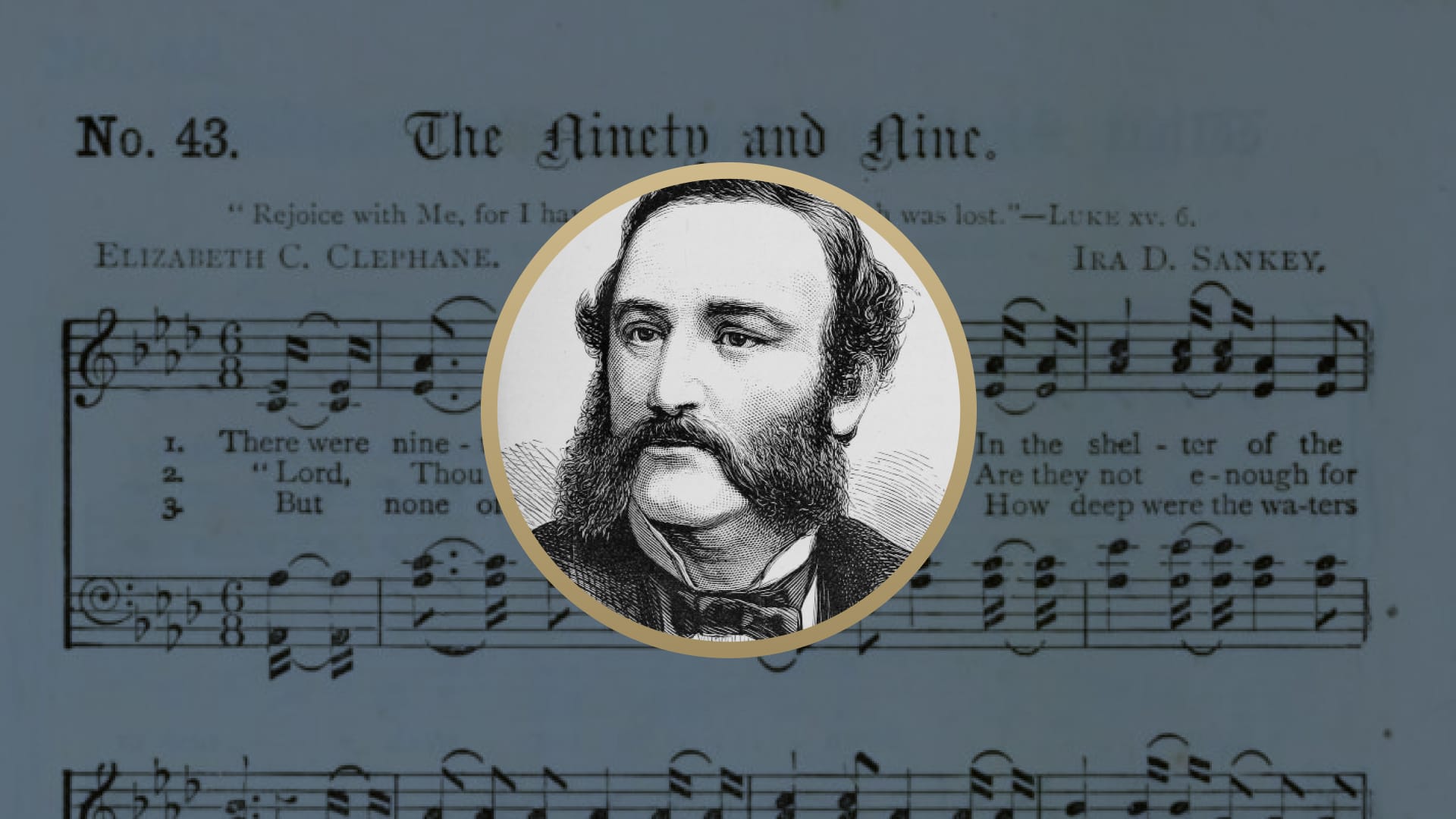
The year was 1874. The two men, evangelist D. L. Moody and his singing assistant Ira Sankey, were exhausted from a long campaign of preaching and singing in Glasgow, Scotland. They had been invited to come and conduct another series of meetings in Edinburgh. Now, as they boarded the train for Edinburgh, Ira Sankey picked up a weekly newspaper, hoping for a bit of news from America.
While perusing the paper in vain, he happened upon the printed lines of a poem by Scotswoman Elizabeth Clephane:
There were ninety and nine that safely lay
In the shelter of the fold
But one was out on the hills away,
Far off from the gates of gold—
Away on the mountains wild and bare,
Away from the tender Shepherd’s care.
Thrilled by the poetic description of the shepherd looking for the lost sheep, Sankey read aloud the poem to his travel companion. Moody, however, was absorbed in a letter from Chicago and did not even look up. So for safekeeping, Sankey cut out the heart-stirring poem and slipped it into his scrapbook.
After arriving in Edinburgh, Dwight L. Moody preached on the thrilling theme of “The Good Shepherd.” He invited the famous Scottish pastor, Dr. Horatius Bonar, to say a few words on the theme. At the end of this address, Moody turned to Sankey and asked, “Have you a solo appropriate for the subject, with which to close the service?”
Sankey hesitated. He could sing the Twenty-Third Psalm, but it had already been sung. Besides, in a room filled with Scots, they all would have spontaneously joined him in the well-known psalm!
Ira Sankey later related that he seemed to hear a voice say gently to him, “Sing the hymn you found on the train.” But that was impossible! The poem had no tune. In vain, he considered what to do next. Again, compelled by the quiet leading of the Holy Spirit, Sankey pulled out the newspaper clipping from his scrapbook and placed it on the organ.
Then, striking the key of Ab (A Flat), he began to sing. As Sankey sang, the tune simply “came” to him with power and increasing confidence. The listening Scots, who rarely heard a solo and had been taught that using an organ in the worship of God was an abomination, were moved to tears. The Holy Spirit was at work in many hearts as Ira Sankey sang the entire hymn, closing with the last stanza:
But all thru’ the mountains, thunder-riv’n,
And up from the rocky steep,
There rose such a cry to the gate of Heav’n,
“Rejoice, I have found my sheep!”
And the angels echoed around the throne,
“Rejoice, for the Lord brings back his own!”
D. L. Moody was himself deeply moved by the song. At the close of the meeting, he asked, “Sankey, where did you get that hymn? I never heard the like of it in my life.” Even Dr. Bonar, a Free Church minister who would not even use his own poems in his own church but followed the Scottish tradition of unaccompanied psalmody, remarked to Sankey, “Well, Mr. Sankey, you sang the Gospel tonight.”
Ira Sankey was born in Pennsylvania on August 28, 1840. From a very early age, he demonstrated a love of music. His parents often sang hymns with their large family in the evenings. Ira’s father was a farmer who also served in the state legislature of Pennsylvania.
When he was sixteen, Sankey attended some revival meetings at a local church 3 miles from his home. It was at that time he was converted to Christ. His talents in music were recognized by those around him, and soon afterward he was asked to lead the church choir.
Upon the outbreak of the Civil War, Ira Sankey enlisted in the Union Army. During his days as a soldier, he formed a choir of the other soldiers who loved singing. His choir of soldiers often sang hymns in the camps as the Lord sent revival and awakening to the other soldiers who were in the midst of death and destruction.
When his enlistment was up, Sankey returned home. There he married Miss Fanny Edwards in 1863. The young lady had been a member in his local church choir.
Seven years later, in 1870, Ira Sankey first met D. L. Moody. The famous evangelist heard Sankey lead the congregation in the stirring hymn, “There Is a Fountain Filled with Blood.” He was so impressed by the young musician that he startled Sankey by exclaiming to him, “I have been looking for you for the last eight years!” After praying over Moody’s invitation, Sankey agreed to come to Chicago to assist the evangelist in his work. Thus began a partnership in ministry that would span oceans and reach thousands of hearts.
Only a year after their friendship began, a terrible event occurred. The city Chicago was devastated by the Great Chicago Fire in 1871. Over 15,000 buildings were destroyed in the conflagration, including Sankey’s lodging place. Hastily, he rowed out into Lake Michigan and from there watched the city burn to the ground. He was able to save only a few of his personal belongings.
Ira Sankey “sang the gospel” at meetings all over the English-speaking world. Although resistance was high in Scotland where unaccompanied psalms were the traditional norm, Sankey’s hymns gained the approval of many sincere believers, including the aforementioned Scottish minister Horatius Bonar. Sankey popularized new hymns by writers such as Fanny Crosby, Philip Bliss, Horatius Bonar, and many others. Accompanied by his handheld organ, he would sing several original compositions.
Personal favorites of Ira Sankey included “Hiding in Thee,” “There’ll Be No Dark Valley When Jesus Comes,” and the hymn for which he is perhaps most famous, “The Ninety and Nine.”
He first published his own collection of favorite hymns in 1873 under the title Sacred Songs and Solos. This collection was expanded and reprinted several times over the coming years. It eventually included twelve hundred pieces!
Sankey’s willingness to hear the voice of God and communicate God’s truth to hearts was a blessing to countless souls. Queen Victoria was personally encouraged by his music. Gipsy Smith was converted under his influence, and the man later became a British evangelist. C. T. Studd, as a young man, was personally inspired by Sankey’s message in song. The list could go on and on of souls touched by the man who, as Bonar had famously put it, could “sing the Gospel.”
As an elderly man, Ira Sankey had the privilege to tour Egypt and Israel in 1898. One memorable experience was his singing Psalm 121 at the top of the Tower of David overlooking the Old City of Jerusalem. Later, in 1906, he published his own musical memoirs, titled My Life and Sacred Songs. Two years later, on August 13, 1908, Ira D. Sankey heard the call of the Good Shepherd and was gathered safely into the Heavenly fold.
Sources and Further Reference:
Sankey, Ira D. My Life and Sacred Songs. London, UK: Morgan and Scott, 1906.

 27:22
27:22