

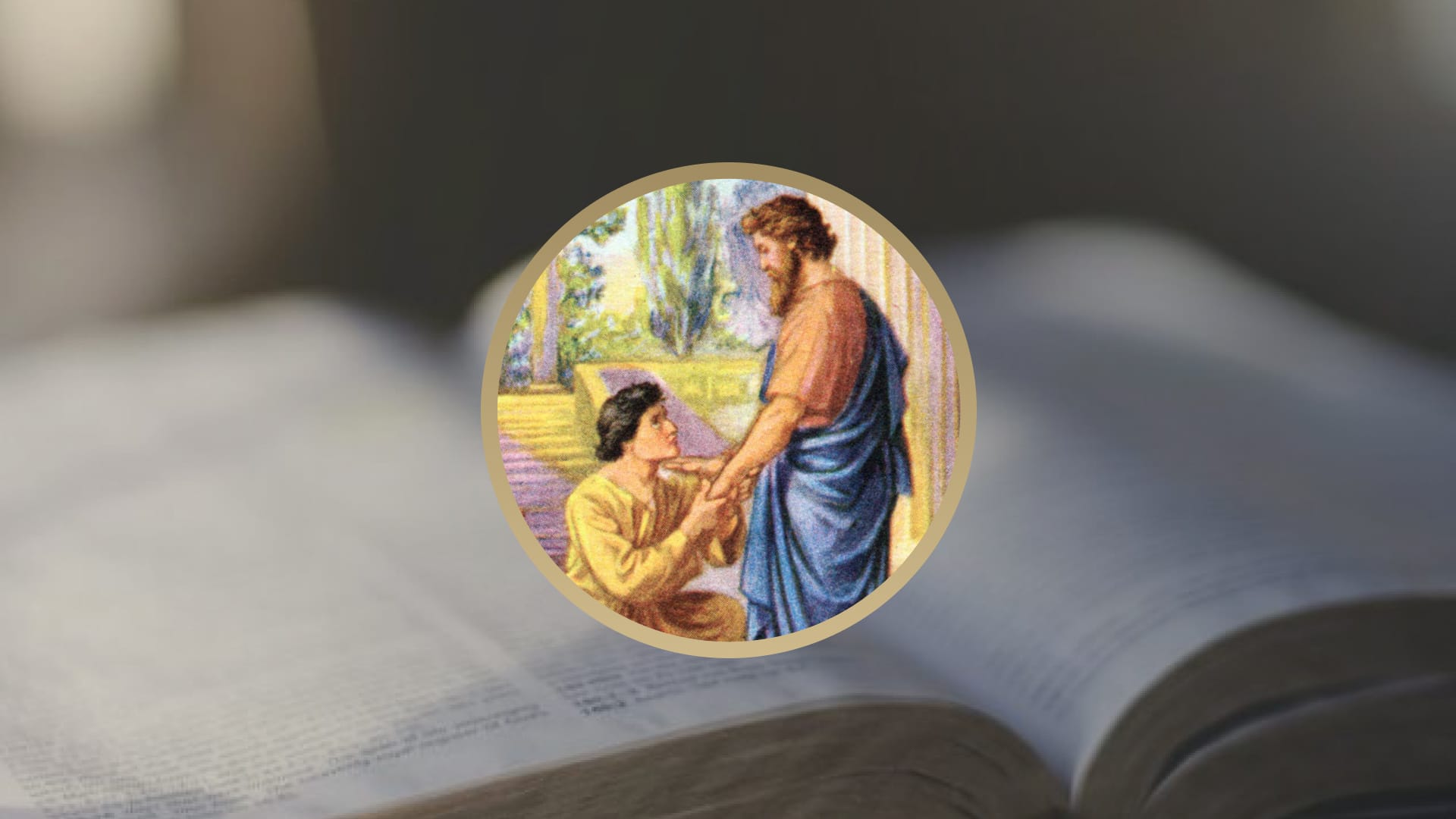
In the personal letter that the Apostle Paul wrote to another believer named Philemon, we have a window into the realities of the first-century world and an example of mediation, reconciliation, and forgiveness.
According to the Biblical account, Onesimus was a bondslave in the house of Philemon. Apparently, Onesimus had committed some wrong against his master and then had fled from his crime and his life of bondage. The Roman world was filled with slave catchers, men who were on the lookout for escaped slaves. Onesimus would have known the penalty for runaways. It was usually crucifixion.
Fearing capture, the fugitive slave appears to have fled all the way to Rome, over 1,000 miles away from his master! There in the capital of the Roman world, he was among the masses of humanity and probably hoped to blend in and hide. Thus, he would then try to forget his former life.
However, God is sovereign over the affairs of men. Who else “happened” to be in Rome at the same time as the fugitive Onesimus? The Apostle Paul was there too. Paul was under house arrest, dwelling in his own rented quarters and under the eye of Roman soldiers. Yet, he was relatively free to preach the Gospel, as Luke described it in the closing words of the Book of Acts, “no man forbidding him” (Acts 28:31).
While in Rome, Paul had recognized Onesimus, or Onesimus had recognized Paul, probably from their former acquaintance when Paul was in Asia Minor. We do not know which it was, but what we do know is that Onesimus had been changed by the power of the Gospel. As a result of their paths crossing again, the apostle sat down to write a letter to his friend Philemon, who was also Onesimus’s former master.
He began, “Paul, a prisoner of Jesus Christ, and Timothy our brother, unto Philemon our dearly beloved, and fellowlabourer” (Philemon 1). The term Paul used—“fellowlabourer”—meant that Philemon was actively involved in the Lord’s work. “And to our beloved Apphia, and Archippus our fellowsoldier, and to the church in thy house” (Philemon 2). Paul mentioned Philemon’s family. Most scholars take Apphia as Philemon’s wife and Archippus as Philemon’s son. This greeting indicates the warmth and depth of friendship between Paul and this Godly family in Colosse. As a wealthy landowner and slaveowner, Philemon would have owned a home that had ample room for guests, and probably Paul had visited and dwelt there in times past.
Paul continued his greeting. “Grace to you, and peace, from God our Father and the Lord Jesus Christ. I thank my God, making mention of thee always in my prayers, Hearing of thy love and faith, which thou hast toward the Lord Jesus, and toward all saints” (Philemon 3–5). The reports of Philemon’s love and faith had come all the way to Rome!
Next, Paul shared with Philemon the prayer that he often offered on his friend’s behalf. “That the communication of thy faith may become effectual by the acknowledging of every good thing which is in you in Christ Jesus. For we have great joy and consolation in thy love, because the bowels of the saints are refreshed by thee, brother” (Philemon 6–7).
Then, Paul tactfully and gently introduced the main topic of his letter. “Wherefore, though I might be much bold in Christ to enjoin thee that which is convenient, Yet for love’s sake I rather beseech thee, being such an one as Paul the aged, and now also a prisoner of Jesus Christ. I beseech thee for my son Onesimus, whom I have begotten in my bonds” (Philemon 8–10).
This news would have come as a great surprise to Philemon. How could Paul have come into contact with his rascally, rebellious slave?
Using a play on Onesimus’s Greek name, which meant “profitable,” Paul continued on the topic of the runaway slave, now redeemed in Christ. “Which in time past was to thee unprofitable, but now profitable to thee and to me: Whom I have sent again: thou therefore receive him, that is, mine own bowels: Whom I would have retained with me, that in thy stead he might have ministered unto me in the bonds of the gospel: But without thy mind would I do nothing; that thy benefit should not be as it were of necessity, but willingly” (Philemon 11–14).
With Paul’s letter in hand, Onesimus willingly had returned to Philemon. No shackles bound him. No one had put him in chains. Instead, Onesimus had returned because he valued a clear conscience. He wanted to make things right between him and his master. Likewise, Paul desired Philemon to receive the fugitive back and forgive him, not of necessity, but willingly.
In his epistle to Philemon, Paul also had suggested a long-range solution. “For perhaps he therefore departed for a season, that thou shouldest receive him for ever” (Philemon 15). Under Mosaic Law, a slave whose term of servitude was completed had the option of remaining with his master forever. The slave would permit the master to take him to a door or doorpost to “bore his ear through with an aul [awl]” (Exodus 21:5–6) as a visible sign that the slave was now bound to the master not by force, but by love.
However, Paul suggested a different alternative with Onesimus. Shackles were no longer needed to keep Onesimus in bondage. He was now bound by a far stronger cord, a cord Paul described in Philemon 16. “Not now as a servant, but above a servant, a brother beloved, specially to me, but how much more unto thee, both in the flesh, and in the Lord?”
Philemon was a master, and Onesimus was a slave. But they were brothers in the Lord. We see here how the Gospel affected social institutions. The slave and the master were still slave and master in their domestic relationship. But, as Paul described in his accompanying letter to the church at Colosse, now they were “one in Christ.”
“If thou count me therefore a partner, receive him as myself. If he hath wronged thee, or oweth thee ought, put that on mine account; I Paul have written it with mine own hand, I will repay it: albeit I do not say to thee how thou owest unto me even thine own self besides” (Philemon 17–19). Whatever crime Onesimus had committed, Paul was willing to make restitution on the fugitive’s behalf. But Paul reminded Philemon that he in large measure owed his very soul’s salvation to Paul’s ministry! What are a few pieces of silver in light of the eternal treasure that Paul had given Philemon and his family?
“Yea, brother, let me have joy of thee in the Lord: refresh my bowels in the Lord” (Philemon 20). The Greek word employed here as “have joy” is ὀναίμην (onaimen) and is a play on the name Onesimus (“profitable”). Paul earnestly desired that his ministry might bear joyful and “profitable” fruit in the forgiving spirit of Philemon toward his repentant returning slave.
“Having confidence in thy obedience I wrote unto thee, knowing that thou wilt also do more than I say” (Philemon 21). Paul used the perfect tense in his words “having confidence,” meaning “I stand convinced.” Paul was fully confident that Philemon not only would forgive Onesimus and welcome him as a brother, but that he might even one day give the slave his liberty to serve the Lord in other ways besides his duties as a bondslave.
Paul then closed his missive to his friend. “But withal prepare me also a lodging: for I trust that through your prayers I shall be given unto you. There salute thee Epaphras, my fellowprisoner in Christ Jesus; Marcus, Aristarchus, Demas, Lucas, my fellowlabourers. The grace of our Lord Jesus Christ be with your spirit. Amen” (Philemon 22–25).
The fact that this letter was preserved in the canon of Scripture is good evidence that Philemon kept and treasured this letter from Paul and heeded his words. Who has wronged you? Would you follow the noble example of Philemon and forgive your offender?
Three important blessings come when we forgive our offenders. First, there is a new relationship with the offender. Second, there is a new relationship with other Christians, just as Paul testified that he would be refreshed by the reconciliation of his two friends. Third, there is a new relationship with the Lord Himself. We value our own forgiveness more when we are willing, like Philemon, to forgive those who have wronged us.




 21:37
21:37