

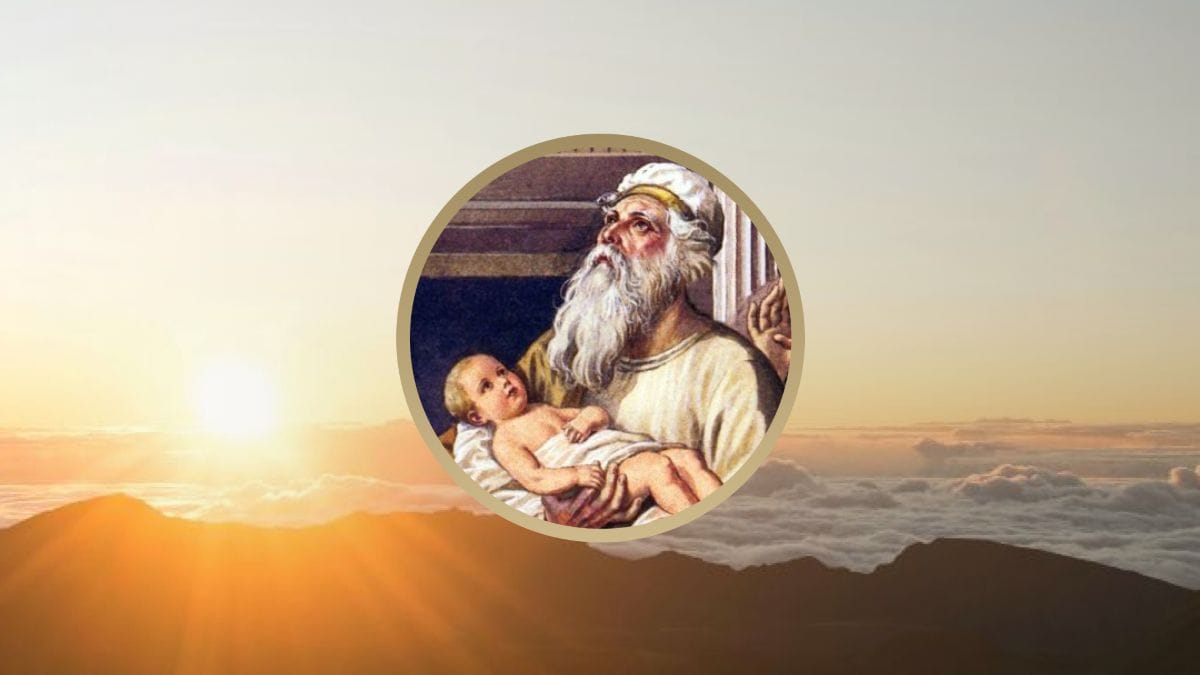
In Luke’s account of the birth of Christ Jesus, we are introduced to a humble, faithful man. He is mentioned in Luke 2:25, which begins the narrative of the time that Joseph and Mary came to the Temple in Jerusalem shortly after the birth of Jesus. There they presented the Child to the Lord.
According to Luke 2:25, “And, behold, there was a man in Jerusalem, whose name was Simeon; and the same man was just and devout, waiting for the consolation of Israel: and the Holy Ghost was upon him.”
Simeon was pronounced by God as “just and devout.” This is the very essence of genuine piety. Simeon was just towards men and devout towards God. Both of these character traits are essential to true and sincere Christianity. Each virtue needs the other.
What good is devotion toward God if it does not manifest itself in true justice and righteous living before the eyes of men? On the other hand, what good is justice toward men if it is not rooted in devotion toward God? Such outward righteousness would then be mere moralism. Simeon combined the two virtues into a beautiful, rare blend.
God uses men with these qualities. Such was Simeon. On that particular day, he was at his post of duty, awaiting the Consolation of Israel, a Messianic title based upon the comfort Isaiah had prophesied of the Messiah. This prophecy is recorded in Isaiah 40:1–3, “Comfort ye, comfort ye my people, saith your God. Speak ye comfortably to Jerusalem, and cry unto her, that her warfare is accomplished, that her iniquity is pardoned: for she hath received of the LORD’S hand double for all her sins. The voice of him that crieth in the wilderness, Prepare ye the way of the LORD, make straight in the desert a highway for our God.”
This day was the one for which Simeon had spent many long years awaiting. Babylon, Persia, Greece, and Rome had all left the imprint of their pagan heels upon the city of Jerusalem. Now Jerusalem lay without comfort, needing the Lord’s Messiah. Simeon, familiar with Isaiah’s prophecy and also familiar with the words of Daniel that hinted at the timetable for the Messiah’s coming, was waiting for that consolation or “comfort” that had been foretold.
“And it was revealed unto him by the Holy Ghost, that he should not see death, before he had seen the Lord’s Christ” (Luke 2:26). People looking at Simeon would probably have thought that his great career was finished, and his life’s work was done.
But Simeon’s most important work was yet in the future. The same may be true for you also! Many elderly people have the mistaken notion that their task on earth is done. According to the Bible, our task is not done, nor is it ever finished until the day of our departure to Glory or the day that Jesus splits the sky at His glorious return (see Isaiah 64:1).
We do not know the day when God will lay our greatest task, our greatest privilege, our greatest joy before our eyes. For Simeon, this day as recorded by Luke began as an ordinary day: “And he came by the Spirit into the temple: and when the parents brought in the child Jesus, to do for him after the custom of the law” (Luke 2:27).
Some have suggested that Simeon was one of the men whose duty was to circumcise eight-day-old baby boys, as prescribed in the Law of Moses, and to offer prayer over these young lives. If so, he probably had seen thousands of babies in his long life. He would have held many little boys in his arms. But as Joseph and Mary brought in their firstborn son, Simeon knew that this Baby was the Hope of his faith for which he had long awaited and had been promised that he would see before he died.
Perhaps it was as the elderly man looked into the eyes of the Creator of the universe that Simeon knew that this was the Promised One. This Child was the promised Consolation of Israel. This Baby was the Seed of the woman spoken of in the protoevangel of Genesis 3:15. This young One was Shiloh, spoken of by Jacob on his deathbed. This little Baby was the Seed of David, the Lion of the tribe of Judah, the Root out of dry ground, the Branch, the Suffering Servant, and the Desire of the Nations—promised by God and prophesied by prophets of old.
What a joyous moment for this aged servant of God! According to Luke 2:28–30, “Then took he him up in his arms, and blessed God, and said, Lord, now lettest thou thy servant depart in peace, according to thy word: For mine eyes have seen thy salvation.” Simeon used in Hebrew the very name conferred by the angel upon Jesus, Yeshua, the salvation of Jehovah. (See Matthew 1:20–21.)
Simeon continued his praise to God and acknowledgement of the blessed Gift in his arms: “Which thou hast prepared before the face of all people; A light to lighten the Gentiles, and the glory of thy people Israel” (Luke 2:31–32).
The phrase Simeon used, “Which thou hast prepared,” is a fascinating one. According to John 1:14, “the Word was made flesh, and dwelt among us.” Thus, Simeon very precisely declared that this tiny Babe had been prepared beforehand. The very Creator of the universe was clothed in flesh and blood. The One Who ordered the galaxies was wrapped in a body of clay.
In Psalm 40:7, a Messianic passage, the psalmist wrote of the Messiah saying, “Then said I, Lo, I come: in the volume of the book it is written of me.” The writer of Hebrews referred to the same psalm when he wrote, “Wherefore when he cometh into the world, he saith, Sacrifice and offering thou wouldest not, but a body hast thou prepared me” (Hebrews 10:5).
Simeon also announced that this Child was prepared “before the face of all people.” His declaration was made while he was standing in a very significant geographical location—the Temple mount. This hill in Jerusalem was named in ancient days Mount Moriah. Here, with steadfast faith, Simeon asserted that this Babe that he held in his arms was prepared of God before the face of all people. This Child would one day rule the world from sea to sea!
“A light to lighten the Gentiles” was Simeon’s next declaration about this special Baby. Because of Jesus Christ, Gentiles would be grafted into the vine, which was God’s chosen people. In the Messiah, Gentiles would inherit all the blessings of Israel. Truly, those who sat in darkness would now see a great light!
Concluding his prophecy, Simeon said, “And the glory of thy people Israel.” Christ is not only the light of the Gentiles, but He is the glory of Israel. He stands as the culmination of the Hebrew heritage—the Lion of the tribe of Judah, the Root and Offspring of David, Shiloh, and the Messiah. These all are Jewish titles, and this little Babe would fulfill them all.
Simeon’s prophetic praise was done. Recorded in Luke 2:33 is the reaction of Joseph and Mary to Simeon’s utterance. “And Joseph and his mother marvelled at those things which were spoken of him.”
Turning from the Babe, Simeon next addressed Mary, the mother of Jesus: “And Simeon blessed them, and said unto Mary his mother, Behold, this child is set for the fall and rising again of many in Israel; and for a sign which shall be spoken against” (Luke 2:34).
Simeon’s words, “the fall and rising again,” are extremely significant. In the 1700s, Edward Gibbon wrote a book titled The History of the Decline and Fall of the Roman Empire. The prophecy by Simeon about Christ is noteworthy in that it is backward from the history of all other empires and kingdoms. For example, Rome rose and then fell. But the Lord Jesus Christ and His people will fall, then rise again!
Rome, the mightiest empire that the world has ever known, now lies in the dust, and the Kingdom of Christ advances. Today, the pomp of Caesar, the arch of Titus, the palace of the Caesars, and the Roman Coliseum have long since crumbled into dust, leaving only a few fragmented stone pillars standing. Yet, Jesus Christ lives on, advancing, triumphant and majestic, sustaining His Church by His Own promise that the gates of hell would not prevail against His Church.
Simeon spoke another prophetic word, this time addressed to Mary: “(Yea, a sword shall pierce through thy own soul also,) that the thoughts of many hearts may be revealed” (Luke 2:35). In just a little over three decades from the time of Simeon’s prophecy to Mary, she would be standing on a piece of ground outside the city gate, near the Temple Mount. A cross would be lifted up from the ground, and Mary would be gazing up through teary eyes at the dying form of her Son. In that hour, she would experience the meaning of “a sword shall pierce through thy own soul also.”
After the prophecy of the fall and rising again of the triumphant Messiah, Simeon quietly faded from the pages of Scripture. He is a splendid example of a man who, in his generation when all things looked bleak, lived with a faith-filled, hopeful eye to the future. Just as Simeon waited for the first coming of Christ, so we await Christ’s coming again. When He comes in His glory to rapture His Church, may Christ find us as He found Simeon—just and devout—and we also faithfully be about His business with the Holy Spirit upon us!
 23:24