
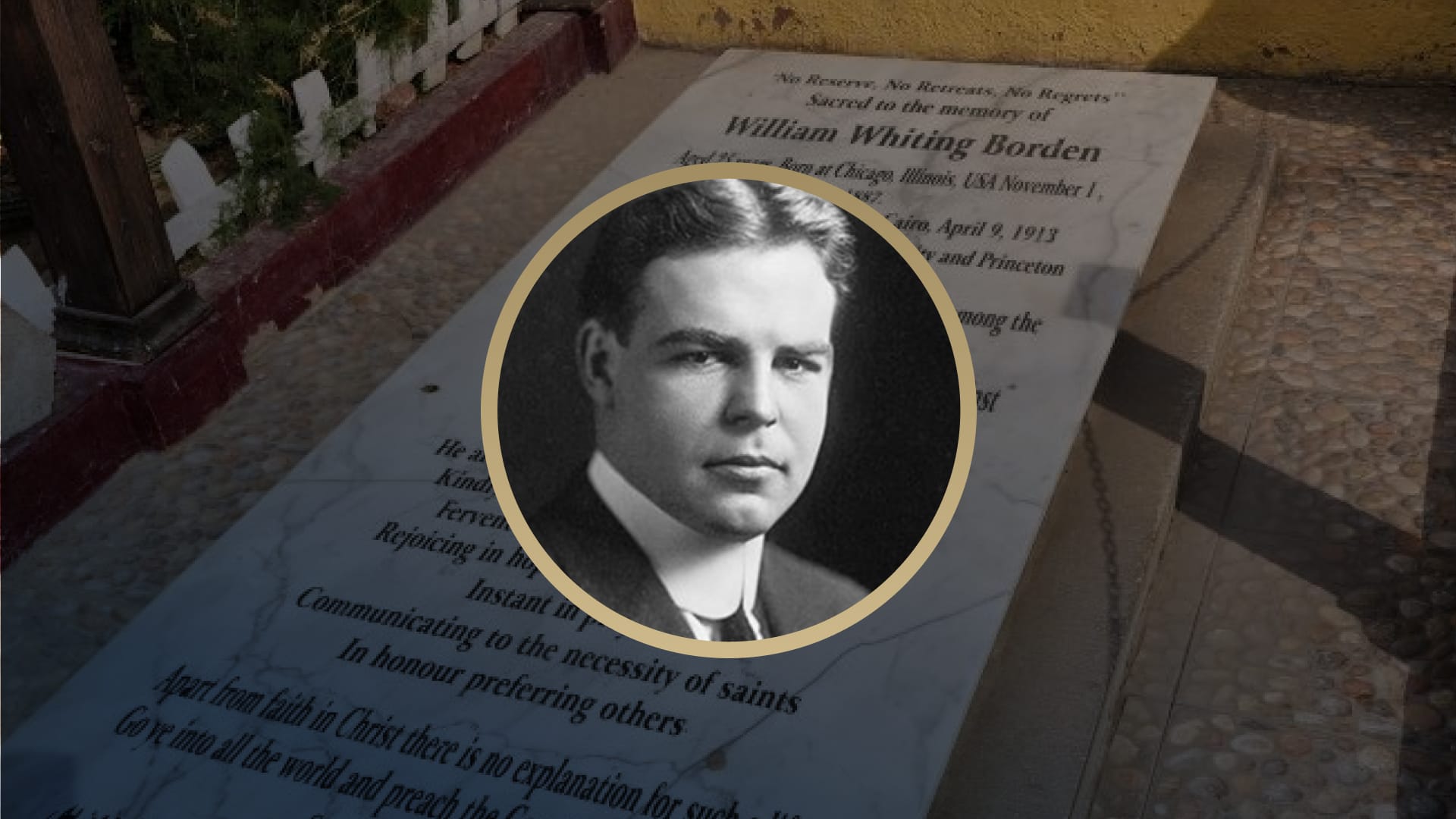
The sixteen-year-old boy stood in amazement as he beheld a large temple in Kyoto, Japan. It was acclaimed to be the “temple of 33,333 gods.” Row upon row were carved wooden images, brightly gilded and set in niches in the walls. He had never seen anything like it before.
Young William Borden was the son of a wealthy businessman. He had graduated with high honors from a prestigious high school in Chicago, Illinois. Before he advanced to Yale University, his parents gave him the opportunity to take a trip around the world, from California westward to Japan, China, India, Egypt, Palestine, through Europe and the British Isles, and back to the eastern seaboard of the United States.
William Borden was already a devoted Christian by the age of sixteen. He was a descendant of William Bradford the Pilgrim, had a Christian heritage, and attended Moody Church where Dr. R. A. Torrey was pastor. Under Torrey’s faithful ministry and under the Godly influence of his own mother, Borden had early trusted Christ as Savior, and he was seeking daily to follow Him as Lord. The young man’s favorite hymn was “O Love That Will Not Let Me Go.”
The trip around the world opened his youthful eyes to the realities of heathenism. He saw the ornate garden temples of Japan. He witnessed the blind subjection of the devotees of Buddhism in China. He stood at the banks of the Ganges River in India and watched as countless numbers of men, women, and children sought ritual cleansing in the filthy waters. He viewed human bodies burned as an offering to the gods. He observed men and women spreading the dung of the “sacred cow” on their faces. These images stamped a lasting impression upon his mind and heart.
Traveling through the Middle East, Borden witnessed the grip of Islam upon the hearts of millions of captive souls. Swearing monotheism, they affirmed indeed the truth of one god—but it was the wrong one! He saw that superstition and blind fear kept the nations in the grip of darkness.
William Borden returned to the United States with a desire to give his life as a missionary of the Gospel. As a student at Yale, Borden was respected by all as a young man with a fixed purpose in life. He refused to join one of the secret college fraternities, affirming that his allegiance was due to God and God alone. He started a prayer group among a few friends who met together before breakfast for Scripture reading and prayer. By the time Borden graduated from Yale, the group numbered more than 1,000 students!
The diligent college student studied hard, played hard, prayed hard, and prospered in all that he did. He was a brilliant scholar, a generous friend, and a faithful witness of the Gospel. He also enjoyed fishing and mountain climbing, and he participated in manly sports, such as wrestling. With all his activities, he was faithful to always carefully keep Christ at the center of his life. On weekends, when many Yale students were partying with friends, Borden could be found with his arm around the shoulder of a city drunk, pointing out the way of salvation.
Few knew that William Borden was a millionaire. When Borden was eighteen years old, his father died suddenly, and William Borden became the manager of a large portion of the family wealth. He dressed nicely but simply. When a friend who knew of Borden’s millions once asked him why he did not buy himself a car, he answered succinctly and sincerely, “I cannot afford it.” When asked about money, he would often smile and say that his family was wrongly identified with the successful Borden condensed milk company. This answer was entirely true, for his family was not the dairy Bordens. His family had acquired their millions in other ways.
William Borden quietly wrote checks to Bible societies and mission works that amounted to thousands of dollars. His gifts were always in secret, for he was laying up treasure in Heaven, not on earth.
William Borden fixed his eyes upon a particular people group in western China—the Kansu people. Centuries earlier, the Kansu had been converted to Islam. They remained in spiritual darkness with no Christian witness. Numbering in the millions, they were an unreached people group in China. To go to the Kansu, Borden knew he must learn Arabic as well as Chinese, but the challenging language, obscure location, and their conversion to Islam did not daunt him.
He graduated from Yale in 1909, and he turned down prestigious opportunities to become famous and wealthier. Instead, Borden entered Princeton Seminary. There, in addition to seminary courses, he began an intensive study of Arabic to prepare himself to reach the Muslims of China. Many who knew him feared that he was “throwing away his life” by going to the other side of the world, but William Borden had no regrets about his chosen course. He had seen the hopelessness and darkness of heathenism, and he had resolved to shine the light of the Gospel in a remote corner of the globe where there was not even one candle of Gospel witness burning.
After his graduation from Princeton Seminary in 1912, Borden said goodbye to friends and family and boarded a ship for Europe. After spending a few weeks in Europe, he moved on to Cairo, where he intended to immerse himself in the Arabic language before traveling onward to China.
Less than a year later, in March 1913, William Borden contracted spinal meningitis, a life-threatening inflammation of the tissues around the brain and spinal cord. After suffering many days with a high fever, Borden died in Egypt at the age of twenty-five. The news was flashed by cable around the world. Memorial services were held in Princeton and at Yale, and at Moody Church in Chicago. A few scorners called his life wasted, but those who knew William Borden best knew that a life lived for Christ is never lived in vain.
Before sailing for the East, William had executed a will. When the will was opened, it was found that he had bequeathed $250,000 to the China Inland Mission. He also left $100,000 to Moody Bible Institute and similar amounts to two other Christian ministries. He gave $50,000 to Princeton Theological Seminary and $25,000 each to the American Bible Society, the Chicago Tract Society, and to the African Inland Mission.
More than his money, William Borden had given his life for Christ, proving his willingness to lay up treasure in Heaven. Inspired by his example of wholehearted devotion to Christ, a generation of young men and women rose up to take his place on the foreign field, and the life and legacy of William Borden continues to bear fruit today.
Sources and Further Reference:
Taylor, Mrs. Howard. Borden of Yale ‘09. London: The China Inland Mission, 1926.


 21:37
21:37