
The unthinkable had happened. Englishmen were at war—with Englishmen! By the summer of 1644, the English Civil War was in full swing. Since the outbreak of hostilities five years earlier in 1639, Royalist forces that supported King Charles I had swept the battlefield of all the various “rebels” that dared to resist royal authority.
The roots of the conflict were varied and complicated, stretching back to the signing of the Magna Carta at Runnymede in 1215, and the attempts to combine elements of the British Isles, including the Picts, Scots, Angles, and Britons over the course of many centuries. By the early seventeenth century, the powers of the king and the English Parliament had reached a definite loggerhead over the question of how power should be balanced between the two.
In the early months of the war, the ragtag army of the Parliamentarians was defeated in every battle it fought. The common working Englishman was poorly armed, poorly equipped, and poorly led. He was no match at all compared to a professional soldier who was led by experienced officers.
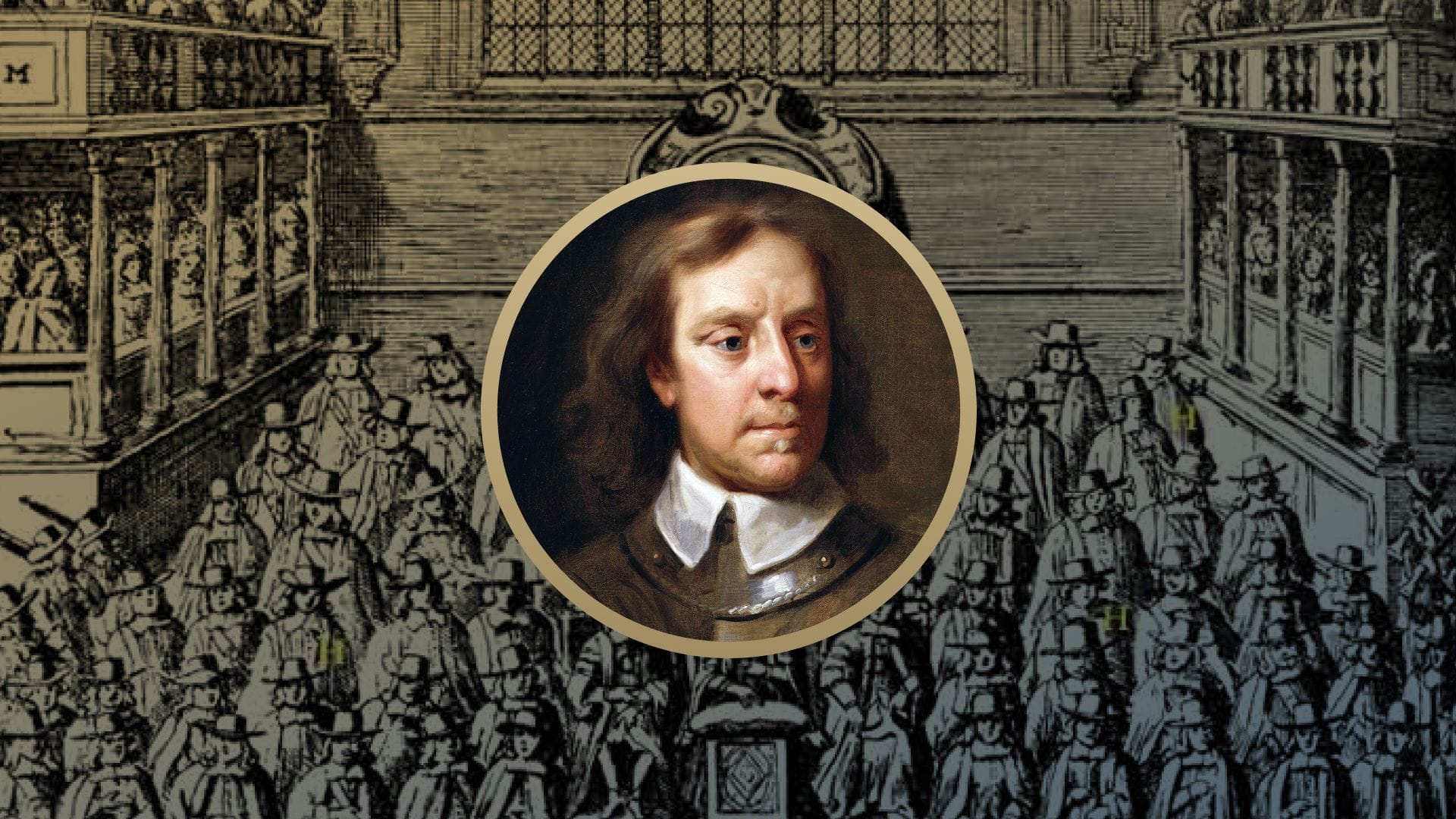
But a “New Model Army” was being built, slowly but surely. Forged in fire, the new model army was emerging from each disaster on the battlefield with new lessons. Their commander was a cavalry officer named Oliver Cromwell. By the summer of 1644 when the war was about to break out, Cromwell had molded his men into a troop of horsemen; these men were disciplined, determined, brave, and obedient. They were called the Ironsides, in praise of their discipline and courage. Old Ironsides became one of Cromwell’s many nicknames.
Once, when another officer criticized Cromwell’s men for their social status, or “low birth,” Cromwell replied, “If you choose godly honest men to be captains of horse, honest men will follow them . . . I would rather have a plain russet-coated captain who knows what he fights for and loves what he knows than that which you call a gentleman and is nothing else.”
At the Battle of Marston Moor in July 1644, Cromwell’s horsemen broke the ranks of the king’s cavalry and turned the tide of battle when they attacked the Royal infantry from the rear! This battle was a turning point in the war, and it secured the northern parts of England for the Parliamentarians.
A year later, in June 1645, Oliver Cromwell led his forces to an even greater victory on the field of Naseby. Cromwell, by this time, had risen to command an entire wing of the Parliamentarian army. His men, the New Model Army, shattered the Royalist forces under the flamboyant Prince Rupert. Cromwell’s men coined the phrase “Praise be for Naseby” to thank God for the dramatic victory.
One of the significant outcomes of the battle was the capture of the king’s personal baggage. The king’s baggage contained secret letters from Charles I to Roman Catholics in Ireland, soliciting an Irish Papist army to be raised and sent across the water to make war on Protestant England. This damning piece of evidence was one of the main reasons that the Parliament of England formally charged their king with high treason.
In a move that shocked all of Europe, the high court of England tried their own king for treason! The court indicted him as “a tyrant, traitor, murderer, and public enemy to the good people of this nation.” For his crimes against his own people, the judgment of the court was that Charles Stuart “shall be put to death by the severing of his head from his body.”
The king was executed on January 30, 1649. Parliament declared England to be a commonwealth. Various factions sought power, and England was plunged into more chaos and civil war for several years. Struggles in Ireland and Scotland, where a group of Royalists proclaimed the exiled son of the executed king, Charles II, as their sovereign, occupied years of bloody conflict. Finally, exhausted and frazzled by division, Parliament passed a new constitution known as the “Instrument of Government.”
Oliver Cromwell, the victorious general of the New Model Army, was asked to take the executive power of government under the title of “Lord Protector.” When he was sworn into office on December 16, 1653, he wore plain, black clothes with no regalia of power. He considered himself the servant of the people under God’s authority.
A simple man with an intense love for righteousness, Cromwell recognized fully that perfection was only found in King Jesus. He acknowledged himself to be a man of many flaws, calling himself humbly a “chief of sinners.” With a prominent wart on his chin and also on his forehead, he was considered ugly and plain. But he cared not for the opinions of man. He knew that he served a perfect Christ Who was King of kings and Lord of lords.
Oliver Cromwell’s roots were among the lower gentry. His landholdings were small, and he did not have a college education. He married Elizabeth Bourchier, the daughter of a leather merchant. Under the blessing of heaven, the couple had nine children. Cromwell had considered emigrating across the Atlantic to Connecticut, but God had other plans for him to serve the people of England. Oliver Cromwell never dreamed in his youth that he would one day be appointed as the chief magistrate of England, Scotland, and Ireland.
The man had many enemies, both at home and abroad. Some derided him as a religious fanatic. But Cromwell labored not to please man, but to please God.
During his five year protectorate, Cromwell did much for the people of God in England, as well as throughout Europe. He called together the body of divines known as the Westminster Assembly. He defended the Waldenses in the Piedmont, boldly threatening military action against those who persecuted his brothers and sisters in Christ. He promoted Puritan ministers and encouraged the printing of Godly literature. Cromwell also reformed the judicial system in accordance with God’s Word.
When offered the crown in 1657, Cromwell turned it down, saying, “I would not seek to set up that which Providence hath destroyed and laid in the dust.” Cromwell set a pattern for a constitutional republic where elected representatives exercised limited power under the law of the land. This pattern would be later followed, however imperfectly, in the British colonies that would later become the United States of America.
Oliver Cromwell, the Lord Protector, died of a urinary infection at age fifty-nine on September 3, 1658. On the night of his death, a great storm swept over the British Isles. Many said that Heaven itself was mourning the fall of a truly great man.
Among Cromwell’s dying words, which were uttered on his deathbed to his wife and children gathered around him, were these words of testimony: “The Lord hath filled me with as much assurance of His pardon, and His love, as my soul can hold . . . I think I am the poorest wretch that lives: but I love God; or rather am beloved of God . . . I am a conqueror, and more than a conqueror, through Christ that strengtheneth me!”
Sources and Further Reference:
D’Aubigné, J. H. Merle. The Protector: A Vindication of Oliver Cromwell. Harrisonburg, VA: Sprinkle Publications, 1997.