

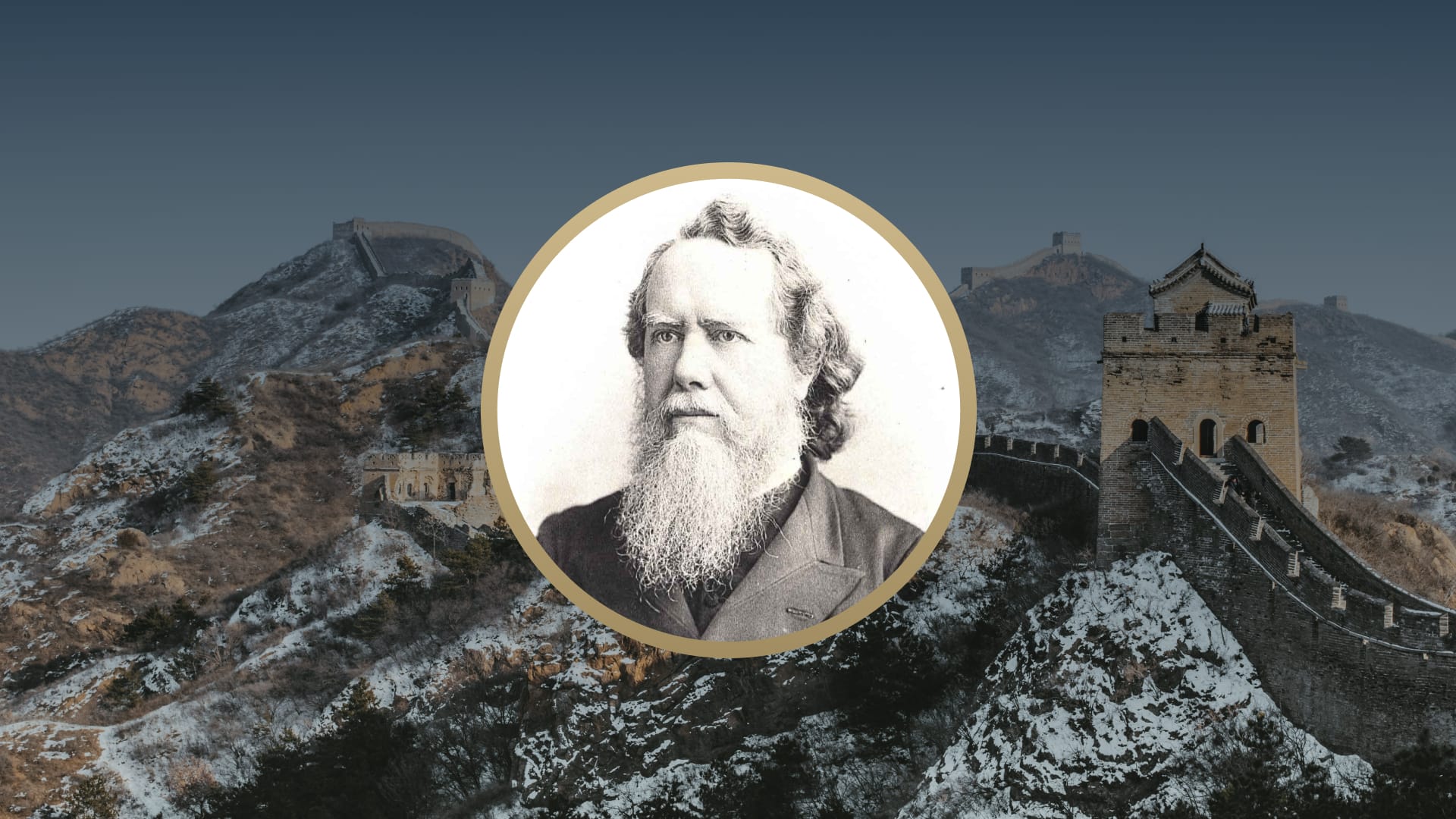
Hudson Taylor is a name that most Christians recognize. Many are aware of the fact that he is regarded as one of the most influential missionaries in the history of global evangelism. Over the course of half a century, the mission that he founded—China Inland Mission—has sent approximately 800 missionary workers into China. These pioneer missionaries preached the Gospel, established 125 schools, and planted thousands of churches over the vast interior of China.
However, few people are aware of the thrilling details of his adventurous life. Taylor personally lived in China for fifty-one years, individually translated the Bible into dialects yet unknown, and opened the eyes of the world to the immense needs and potential of the Chinese people. As he matured in his faith, he learned to rely less and less upon his own strength, and more and more upon the abiding presence and power of the Lord Jesus Christ. This abiding in Christ has been called Hudson Taylor’s “spiritual secret.”
James Hudson Taylor was born on May 21, 1832, in Yorkshire, among the rolling hills and valleys of northern England. His father was a chemist and also a lay preacher in the Methodist church. Hudson was a sickly child. His father often prayed that God would strengthen his weak son and make him a mighty man to accomplish great things for God’s Kingdom.
In his teens, Hudson Taylor experienced a period of wandering from the faith of his parents, doubting the truths of God’s Word. One day, when he was sixteen, he was alone at home. He began to peruse his father’s books. Unbeknownst to him, his mother, who was away from home on a visit with friends and family, felt a special burden to pray for her son. She quietly withdrew from the others and poured out her heart to God, pleading for the soul of her son.
Miles away, Hudson Taylor was poring through his father’s books. In one book, he was suddenly gripped with the power of the phrase, “the finished work of Christ.” The Holy Spirit revealed to Hudson’s heart the sufficiency of the atoning work of Jesus Christ. He later wrote of his conversion that day: “There was nothing in the world for me to do save to fall upon my knees and accept this Savior and His salvation to praise Him for evermore.”
When his mother returned home from her visit, Taylor ran out to welcome her and share his good news. Before he could say a word, however, his mother threw her arms around the neck of her son and said, “I know, my boy, I know.”
In the zeal of his new faith, Hudson Taylor consecrated himself to God and for a work of which he knew not. He later wrote of that decision, “I besought Him to give me some work to do for Him, as an outlet for love and gratitude; some self-denying service, no matter what it might be, however trying or however trivial; something with which He would be pleased, and that I might do for Him who had done so much for me.”
China was a vast, closed country when Hudson Taylor was a young man. Few Europeans had ever explored past the coastal cities. Under the influence of millennia of superstition and mystic religions such as Buddhism and Confucianism, the Chinese people viewed Westerners as “foreign devils” and were deeply suspicious of the motivations of Westerners.
With the blessing of his parents, Hudson Taylor gave himself to the task of taking the Gospel to China. He began studying medicine, along with Hebrew, Greek, and Chinese. In his free time, he worked among the poor people in the London slums. He denied himself luxuries so he could give money to the destitute. An early romantic attachment to a music teacher ended in disappointment when her family objected to sending their daughter to China.
Undaunted, Taylor resolved to go alone. In 1854, he arrived for the first time in Shanghai. After experiencing fruitless attempts to evangelize the Chinese with Western methods, he decided to relate to the people in a different manner. He shaved his forehead, grew a pigtail, and adopted the culture: Chinese dress, food, and customs. He immersed himself in the Chinese language until he could speak it as well as any native Chinese.
Eventually, frustrated with the bureaucracy of an English mission agency that sought to control and criticize his every move, he resigned from their support. As a result of breaking ties with the mission agency, he lost his personal income. Thus, Taylor launched out on his own as an independent missionary in the city of Ningbo in northeastern China. It was in Ningbo that his path crossed with that of Maria Dyer.
Maria was the orphaned daughter of Samuel Dyer, a faithful missionary who had labored long under the auspices of the London Missionary Society. The overseer at the girls’ school where Maria served called the zealous young Hudson Taylor a “poor unconnected nobody.” Notwithstanding the opinion of her overseer, Maria Dyer married that “nobody” who, by the grace of God, would become somebody under God’s abiding presence!
Hudson Taylor and Maria Dyer were married on January 20, 1858. Over twelve years of marriage, God blessed them with nine children. But under the strain of childhood diseases in a foreign land, only four children survived to adulthood.
Together, the couple launched the China Inland Mission while on a visit back to England in 1865. They put ten pounds of their own money into the new bank account and trusted God to grow it according to His will. They resolved that they would not solicit funds. Instead, they decided to rely upon God alone for provision as He laid the work upon the hearts of His people. They also determined that workers would be taken for the mission regardless of denominational attachment and that their missionaries would dress and eat in the same manner as the Chinese. Their focus would be entirely upon the inland provinces of China not yet touched by a Gospel witness.
Over the years, the Taylors endured many hardships. The death of their children brought deep sorrows. Civil war in China almost disrupted the work entirely. Furthermore, in the midst of the Taylors’ personal grief and endeavoring to minister in a war-torn country, their friends turned against them. Suspicious and critical fellow missionaries told the Taylors that it was inappropriate to bring young, single women to the mission field. On top of that, other European missionaries rebuked them for their adopting Chinese dress and habits. Yet, the Gospel work continued, in spite of all opposition.
In July 1870, Hudson Taylor suffered the deepest blow of all—the loss of his beloved wife, Maria. Yet he pressed on in his work. Broken in health, worn down by sorrows, and surrounded by critics, he labored on for Christ.
Stripped of his own strength, he found strength in the abiding presence of Christ. This growth in dependence upon the living presence of Christ has been called Hudson Taylor’s Spiritual Secret, the title of a book written by his daughter-in-law. But it was not really a secret at all. Hudson Taylor was merely living as every Christian should live—in obedience to our Lord’s command: “Abide in Me.”
Taylor later married Jennie Faulding; the couple was blessed with four children, two of whom survived to adulthood. Increasingly, day by day and moment by moment, Taylor relied on Christ’s abiding presence and power. He testified, “I used to ask God to help me. Then I asked if I might help Him. I ended up asking Him to do His work through me.”
In accordance with our Lord’s promise to provide eternal fruit to those who abide in Him, God gave a mighty increase. Hundreds upon hundreds of missionaries set out to follow in Taylor’s footsteps. The Chinese Bible that Taylor had translated was printed and distributed in thousands of cities and villages in remote areas of inland China. Native Chinese pastors began to experience God’s call to preach and to live out their teacher’s “secret” in their own daily lives.
J. Hudson Taylor died in China on June 3, 1905. He was buried next to his first wife, Maria, on the banks of the Yangtze River. The tomb is now obscured by industrial buildings in the city of Zhenjiang, but the marker has been restored appropriately on the grounds of a Chinese church. The marker notes not his great accomplishments or grand success, but simply testifies on behalf of the grateful people of China that the founder of the China Inland Mission was “A MAN IN CHRIST.”
Sources and Further Reference:
Taylor, Dr. and Mrs. Howard. Hudson Taylor: In Early Years—The Growth of a Soul. Littleton, CO: OMF International, 1988.
Taylor, J. Hudson. To China with Love. Minneapolis, MN: Bethany House Publishers, 1972.

 22:09
22:09