

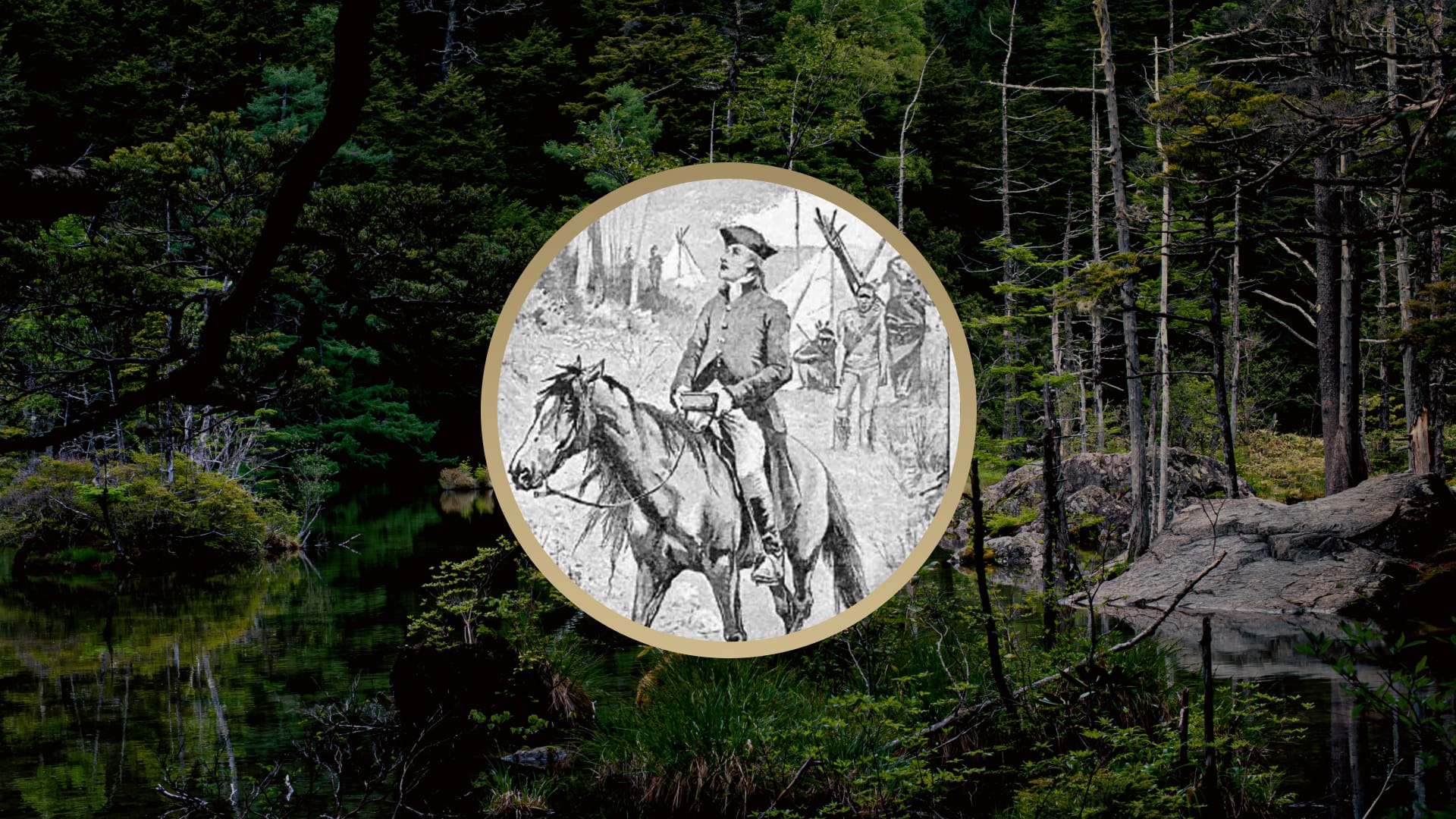
The young minister of the Gospel weighed his options. A large, influential church on Long Island had given him a gracious invitation to become their pastor. If he accepted the position, he would have a comfortable salary, an esteemed pulpit, a beautiful home, and a position of influence and notoriety that could place his name among the honored of the land.
But deep in his heart, the young man knew that God had called him to take the message of the Gospel to the Indian tribes of the western frontier. Such missionary work would take him far from friends and family. He would serve and labor in isolation. He would face misunderstanding and suspicion. He would eat whatever he could find. He would suffer from exposure and disease, far from medical help. He would endure cold winters, harsh conditions, drenching rain, and long hours in the saddle. But where Jesus led, David Brainerd would follow. After a brief struggle, the decision was made. David Brainerd would go west to the Indians.
Brainerd was born on April 20, 1718. His parents were Hezekiah and Dorothy Brainerd, and they lived in the community of Haddam, Connecticut. David Brainerd’s father was respected in the community and served in the colonial legislature. His father died when he was still a young boy, and later his mother also died. His parents were buried in the churchyard, leaving David Brainerd an orphan at the age of thirteen.
Brainerd was taken in by an older sister and her husband. He lived with them until he could launch out on his own. At nineteen years old, he inherited a small farm outside of the community of Durham. It was decided that he would enter Yale College to prepare himself for whatever the future might hold.
While preparing to enter Yale, the Lord gripped the heart of David Brainerd. One day in that summer of 1739, while “walking in a dark thick grove,” Brainerd recorded in his journal that “unspeakable glory” opened upon him. He testified, “I don’t mean any external brightness, for I saw no such thing, nor do I intend any imagination of a body of light or splendor somewhere away in the third heaven, or anything of that nature. But it was a new inward apprehension or view that I had of God; such as I never had before, nor anything that I had the least remembrance of it. I stood still and wondered and admired.”
David Brainerd said of this experience, “I felt myself in a new world.” He publicly confessed Christ Jesus as his Savior and devoted himself to the ministry of the Gospel. The experience of Brainerd was not isolated or new. Across the continent of North America and across the ocean in the British isles, the winds of revival were blowing. A man named George Whitefield was preaching to Welsh coal miners. Charles Wesley was writing stirring hymns, and his brother, John Wesley, was setting out on horseback to preach the Gospel in English towns and villages. Only two years after Brainerd’s conversion, Jonathan Edwards—an American revivalist preacher that the young man came to love and admire—would preach in Connecticut his famous sermon, “Sinners in the Hands of an Angry God.”
The cold formalism of the Congregational church had quenched the fervent piety of the early Puritan settlers. The heritage of the Godly Pilgrims had been forgotten. The “Halfway Covenant” allowed the children of unconverted parents to be baptized as “halfway” members of the church, allowing them to vote and hold office. Truly, the “salt” had lost its savor. Christianity was a cultural norm, but it was not a living reality.
But the “Great Awakening” changed all this. Men and women began to be concerned about the state of their souls. Even boys and girls were awakened to their need of personal faith in the atoning work of Jesus Christ. David Brainerd was at the heart of the glorious revival that was beginning to spread across New England.
At Yale, Brainerd was discouraged by the coldness of the faculty toward the revival. On one important occasion, he remarked that he regarded some of the local clergy on the faculty were not Godly men and were yet in an unconverted state! For his impudence, David Brainerd was expelled from Yale. He later was convicted by the Holy Spirit to come back and ask forgiveness for his imprudent speech against this professor.
Brainerd cared not for the applause of men. He wrote in his journal, “I cared not where or how I lived, or what hardships I went through, so I could but gain souls to Christ.” He set his face away from the established churches of the East and turned it toward the wilderness of the West. Tribes, such as the Mohicans of New York and the Delawares of Pennsylvania, were in need of the witness of the Good News.
In November 1742, David Brainerd was consecrated as a missionary. By this time, he had already contracted tuberculosis, a slow and debilitating disease that attacks the lungs. From time to time, Brainerd would be laid low by the illness. But whenever he recovered strength, he would go back to work. He had a very melancholy temperament, and he often wrote in his journal of discouragement, spiritual anguish, and darkness. He was introspective to a fault, but Christ always pulled him away from his own musings and back upon the path of obedience and victory.
An attractive offer came from the village of East Hampton on Long Island to occupy an empty pulpit. Minister and theologian Jonathan Edwards called the place “the fairest, pleasantest town on the whole island, and one of its largest and most wealthy parishes.”
But David Brainerd realized that many eager, young ministers would be happy to fill this empty pulpit. Few would go where God had called him to go—to the Indians of the American West. He wrote in his journal, “Here am I, send me; send me to the ends of the earth; send me to the rough, the savage lost of the wilderness; send me from all that is called comfort on earth; send me even to death itself, if it be but in your service, and to promote your kingdom.”
He plunged into the wilderness with the Bible in his hand and a burning desire in his heart to follow Christ Jesus. He recorded, “All my desire was the conversion of the heathen.” The blessing of God attended his efforts. His published journal records many trials, but also many victories: sermons preached, translations completed, Indian churches established, and heathen hearts transformed.
Gradually, tuberculosis worked its devastating ruin. Brainerd began consistently coughing up blood. He grew so weak that he could no longer sit up in the saddle. The twenty-nine-year-old Brainerd was carried to the home of his friend Jonathan Edwards, where he was tenderly nursed by Jerusha Edwards, one of Edwards’ daughters. She, in turn, contracted tuberculosis from her patient, and the two were united in death instead of in marriage, as might have been the case had they both lived.
Brainerd’s decision to follow Jesus bore abundant fruit beyond his brief life. Churches he founded continue to this day. His younger brother, John, carried on his work among the Delaware Indians. Dartmouth College was founded to train Indians for the ministry. Missionaries, such as William Carey, Adoniram Judson, Henry Martyn, and Jim Eliot, were among those influenced by the example of this faithful disciple who decided to follow Jesus, whatever the cost.
Sources and Further Reference:
Brainerd, David, and Oswald J. Smith. David Brainerd, the Man of Prayer. Grand Rapids, MI: Zondervan, 1941.
Brainerd, David, and Richard A. Hasler. Journey with David Brainerd: Forty Days or Forty Nights with David Brainerd. Downers Grove, IL: InterVarsity Press, 1975.
Edwards, Jonathan, and Norman Pettit. The Life of David Brainerd. New Haven, CT: Yale University Press, 1985.


 22:09
22:09