
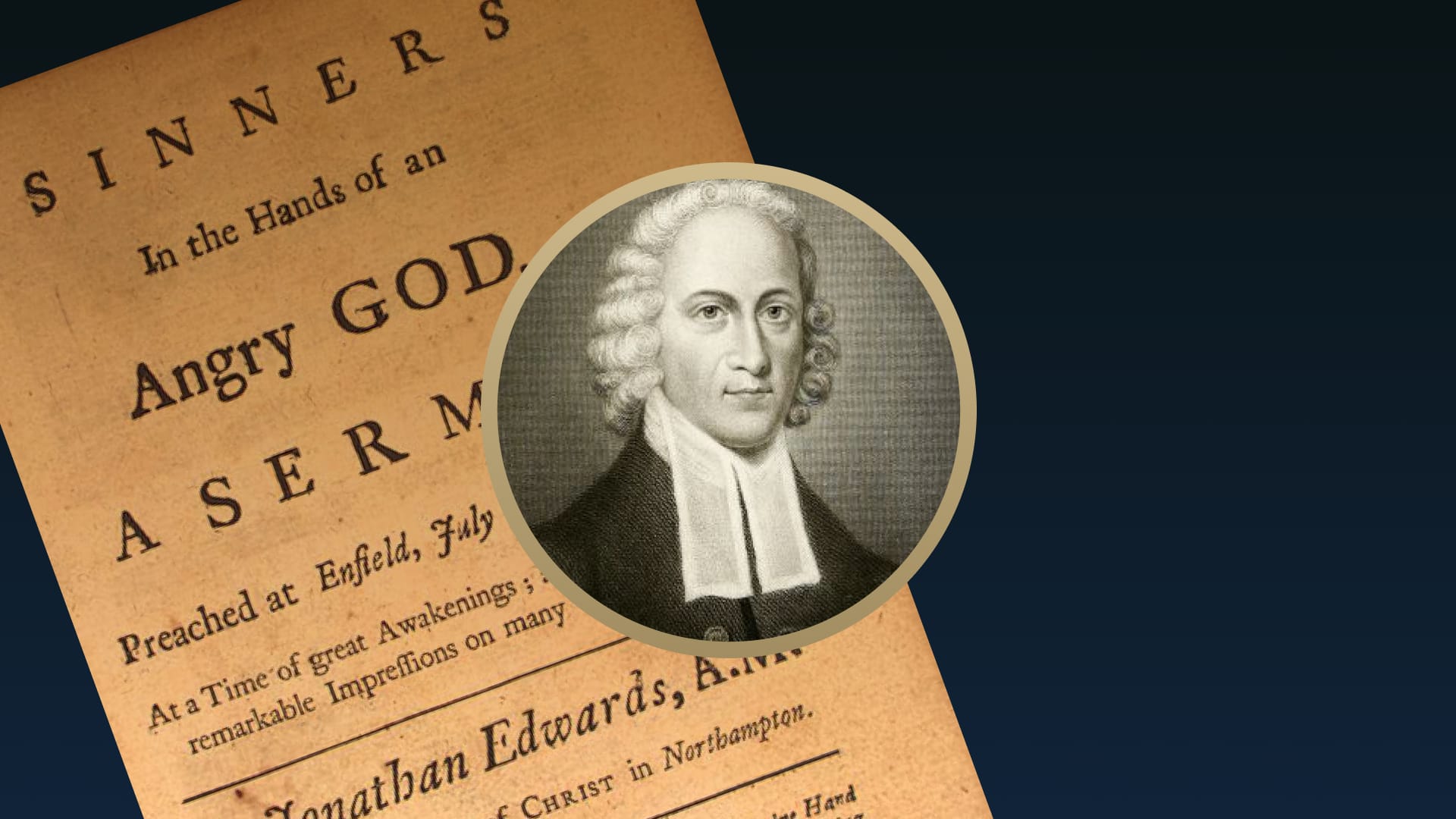
It was the Lord’s Day, July 8, 1741. A visiting minister from Northampton, Massachusetts, was to preach in the village church in Enfield, Connecticut. The minister was not particularly famous or popular, but he was known as an honest servant of the Lord who spoke the truth and relied upon the power of the Holy Spirit.
He had chosen as his text a portion of Deuteronomy 32:35, “their foot shall slide in due time.” He had previously preached this same sermon in his home church in Northampton. He had given it the austere title, “Sinners in the Hands of an Angry God.” When this particular sermon was first preached to the Massachusetts congregation, there had been no unusual effects.
As the preacher began preaching that July day in Enfield, Connecticut, there were no outward manifestations that this sermon would be different from any other previously preached message. The minister’s delivery was not dramatic or energetic. Instead, he had read slowly and distinctly from a handwritten manuscript. He described in the language of the Bible the everlasting fate that awaited the sinner, apart from the saving grace of the Lord Jesus. The minister viewed himself as God’s emissary and saw his duty as a simple one: to speak the truth.
As he preached, he drew upon vivid imagery to describe the helplessness of all human effort for any person to save himself. He affirmed from the Scripture that human righteousness, baptism, and church membership were all insufficient to save the sinner from everlasting damnation, and that all human effort could no more keep a soul out of hell than “a spider’s web would have to stop a falling rock.”
He described in Biblical terms the “bottomless gulf” that was the eternal fate of the wicked: the burning darkness, the torments, the unquenchable thirst, the terrible company of Satan and his hosts of demons, the agonies of opportunities lost, and the eternal horrors of a Christ rejected. Before the sermon was over, church members who had long trusted in the outward elements of sacraments and ceremonies were clinging to their pews with white knuckles, lest they fall headlong into the flames of a black, yawning hell!
An eyewitness described terrified men and women crying out in the midst of the sermon, “What must I do to be saved?” He went on to say how the sanctuary was pierced by “shrieks and cries” of those under heavy conviction. The minister descended from the pulpit. Now at eye level with the congregation, he described the mercy of God in Jesus Christ: that the Son of God had suffered the wrath of God for the sake of the lost sinner, and that Christ crucified was the only hope of salvation. Many souls that day repented of their sin and trusted in a risen Lord for their salvation!
Jonathan Edwards was the advocate of truth that God used on that memorable July day. His sermon became known around the country and was reprinted in newspapers throughout New England. The Great Awakening was a mighty work of the Spirit of God that swept through the American colonies from the 1730s to the 1760s, preparing people spiritually for the days of independence in the decades to come.
A man of God, Edwards relied upon the Spirit of God to enable him to perform the work of the Lord. He was born in East Windsor, Connecticut, on October 5, 1703. His parents were Timothy and Esther Stoddard Edwards. He was the only son among ten sisters! Both his father and his maternal grandfather, Solomon Stoddard, were respected ministers of the Gospel, and they poured their energies into preparing young Jonathan to take up the mantle of the Lord Jesus.
Jonathan Edwards was educated by his father and ready for college at the age of thirteen. He personally embraced the Lord Jesus as his Master in 1721, at the age of eighteen. A year later, he became a pastor, serving a church in New York. After serving in various positions in New England as a preacher and also for a period as a tutor at Yale University, Edwards eventually came to Northampton to assist in the ministry of his elderly grandfather, Solomon Stoddard. Upon his grandfather’s death, he became pastor of that Congregational church.
In 1727, Edwards married Sarah Pierrepont, a girl whom he had met eight years earlier, when he was sixteen years old, and she was only thirteen. Their long friendship and mutual attraction had blossomed into mature love. The Lord blessed the couple with eleven children over the span of a long, fruitful marriage that became a model of loyalty and harmony.
Before the coming of the Great Awakening, the churches of New England had lapsed into a sense of false security. Church membership had become a matter of social standing. A teaching called the Half-Way Covenant allowed men and women who had been baptized as infants into the church to bring their own children forward for baptism, despite the fact that the parents had never made any profession of personal faith. Edwards’ beloved grandfather, Solomon Stoddard, had advocated this position of church membership without spiritual conversion, which led to the spiritual decline of many souls in the congregation.
This practice troubled Jonathan Edwards. He began to pray and preach the necessity of revival. During the winter of 1734, a surprising number of young people and their parents began asking questions about salvation! Many were converted to Christ. After a lull of spiritual activity, the astonishing power of the Holy Spirit was manifested again after Edwards preached the sermon “Sinners in the Hand of an Angry God” in Connecticut. The revival spread to other places. Souls were saved. Christians were awakened to a new sense of duty. The work of the Holy Spirit was manifested even in the surrounding communities! Taverns closed their doors, and notorious sinners were gloriously saved.
Plenty of opposition erupted. Some pastors questioned the genuineness of the results. Some of the members of Edwards’ own congregation claimed that he had gone too far in asserting the necessity of new birth.
Jonathan Edwards was removed from his Northampton pulpit in 1750. He took his family westward and served as pastor in a small frontier settlement while also working as a missionary to the surrounding Indian tribes. Again, the Holy Spirit was manifest, and souls were added to the Kingdom of Heaven.
Not only did Jonathan Edwards preach the truth of the Bible, but he was a man of truth in his own personal life. His famous Resolutions, a list of seventy moral and spiritual commitments that he began writing when he was nineteen years old, have been an inspiration to many young men and women who seek to be conformed to the image of Christ. One of these personal resolutions testifies of his love for the truth: “Resolved, in narrations never to speak any thing but the pure and simple verity.”
Not only a preacher, Jonathan Edwards was also a productive writer whose published works cover twenty-six volumes. He wrote on revival, charity, the Holy Spirit, prayer, “religious affections,” “advice to young converts,” and on many other topics embracing everything from theology to science. His writings continue to encourage and bless many to this day. In a time when the ideas of the French Enlightenment were sweeping across the universities, he faithfully proclaimed the Bible as the only sure source of Divine revelation.
In addition to his lasting and fruitful spiritual legacy, Jonathan and Sarah Edwards left a physical lineage that has been a tremendous blessing to the United States of America. Besides hundreds of pastors and missionaries, their physical descendants include thirteen college presidents, one hundred lawyers, thirty judges, sixty-six medical doctors, and eighty civil magistrates, including three United States senators and one vice president!
Edwards himself was called to the presidency of Princeton in 1758. His inaugural sermon from Hebrews 13:8, “Jesus Christ, the same yesterday, today, and forever,” was remembered by all who heard it.
When a smallpox epidemic threatened the college, the president wanted to set an example to his students by taking the inoculation. Jonathan Edwards died of complications from the injection, resulting in his serving at Princeton for only a few short months. But his legacy and his influence remain today wherever men and women love the “pure and simple verity” and rely upon the power of the Holy Spirit to apply His truth to human hearts.
Sources and Further Reference:
Murray, Iain H. Jonathan Edwards: A New Biography. Carlisle, PA: Banner of Truth Trust, 1987.