

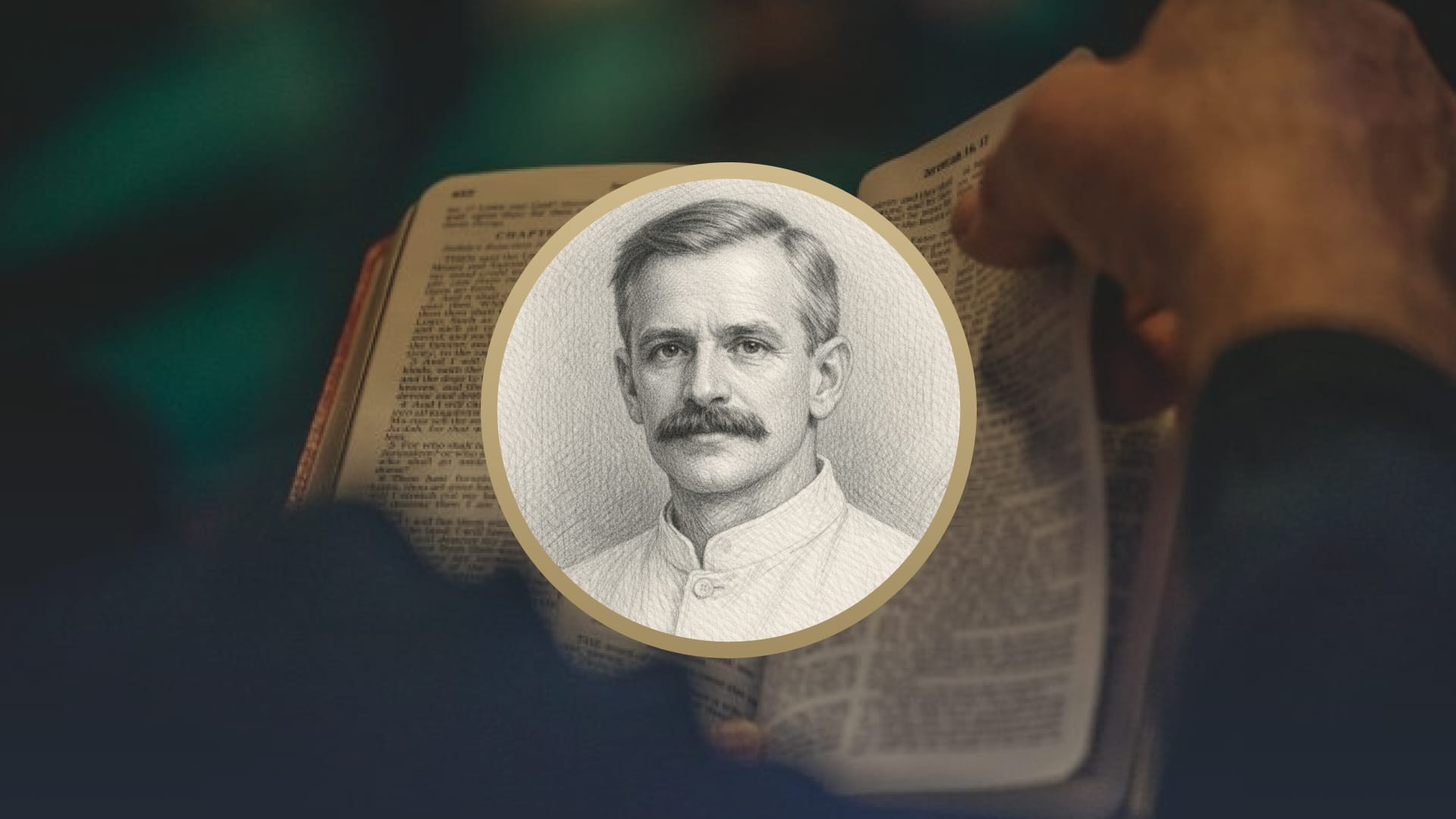
Just after the end of the Civil War, a pastor and his wife welcomed another baby boy into the world. They named their baby John Nelson Hyde, and they devoted their son to the service of the Lord. The father, Pastor Smith Harris Hyde, and his wife Lucinda had prayed that one of their boys would be used mightily of God in the advancement of the Gospel.
Their son John grew up in the little farming town of Carthage, Illinois, where his father served as pastor of the local Presbyterian church. Young John was very close to his older brother, Edmund, and deeply admired him. Both boys attended Carthage College in their local community. When Edmund went to McCormick Theological Seminary in Chicago to prepare himself for full-time ministry, John decided to enter the Lord’s service as well.
While as a student missionary on a westward journey to preach in Montana, Edmund died suddenly of a high fever. The entire Hyde family was heartbroken by the news. John was particularly affected and, as a result, spent much time in prayer. During this time of heartfelt prayer, John committed to take his brother’s place in serving God and dedicated himself to become a missionary. His parents were grateful; although God had taken one of their sons to Himself, they rejoiced that He had answered their prayer by sending one of their boys overseas as a missionary.
During the latter part of the Victorian Age, the world seemed to be on the very verge of a glorious Millennial Age. The Colonial powers of Europe, and increasingly America also, had access to the dark, remote corners of the world. Bible societies and mission agencies were sending missionaries abroad by the hundreds. Bible translations in other lands without the Scriptures were being completed. The world was at peace. It seemed that soon the ancient prophecy would be fulfilled that the nations would “beat their swords into plowshares, and their spears into pruninghooks” (Isaiah 2:4).
John Hyde was seized by this sense of missionary optimism. Surely, Christ would soon come and the world would be redeemed! Hopefully, Isaiah’s words would be realized in his glorious prophecy in Isaiah 11:9, “The earth shall be full of the knowledge of the LORD, as the waters cover the sea.”
The Lord pressed the vast field of the lost souls in India upon John Hyde’s heart. Near the modern border of the nations of India and Pakistan is the vast region known as the Punjab. This area is inhabited by the ancient, powerful Punjabi people. In 1849, Great Britain had annexed the Sikh Empire, bringing the vast territory under her influence.
Punjabi culture and language were steeped in centuries of proud tradition. The women wore brightly colored dresses, called shalwar-kameez, and long shawls called daputtas. Men wore bright turbans called dastārs over their hair. To this land and these people Hyde felt compelled to go to share the Gospel.
Even as a youth, Hyde had poor hearing. Therefore, he anticipated that he would have difficulty catching the intricate complexities of a foreign language that was strange to his ears. Yet, he endeavored to do his best for God’s glory. After preparation and training, he made plans to set sail for the Punjab in 1892. Finally, he boarded a steamer in New York, bound for India! While on his voyage, he read a letter from a dear Christian friend who said that he would be praying for Hyde, especially that he would be filled with the Holy Spirit.
The newly appointed missionary was outraged at the very suggestion that he was not filled with the Holy Spirit already! In anger, he destroyed the letter. But as the task loomed larger and larger, Hyde grew increasingly aware of his own inabilities. Finally, he humbled himself before the Almighty. He threw himself down beside his bed on the ship and beseeched God to do what his friend had asked—fill him with the Holy Spirit to empower him for the work before him. God graciously answered his humble request.
Even with the empowering of God’s Holy Spirit, Hyde knew that persecution and trouble awaited him. His work would not be easy. The suspicions among the Punjabi people ran deep. Prejudices against Westerners were strong. In 1898, Hyde was seized by a severe case of typhoid fever. As a result, he was confined to a bed for seven long months.
During his long convalescence, Hyde began to realize that evangelization was not merely about preaching; it also involved prayer. Studying the Scripture, he discovered that prayer and intercession were a vital part of the Apostle Paul’s missionary labors. Beginning in 1899, John Hyde began spending entire nights beseeching God for the souls of the lost.
In 1904, Hyde organized a group known as the Punjab Prayer Union. The members of this union committed to spend half an hour each day in prayer for revival and the conversion of the lost. His friends began to call him Praying Hyde.
John Hyde never married. He devoted himself entirely to God and to the advancement of the Gospel among the people he had come to love. In 1908, Hyde began praying that God would grant him a new convert every day. A year later and to his great delight, more than four hundred new believers were among the Punjabi people!
Although he was not elderly, by 1911, Praying Hyde was broken in health. In addition to the lingering effects of typhoid fever, he was also diagnosed with a congenital condition called dextrocardia, a defect where the heart is on the right side of the chest rather than on the left side.
John Hyde left India to return home, but he continued to pray for the people he loved. On his trip homeward, he stopped in England to join his friend J. Wilbur Chapman in an evangelistic campaign.
After arriving in the United States, physicians diagnosed Hyde as having a malignant brain tumor; they recommended surgery. In 1912, despite undergoing brain surgery, Praying Hyde went home to be with his Lord and Master. He was forty-six years old. His body was buried in the family plot of Moss Ridge Cemetery in Carthage, Illinois. Even unto his last moments on earth, Hyde continued to pray that God would send forth laborers into His harvest.
Over the years, many missionaries have been inspired by John Hyde’s example. Today, it is estimated that there are millions of Christians in India and Pakistan who have been influenced, either directly or indirectly, by Praying Hyde. His last words were very fitting: “Shout the victory of Jesus Christ!”
Sources and Further Reference:
Carre, Captain E.G. Praying Hyde, Apostle of Prayer: The Life Story of John Hyde. Newberry, FL: Bridge-Logos Publishers, 2001.

 27:22
27:22