
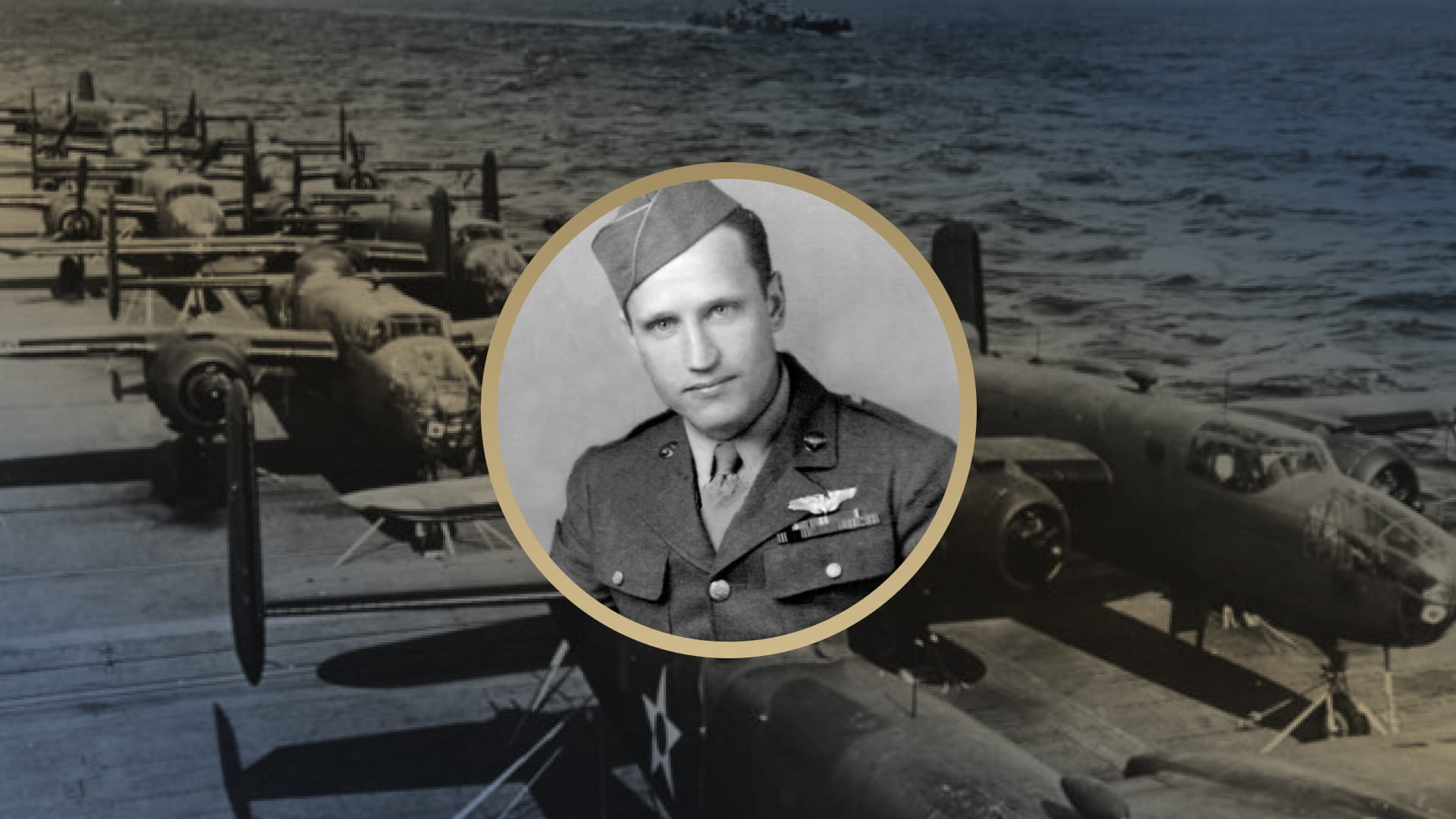
Sergeant Jacob DeShazer was assigned to kitchen duty on December 7, 1941, and was peeling potatoes when the news came that Pearl Harbor had been attacked by the Japanese Imperial Air Force. DeShazer was filled with hatred at the knowledge that his fellow servicemen had been strafed and bombed in Hawaii. He shouted out in anger, “Japan is going to pay for this!”
DeShazer was the son of faithful Christian parents who told him as a young boy in their family worship times the stories of Jesus and His love for men. But DeShazer had forsaken the faith of his parents. His school teachers had questioned and mocked the Bible stories that he had learned. By the time that he had enlisted in the United States Army Air Corps, he doubted whether or not there was even a God.
DeShazer’s smoldering desire for retribution against the hated Japanese was given an unexpected opportunity. The members of the 17th Bomb Group were told that there was a secret plan to retaliate against Japan. They were not given any details but were informed that it would be a dangerous mission that required volunteers who were willing to risk all. DeShazer quickly volunteered!
The crews were taken to Florida and then to the Southwestern deserts where they were trained in water navigation and low-level bombing runs in their B-25 bombers. They were then transferred to the West Coast where 16 B-25s were loaded onto the aircraft carrier the USS Hornet under secret orders to attempt the impossible: a counterattack against the mainland of Japan. The raid was commanded by Lieutenant Colonel Jimmy Doolittle.
The mission was a risky and daring one! B-25s had never taken off from an aircraft carrier before. But high command deemed it important to show the people of Japan and Emperor Hirohito himself that Japan was not too far away for the United States to give payback for attacking Pearl Harbor! Knowing that it would be impossible to return to their carrier and land, the one-way mission team would bomb targets inside Japan, then fly over Japan and hope to have enough fuel to make it to friendly airfields in China!
Under strict silence, the task force sailed toward Japan. The carrier sighted a Japanese picket boat, a small vessel used for early enemy detection, when the Americans were still 750 miles from Japan. Fearing that the picket boat might signal their approach, Doolittle decided to take off earlier than planned—fully aware that if they launched early, then they would probably not have enough fuel to reach China! Jacob DeShazer was the bombardier on the last plane to take off from the USS Hornet. Amazingly, all sixteen bombers slowly lumbered into the skies, timing their takeoffs to get a final shove upward by the upward pitch of the bow of the ship!
DeShazer’s plane was assigned to bomb an aircraft factory in the city of Nagoya. On the way toward his target, DeShazer remembered seeing a Japanese fisherman in a boat waving at the plane, while probably never dreaming that he was waving at an American bomber. The bombardier also recalled distinctly aiming a .30-caliber machine gun at the Japanese civilian and trying to kill him as they passed. He said, “The fisherman stopped waving!” Although he failed to kill the civilian, DeShazer fully intended to at the time. In fact, he did not care if every person in Nagoya was killed. The bombing run was a success, and DeShazer released the devastating bombs carried by his crew’s B-25, which was chillingly named the Bat Out of Hell.
As feared, the B-25 exhausted its fuel before reaching a friendly airfield. In the black darkness, the crew bailed out. DeShazer remembered hanging in his parachute, wondering if and where he would land. He landed atop a freshly dug grave in a cemetery and said in his personal testimony, “I threw my arms around that mound of dirt and gave it a good hug.”
An ocean away, his mother awoke in the middle of the night, seized with a sudden urge to pray for her son. “Oh God, save him” she prayed. She then went back to sleep, but not before marking the time of the unusual awakening. Little did she know then that at that very moment, her son was parachuting into the darkness above enemy territory.
Meanwhile, the relief of landing alive turned to dismay when DeShazer realized that he had landed near a party of Japanese troops! The enemy deceived the American crew into thinking they were friendly Chinese, but then the enemy soldiers disarmed and captured the Americans. Eight of the Doolittle raiders were captured that night, and among them was Jacob DeShazer. Three of the eight men were executed; the other five men endured a long, cruel captivity.
The Japanese had been taken off-guard by the attack. They were astonished and infuriated that the Americans had come seemingly “out of nowhere” to bomb Tokyo itself, along with other key cities like Nagoya. The Japanese guards tortured their prisoners in an attempt to get them to tell them where they had flown in from that had resulted in the successful surprise attack.
One of the five Americans died in captivity. DeShazer remembered sitting on a hard two-by-four for long hours, staring at a concrete wall. He was often beaten and almost starved to death. Every day, his hatred against the Japanese grew until it became an all-consuming bitterness. In his personal testimony, DeShazer admitted, “My hatred for the Japanese people nearly drove me crazy.”
Of the forty months that he spent in captivity, thirty-four of them were in solitary confinement. In those miserable hours of solitude, he recalled the Scripture verses that his parents had taught him. Then, amazingly, at the very hour of his need, the Japanese guards brought the American prisoners some reading material! He begged the guards to find him a Bible. One day in May 1944, somehow a Japanese guard brought him a Bible! DeShazer read it eagerly from cover to cover.
Jacob DeShazer contrasted the hatred in his own heart with the love of God revealed in Jesus Christ. Jesus loved His enemies and prayed for those who tortured and killed Him. DeShazer realized what a miserable, bitter fool he had been to reject the love of God! On June 8, 1944, in the solitude of his cell, Jacob DeShazer called upon the Lord for salvation.
In the weeks that followed, he was amazed to see the Holy Spirit take away the hatred in his heart for his guards and replace it with love for them. He even learned to love a particularly cruel guard who had beaten him and smashed his bare foot in a door jamb! He prayed for the conversion of the Japanese and later testified, “I found my bitter hatred changed to loving pity!” He went on to say, “With His love controlling my heart, the 13th chapter of First Corinthians took on a living meaning.” Jacob DeShazer spoke of the way that he found the “more excellent way” of living by charity that the Apostle Paul described.
DeShazer was released when American paratroopers came to set him and the other prisoners free in August 1945. Among some of the initial foods he was given, ice cream was a very special treat. He put on twenty pounds in the first twenty days of liberty!
DeShazer had promised the Lord that if he was ever set free, he would return to Japan as a missionary. After attending Seattle Christian College and then Asbury Theological Seminary in Kentucky, Jacob DeShazer kept his word.
He returned to Japan with his young wife, Florence, and their firstborn son, Paul, in 1948. The wounds of war were still fresh. Thousands of Japanese came to faith in Christ during the first year of his preaching. DeShazer wrote a tract in Japanese titled I Was a Prisoner of Japan. In the tract, he shared his own testimony of salvation and his heart’s transformation from hatred to love.
One of the most remarkable converts was Captain Mitsuo Fuchida, the Japanese commander who had led the bombing raid on Pearl Harbor! The two former enemies eventually preached and ministered together side by side—two men, once divided by hate and now bound together as spiritual brothers in the love of Christ and the advancement of the Gospel.
Over the course of his long ministry that spanned thirty years, Jacob DeShazer planted twenty-three churches in Japan. One of those churches was in the city of Nagoya—the very city where he had dropped his bombs as a bombardier during the Doolittle Raid!
Jacob DeShazer died peacefully in his sleep in 2008, at the age of ninety-five. Even in his old age, he eagerly told his fascinating story to anyone who would listen, testifying of the power of God’s grace to transform a human heart and enable a Christian to love his former enemy.
Sources and Further Reference:
Goldstein, Donald, and Carol Aiku DeShazer Dixon. Return of the Raider. Lake Mary, FL: Creation House, 2010.