

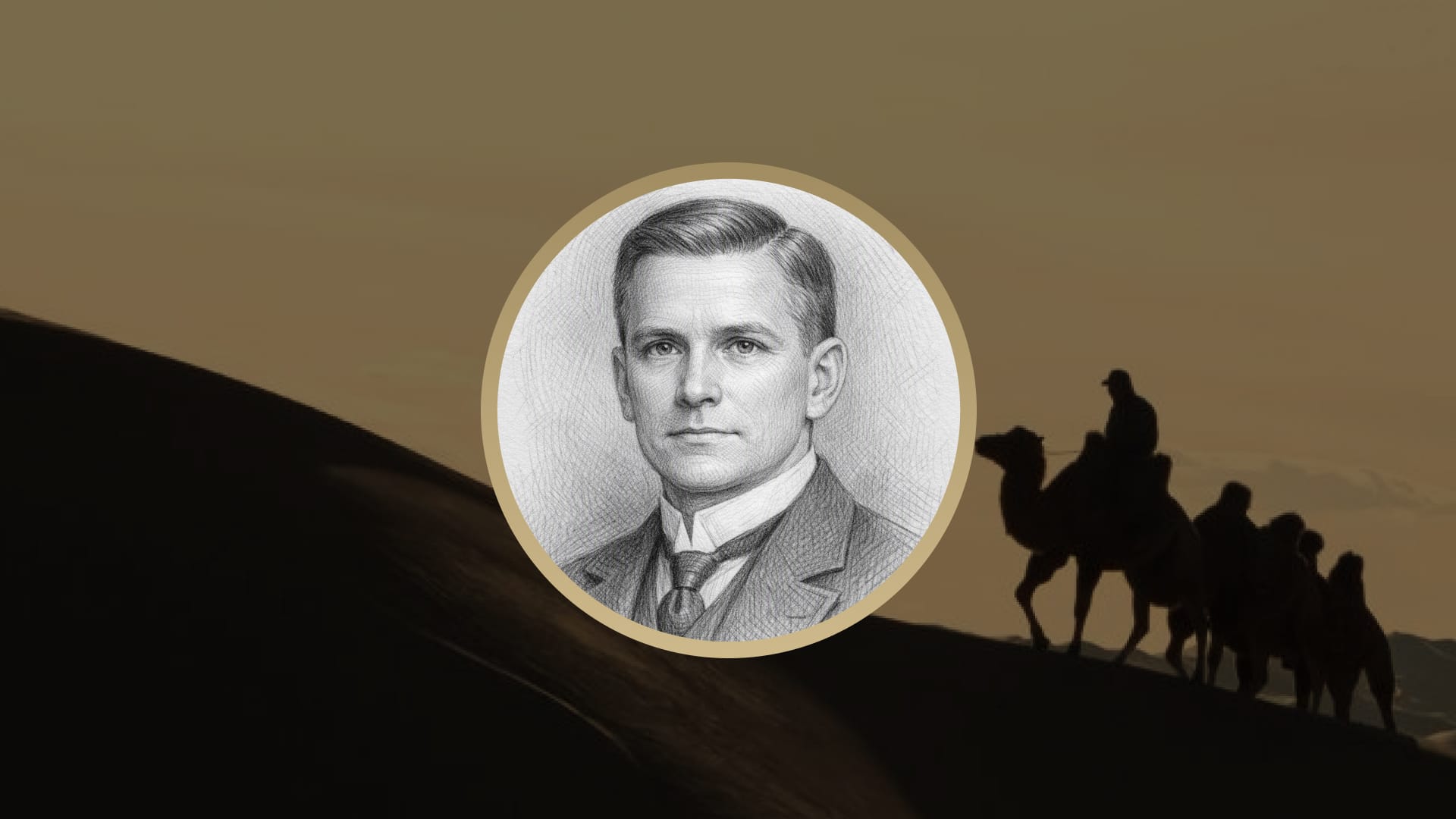
For many Christians in the nineteenth century, the mysterious world of Arabia was almost as far away and fanciful as the tales of One Thousand and One Nights, or, as the book is more commonly known in English, The Arabian Nights. In 1890, one brave missionary ventured into the sandy deserts of Arabia to bring the Gospel back to the lands of the Middle East from which it had arisen centuries earlier. Samuel Marinus Zwemer would become known as the Apostle to Islam, a man who unlocked the language, culture, and religion of Islam to the Western World.
Samuel Zwemer was born in Vriesland, Michigan, on April 12, 1867. His parents were immigrants from the Netherlands. Samuel was the thirteenth of his fifteen siblings! His father was a pastor in the Dutch Reformed Church, and it was in his father’s parsonage that he was born into the world. Although Samuel did not know for many years, his parents had dedicated him as a baby to the service of Christ in the advancement of foreign missions.
Young Samuel was taught to love and memorize Scripture from a very early age. Life in the parsonage gave him a love for the Bible, a love for souls, and a deep respect for his Godly parents. Indeed, of the fifteen Zwemer children, all six girls became Christian schoolteachers, and five of the sons entered full-time Christian service as pastors and missionaries.
On March 9, 1884, while still a teenager, Samuel professed his faith in Christ Jesus as his Savior and Lord. In preparation for the service of Christ, he later attended a local Christian college started by Dutch pioneers called Hope College. At the age of twenty, Samuel Zwemer offered himself as a candidate for foreign service as a missionary of the cross.
Following his graduation from Hope College, Zwemer traveled eastward to New Jersey. There he attended New Brunswick Seminary to study theology, Biblical languages, and foreign missions. Along with a few other like-minded students, Zwemer set his sights upon one of the most unreached and difficult mission fields in all the world at that time: the Muslims of Arabia.
No mission agency would give Zwemer any sort of sponsorship. The evangelistic task was deemed too difficult. Muslims were too closed to the Gospel. Environmentally, Arabia was too hot for Westerners. Also, the Arabic language was too complicated to master. Plus, terrorists among the radical sects of Islam were too dangerous. These reasons were among the many objections that Zwemer heard.
But Samuel Zwemer was not deterred! He famously said, “If God calls you and no board will send you, bore a hole through the board and go anyway.” In 1888, Zwemer and a few close friends formed their own mission agency, The Arabian Mission.
Having completed his seminary training and ordained as a minister of the everlasting Gospel, Samuel Zwemer boarded a ship bound for the Middle East. Accompanying him was his close friend, James Cantine. Another friend, Old Testament professor Philip T. Phelps, remained in New Jersey to help raise funds for the missionary effort.
Assured of nothing except the certainty of his divine call, Zwemer settled first in Beirut, in present-day Lebanon. In Beirut, he and Cantine embarked upon the difficult study of Arabic. Following this language preparation, the young missionaries traveled to Cairo, Egypt, and continued to perfect their command of Arabic. They also explored possibilities of where they might have an opening to serve.
A city along the Tigris and Euphrates waterways named Basrah was chosen as a strategic center for the advancement of the Gospel into Arabia. They settled there, and for six long years Zwemer labored, interacting with Arabs, mastering the nuances of the language, and slowly and diligently learning the ancient customs and habits of the bewildering array of Arab tribes.
Two young female missionaries from Australia arrived in Basrah. Their desire and goal was to help instruct Arab women and children. The Australian mission society under whose auspices they were sent had a rule against young ladies seeing male friends. However, love has a way of overcoming obstacles! Zwemer managed to get a job teaching them English, and he fell deeply in love with one of the young missionaries, Amy Wilkes, who was also a nurse.
In 1896, Samuel Zwemer and Amy Wilkes were united in marriage at the British Consulate in Baghdad. The Australian missionary society demanded that the bridegroom reimburse the mission agency for the travel expenses incurred by the young lady’s voyage to Arabia. Thus, it was often joked that, according to the time-honored Arabic custom, Zwemer had paid the dowry for his new bride!
The married couple labored together at a mission station established on the island of Bahrain in the Persian Gulf. They distributed Gospel tracts in Arabic, preached the Good News of Jesus Christ to anyone who would listen, and provided free medical care to the needy people.
Zwemer began writing in his spare time. He was appalled at the lack of interest in the Christian world to the needs of the Arab people. His first book was titled Arabia: The Cradle of Islam. In the book, he pointed out the wonder and beauty of the Middle East and the land of Mesopotamia from which sprang the three great world religions: Judaism, Christianity, and Islam.
Many personal hardships came to Samuel and Amy Zwemer. Two daughters wasted away under the terrible effects of dysentery and were buried in a simple grave on the island of Bahrain. Their tomb is inscribed with the words, “Worthy is the Lamb to receive riches.”
The Zwemers returned to the United States on furlough in 1905. Zwemer’s talent for encouraging others was clearly recognized, and he was appointed as the field secretary for the Reformed Board of Foreign Missions. He traveled to colleges and universities, pleading with young people to obey the Lord’s command to go into all the world and preach the Gospel to every creature. A friend, amazed at his zeal to travel and speak with an almost impossible schedule and itinerary, called Zwemer “a steam engine in breeches.”
Samuel Zwemer was saddened by the apathy of many church leaders. He saw their lukewarm carelessness as the leaven threatened the life and health of the Church of Jesus Christ. He preached hundreds of sermons, wrote dozens of books and articles, and published a periodical called The Moslem World, urging his fellow believers to consider the claims of Christ in Arabia.
Traveling widely, Zwemer went to every country in North Africa. He journeyed extensively around Egypt. He went to Iran and Iraq. He even visited India, China, and the islands of Indonesia, countries where millions of followers of Islam reside and live, hoping vainly in the falsehoods of Mohammed and their blind allegiance to Allah.
In 1929, Zwemer settled down from his travels to become the professor of missions at Princeton Theological Seminary. His influence was felt in the lives of many young men and women who devoted themselves to mission work in Muslim lands. William Borden is one name among many in that sphere of influence.
Following the death of his beloved Amy, Zwemer remarried in 1940. His second wife was Margaret Clarke. She also shared his love for Christ and for the souls for whom Christ died.
Samuel Zwemer became a champion not only for the cause of missions, but also for the fundamentals of the Christian faith which were under attack by liberal theologians in Europe and America. He staunchly defended the deity of Christ, the necessity of the blood atonement, and the absolute inerrancy of the Holy Scriptures.
In 1952, at the age of eighty-four, Samuel Zwemer died of a heart attack. The heart that had beat so long and strongly for Christ and for the Muslim world was laid to rest. The Zwemer Center for Muslim Studies continues his legacy, even to this day.
Sources and Further Reference:
Wilson, J. Christy, Apostle to Islam: A Biography of Samuel M. Zwemer. Grand Rapids, MI: Baker Book House, 1952.


 21:37
21:37