

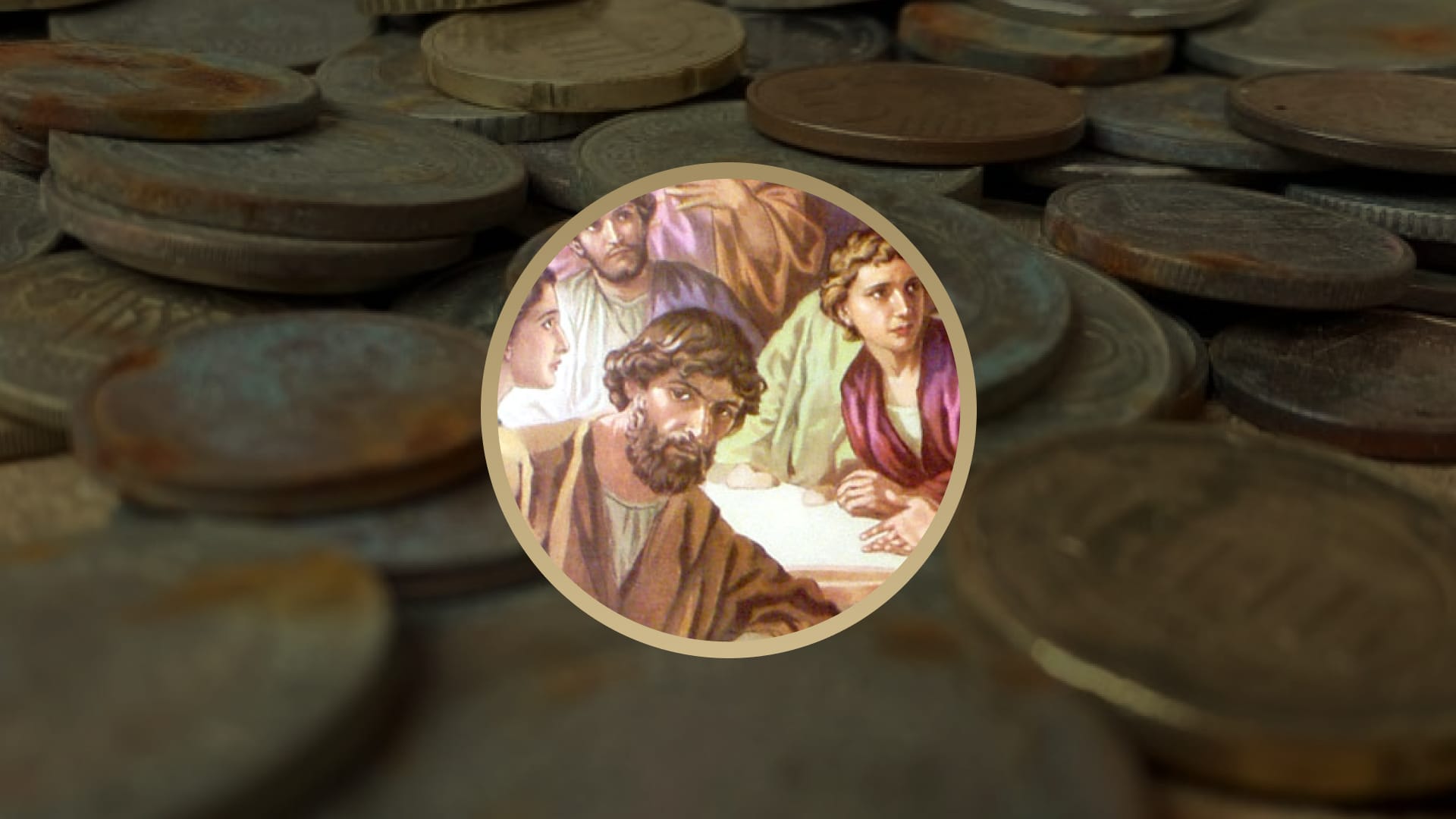
No one would have suspected that Judas would be the betrayer of Christ. In many religious paintings of the Last Supper, Judas Iscariot is portrayed as a swarthy, sinister-looking man who is readily identified as the villain. But the Bible record presents an entirely different picture.
Judas Iscariot would have passed as among the most faithful of the Lord’s disciples. He was the one who “held the bag,” meaning he was trusted and admired by his fellow disciples. The position as treasurer was a position of trust, occupied by those who had earned well-deserved respect. Judas Iscariot was the disciples’ treasurer.
Even in that dark hour when Jesus told Judas, “That thou doest, do quickly” (John 13:27), the other disciples had no idea what was the purpose of the errand. They assumed that Judas was leaving to go transact legitimate business.
The act of Judas Iscariot teaches the sobering warning that one must always beware of the leaven of sin. Similar to the leaven of yeast, the presence of sin is often imperceptible. Like leaven, sin can grow slowly and appear in surprising places. Finally, just like leaven, sin affects all that it touches.
Very little is known of Judas Iscariot’s background. His title Iscariot implies that he was a “man from the village of Kerioth,” a small village in the hills north of Jerusalem near the more famous town of Shiloh. Some scholars have suggested that Iscariot could mean he was a “man of murder,” possibly a member of a group of Jewish rebels. These Jewish rebels were called the Sicarii, so-named for the long, hidden daggers (sica) that they kept concealed under their garments. Still others have suggested that Judas was called Iscariot as a mark of shame, since the Hebrew word shaqar means “lying.” It would be like calling Judas “Judas the Liar.”
The latter two name theories are somewhat contrived. Judas was probably called Iscariot to denote the place of his origin, just as Joseph of Arimathea was called by that name to identify his native village. Jesus of Nazareth is another example of a man being identified by his place of origin.
It is uncertain when Judas was first called to follow Jesus; however, by the time that Mark recorded the complete list of the twelve apostles in the third chapter of his Gospel, Judas Iscariot was included, the last one in the list.
On several occasions throughout the Gospel record, Judas Iscariot was referenced specifically in the account. Jesus spoke specifically of the traitor in John 6. Just after giving the Bread of Life discourse, many of Christ’s followers began going away, disappointed that He had no more physical food to offer them and instead was speaking of spiritual food. Jesus asked His disciples, “Will ye also go away?” (John 6:67). Peter answered for the twelve, “Lord, to whom shall we go? thou hast the words of eternal life. And we believe and are sure that thou art the Christ, the Son of the living God” (John 6:68–69).
Following this bold declaration from Peter, Jesus said, “Have not I chosen you twelve, and one of you is a devil?” (v. 70). The Apostle John made it clear about whom Jesus was speaking: “He spake of Judas Iscariot the son of Simon: for he it was that should betray him, being one of the twelve” (John 6:71).
In Bethany, shortly before the betrayal and crucifixion of Jesus, we have the record of the scene of Mary anointing the feet of Jesus in the home of Lazarus and his sisters, Mary and Martha. After she lavishly anointed Christ’s feet with expensive spikenard and humbly wiped His feet with her hair, Judas Iscariot spoke. He offered his opinion of the costly gift, “Then saith one of his disciples, Judas Iscariot, Simon’s son, which should betray him, Why was not this ointment sold for three hundred pence, and given to the poor?” (John 12:4–5).
John the Apostle gave this comment regarding the motives of the betrayer, “This he said, not that he cared for the poor; but because he was a thief, and had the bag, and bare what was put therein” (John 12:6). This verse informs us that, in addition to secretly being a traitor, Judas was also secretly a thief. Entrusted with the money bag that contained the means of the sustenance for Christ and His band of followers, Judas apparently pilfered from the general fund from time to time. He was selfish and deceptive, and he masked his greed with a show of piety and a feigned concern for the needs of the poor.
Jesus rebuked Judas for his comment: “Let her alone: against the day of my burying hath she kept this. For the poor always ye have with you; but me ye have not always” (John 12:7–8). Again, like leaven, the greed and selfish ambitions of Judas were unnoticed by all but the Lord. The coming days would reveal the depth of Judas Iscariot’s greed.
After Christ’s triumphal entry into Jerusalem on a donkey and to the shouts of “Hosannah,” the scheming Pharisees sought opportunity to take Jesus when He was isolated from His supporters. Originally, they did not plan to arrest Him on a feast day “lest there be an uproar of the people” (Mark 14:2).
But the surprising offer by Judas Iscariot changed the minds of the chief priests and scribes. He came to them secretly and inquired, “What will ye give me, and I will deliver him unto you? And they covenanted with him for thirty pieces of silver” (Matthew 26:15).
According to Exodus 21:32, thirty pieces of silver was the value of a slave. Also, in the providence of God, the same was exactly the price foretold by the prophet Zechariah and given to the potter in Zechariah 11:12. Surely, Judas was unaware of the precise prophetic announcement of his evil transaction!
From the moment the deal was sealed, Judas looked for an opportunity to betray the Lord of glory into the hands of sinful men. On the evening of the Passover, the opportunity came. Jesus foretold of His betrayal in words of unmistakable clarity. “Verily I say unto you, that one of you shall betray me” (Matthew 26:21).
Judas Iscariot demonstrates to us the mystery of Divine sovereignty and human responsibility. On the one hand, his act was ordained from the beginning, and yet, Judas retained the terrible guilt of his willful, selfish choice to betray the Master. “The Son of man goeth as it is written of him: but woe unto that man by whom the Son of man is betrayed! it had been good for that man if he had not been born” (Matthew 26:24). Jesus called Judas “the son of perdition” (John 17:12). Yet, Judas bore the weight of his own depravity.
When Jesus washed the feet of His disciples, Judas Iscariot was still in the Upper Room. His dirty feet would have still had the dust from his stealthy visit to the Sanhedrin. Yet, Jesus, God in the flesh and wholly aware of the deed, also washed the feet of Judas. Later, according to Christ’s earlier statement recorded in John 13:26, when Christ dipped His bread into the sop and handed it to Judas, it was clear testimony that Judas was the betrayer.
Yet, so smooth and deceptive was Judas that, even then, the other disciples did not catch the clear intent. The giving of a piece of sop (bread dipped in liquid) was regarded as a special honor. This action was the fulfillment of the prophecy of the psalmist in Psalm 41:9, “Yea, mine own familiar friend, in whom I trusted, which did eat of my bread, hath lifted up his heel against me.” This prophetic significance was lost on the disciples at the time.
Still, they wondered who the betrayer might be. After Judas received the sop, according to John 13:27, “Satan entered into him.” Then Jesus told Judas, “That thou doest, do quickly.” Judas Iscariot “having received the sop went immediately out: and it was night” (John 13:30). Still, the disciples did not know who the betrayer was.
Christ continued after Judas left. That night our Lord instituted the Lord’s Supper, gave the Upper Room discourse, and then offered His High Priestly Prayer.
In the Garden of Gethsemane, illuminated by the glare of the torches, Judas Iscariot was seen again. Drawing near to the Master, Judas gave Christ the kiss of betrayal. Christ submitted Himself into the hands of sinful men.
After the condemnation of Jesus, Judas Iscariot committed suicide in an ultimate act of selfishness and cowardice. He announced to the Jewish authorities, “I have sinned in that I have betrayed the innocent blood” (Matthew 27:4).
Throwing down the pieces of silver at their feet, Judas went out and hanged himself in the Valley of Hinnom. In the first chapter of the Book of Acts, another related and gruesome detail is recorded. According to Acts 1:18, after Judas had hanged himself, his body fell down from the tree and against the rocks, where “he burst asunder in the midst, and all his bowels gushed out.”
The life and death of Judas Iscariot, the son of perdition, provides a sobering reminder to give heed to the command of our Lord to “beware of leaven.” We are to realize that not all who profess loyalty are genuine. Even among the band of disciples, there was a betrayer.