

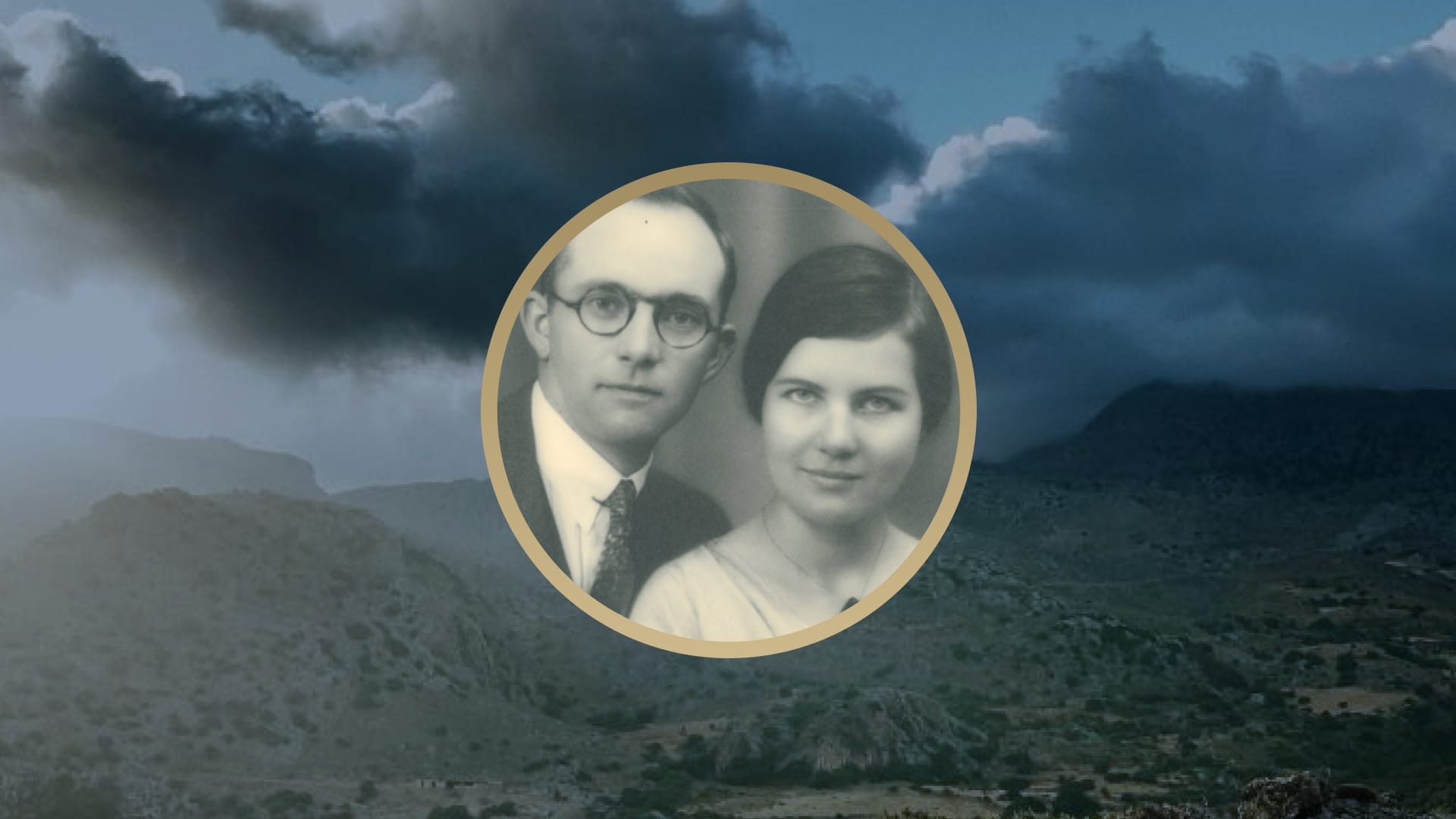
The young couple from America stood side by side on a hill. The location was a remote area deep in the heart of China. A year earlier, the two had stood together at the marriage altar. They had faced a bright future before them, a future seemingly filled with hope and promise as they purposed to serve the Lord together. Little did they know then that their love for the Master would lead them to their present situation—on the hill of execution outside the Chinese village of Miaoshou. Lying nearby was their three-month-old daughter Helen Priscilla, wrapped in a warm sleeping bag. How had they come to this point in their lives?
A bloody civil war was being waged in China. General Chiang Kai-shek led the army of the Republic of China (Nationalists) in a bid to maintain control of the vast but heterogeneous country. Mao Zedong led the Chinese Communist Party (CCP) in an attempt to take control of the reins of centralized power.
The war had already ravaged vast swaths of the countryside. It was during this war that the young couple, John and Betty Stam, had arrived in China as missionaries. Settling in at their mission station, the Stams had hoped that they would be able to minister to the Chinese people and be free from political and military interference. But it was not to be. The Communists had seized the couple, removed them from the mission station, and had taken them to a remote area. At the hands of the Communists, the young couple’s time had come to die side by side, as martyrs for the Lord Jesus Christ.
The husband, John Stam, had deep roots in his father’s land of Holland. His father was a Dutch immigrant to America. He had been given a Dutch-English New Testament that he studied in order to learn the language. But reading the New Testament had changed his life! He and his wife sought to raise their children in the ways of the Lord. They started a rescue mission called “Star of Hope” in Paterson, New Jersey, as a way of spreading the Gospel.
Their son John was born on January 18, 1907. He grew up with a love for the Kingdom of God and a desire to seek first God’s Kingdom in every area of life. John Stam was saved at the age of fifteen at a service at the family mission. He soon became personally involved in giving the Gospel to others.
John Stam enrolled in the Moody Bible Institute with the hope of preparing himself to serve as a foreign missionary. At Moody Bible Institute, he met another student, a beautiful young lady named Elisabeth Scott. She likewise had a love for the Kingdom of God and a desire to spend her life in the service of Christ.
Elisabeth Scott was born in China on February 22, 1906. The daughter of American missionaries, she had the great advantage of growing up knowing Chinese almost as well as English. She loved Chinese ways, Chinese food, and Chinese customs. Above all, she loved the Chinese people for whom Christ had died.
Elisabeth, called Betty by those who knew her well, told John Stam about the wonders of China. After her graduation from Moody in 1931, Betty sailed for China. John followed a year later in 1932, after the completion of his studies.
During his graduation speech, John Stam said to his classmates, “Shall we beat a retreat and turn back from our high calling in Christ Jesus, or dare we advance at God’s command in the face of the impossible? Let us remind ourselves that the Great Commission was never qualified by clauses calling for advance, only if funds were plentiful, and no hardship or self-denial was involved. On the contrary, we are told to expect tribulation and even persecution, but with it victory in Christ.” With these words freshly delivered, John sailed for China.
In October 1933, John Stam and Betty Scott were united in marriage. For the first few weeks and months, the Stams served with other missionaries as he steadily mastered the language and culture. Finally, the couple was assigned a permanent mission station in the village of Jingde, located west of Shanghai in an agricultural area.
By the time of their settlement in Jingde, John and Betty Stam had recently welcomed their firstborn child, a little girl named Helen Priscilla. The baby brought a spark of joy and hope into their lives, even with the shadow of civil war looming across the land.
The Stams arrived in Jingde in late November 1934. Two weeks later in early December, they were startled in the early hours of the morning by a loud pounding on the door of their abode. Communist soldiers shouted, demanding entry. Without waiting for an invitation, the soldiers broke the lock and entered the mission station.
Fearless and confident, John Stam greeted the Communist soldiers. Betty Stam hospitably boiled some water for tea and served biscuits (cookies) to the Communist troops. The soldiers were under orders to apprehend foreigners, and notwithstanding the kindness of the missionaries or their helpless infant baby, the Stams were placed in a local prison. Betty Stam was allowed to nurse her little baby.
On the following day, John and Betty Stam were marched out of Jingde to walk twelve miles on foot to the nearby village of Miaoshou. John Stam was bound, but his wife was allowed to carry her baby and to nurse her at intervals along the way. In Miaoshou, they were housed with other prisoners, many of whom were hardened criminals.
One of these criminals overheard some of the Communist guards talking among themselves, plotting to kill the Stam infant so they would not be bothered with a baby. The Chinese criminal pleaded with his countrymen to spare the baby. The Communists coldly replied, “Then it’s your life for hers.” The brave man submitted to execution on the spot, willing to die in order to save the innocent American baby.
On December 8, John and Betty Stam were led outside the town to the top of Eagle Hill. Betty Stam had left the baby behind in the prison which was an abandoned home. The baby was warmly swaddled in a sleeping bag, with a few American dollar bills and a small supply of diapers hidden inside the sleeping bag. Like Jochebed, the mother of Moses, she entrusted her baby to the Lord and then joined her husband to face their destiny.
Side by side, John and Betty Stam knelt at the top of the hill. A sword was raised over the husband first. Betty bravely watched as her husband’s head was completely severed with one blow. Another flash of the sword, and the two young martyrs were welcomed by angels and archangels in the presence of the King of Kings Who said, “Fear none of those things which thou shalt suffer: behold, the devil shall cast some of you into prison, that ye may be tried; and ye shall have tribulation ten days: be thou faithful unto death, and I will give thee a crown of life” (Revelation 2:10).
After the Communists moved out from the area, a Chinese Christian known as Evangelist Lo heard about the deaths of the two missionaries. He came to the blood-soaked ground and found the bodies of the martyrs side by side. He tenderly sewed the heads of the parents onto their lifeless bodies and tearfully gave them a Christian burial. Evangelist Lo inquired about the couple’s baby and began a frantic search for her.
He found the infant, still wrapped in the sleeping bag. She had been without food or drink for approximately thirty-six hours. Evangelist Lo passed the Stam baby to his wife. Similar to Jochebed hiding her baby Moses, so Lo’s wife also hid the orphaned infant in a basket. Walking 100 miles, the two Chinese Christians brought the orphaned American baby girl to safety at a mission station. The infant was eventually taken to Betty’s Stam’s parents, the Scotts, who raised young Helen Priscilla Stam.
The news of the martyrdom of John and Betty Stam was announced all over the world. Hearing of that tragic account, hundreds of young men and women devoted themselves to advance the Kingdom of God in foreign missions. In 1941, five Chinese Christians were baptized by a national pastor in the town of Jingde. Today there are hundreds of thousands of Christians across China who are still seeking first the Kingdom of God and His righteousness. Indeed, John and Betty Stam’s sacrifice and martyrdom is a mighty testimony of love for God and His Kingdom, love for people, and “they loved not their lives unto the death” (Revelation 12:11).
Sources and Further Reference:
White, Kathleen. John and Betty Stam. Minneapolis, MN. Bethany House Publishers: 1990.
 26:13
26:13