

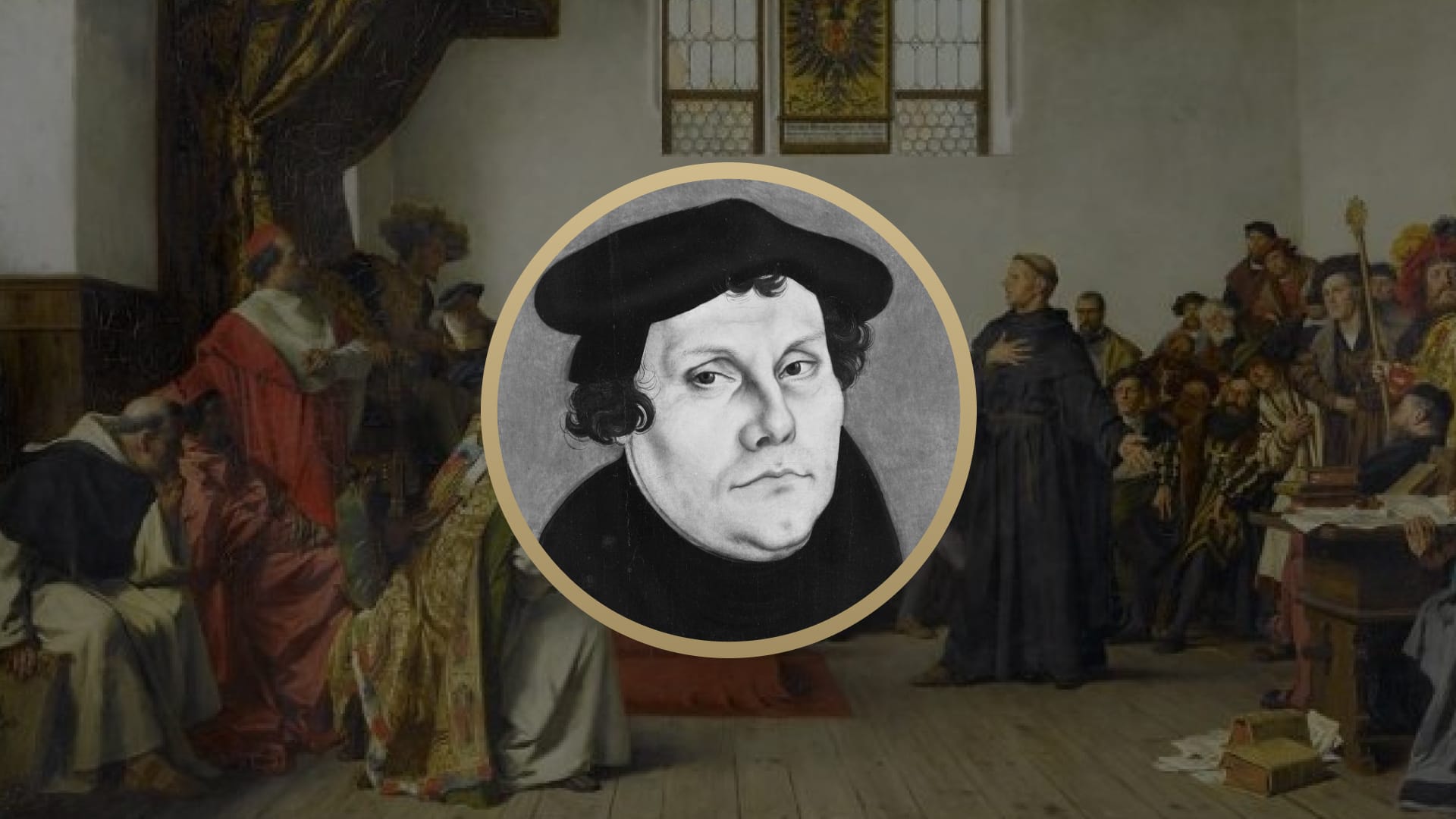
The emaciated monk wept bitterly on the floor of his chamber. Try as he might, he could not break the chains of uncleanness. He had renounced the world. He had fled all temptation. He had taken the Augustinian vows of poverty, chastity, and obedience.
The man had left a promising legal career. He had given away all of his belongings. He had come to the monastery to find peace and seclusion from the world, but, to his horror, he had discovered that his own heart was filled with sin! Masses, candles, beads, fasting, penance, and even painful flagellations had not removed the sin from his heart.
In this miserable condition, an elderly brother monk named Johann von Staupitz comforted his distraught companion with the consolation of Scripture. He encouraged the monk, named Martin Luther, to look away from his own heart and to seek righteousness in the Lord Jesus Christ. He taught Luther that repentance is not a system of self-imposed punishment but a change of heart and mind that results from an appreciation of Christ’s sacrifice for us upon the cross of Calvary.
By the grace of God, Martin Luther’s heart was gradually transformed. He eventually found peace and satisfaction in “knowing that a man is not justified by the works of the law, but by the faith of Jesus Christ” (Galatians 2:16).
On October 31, 1519, Martin Luther famously nailed his Ninety-Five Theses to the door of the Castle Church in Wittenberg. The theses were a series of questions, propositions, and observations that were intended to make men consider and compare the Word of God with the current practices of the Church of Rome.
Luther’s purpose was not to start an exodus from the Church. Rather, he was seeking to point out the dangers of false teachers who had gradually infiltrated the Roman Church and brought with them falsehood and confusion. Martin Luther suggested that the command of the Lord Jesus to “repent” was a call for believers to live in a spirit of humility and repentance rather than to perform specific acts of penance. He questioned the practice of indulgences, which was the selling of pardons for a fee. He asked that, if the Pope had power to deliver souls from purgatory, then why did he not empty purgatory out of Christian charity rather than sell indulgences for “filthy lucre”?
These observations made a stir throughout Europe! Soon the monk from Wittenberg and his bold theses became a flashpoint throughout the continent. He was placed under the Pope’s curse and under the Emperor’s ban. He was summoned to Rome. But under the protection of his Saxon prince, Martin Luther remained in Wittenberg, where he was safely out of the reach of his enemies.
Luther continued to write and debate with scholars as God gave him opportunity. He issued An Address to the German Nobility, which called them to loyalty to the Word of God over the Pope. He wrote a pamphlet titled The Babylonian Captivity of the Church, which described the apostasy and unfaithfulness of the Church of Rome. His bold speech at the Diet of Worms, where he was promised safe conduct, has become famous throughout the world: “My conscience is bound in the Word of God: I cannot and will not recant any thing . . . Here I stand. I cannot do otherwise. God help me! Amen.”
On the way home from Worms, Martin Luther was seized and carried off by armed horsemen. The Duke of Saxony, knowing that Luther was a wanted man, had arranged for this capture to preserve Luther’s life. Hidden in an isolated fortress known as Wartburg, Luther engaged in perhaps his greatest life’s work, the translation of the Greek New Testament into the common language of the German people.
Martin Luther fully realized that it was not enough to point out falsehood. God’s servants also must patiently and faithfully teach the truth. It is only when truth is loved and treasured that falsehood can be hated and shunned. After the Bible was translated into German, Luther began to faithfully exposit the Word of God to the people of God.
On June 13, 1525, Martin Luther married Katharina von Bora, a nun who had come out of error and darkness under the influence of Luther. Luther found great blessings in his marriage to Katharina. He remarked, “God’s highest gift on earth is a pious, cheerful, God-fearing, and home-keeping wife.” Indeed, she was truly “a help meet” for Martin Luther. They lived happily together for twenty-one years and reared six children—three sons and three daughters. The Luther home was filled with music and cheerfulness!
These years were not always easy for Martin Luther. Extremists tried to turn a spiritual revival into a political upheaval. The German Peasants’ Revolt brought blood and terror to thousands across Germany. Luther warned that “false teachers” were leading God’s children astray into delusion and misery. Luther and his family were threatened with death by those who hated the truth of God. Bishops and scholars twisted Luther’s words to make him seem to say what he was not saying!
Martin Luther not only warned against false teachers, he also helped to train and raise up a new generation of faithful teachers of truth. Young men found him a willing mentor, a kind father, and an able teacher.
By the time Martin Luther died on February 18, 1546, thousands of Christians all across Europe had been turned away from falsehood to embrace the truth. Monks, bishops, parish priests, civil magistrates, and even dukes and princes became true shepherds of souls and protectors of the flock. Luther’s most famous hymn, “A Mighty Fortress Is Our God” gives God thanks for the triumph of truth over error.
And though this world, with devils filled,
Should threaten to undo us,
We will not fear, for God has willed
His truth to triumph through us.
The prince of darkness grim,
We tremble not for him;
His rage we can endure,
For lo! his doom is sure;
One little word shall fell him.
Sources and Further Reference:
Schaff, Philip. History of the Christian Church. Peabody, MA: Hendrickson Publishers, 2006.
D’Aubigne, J. H. Merle. History of the Reformation. Harrisonburg, VA: Sprinkle Publications, 2003.


 23:24
23:24