
There are times in life we are called upon to stop listening to all other voices and to hearken only to the voice of God. Such a time came two thousand years ago for a common laborer in an obscure rural village in northern Israel.
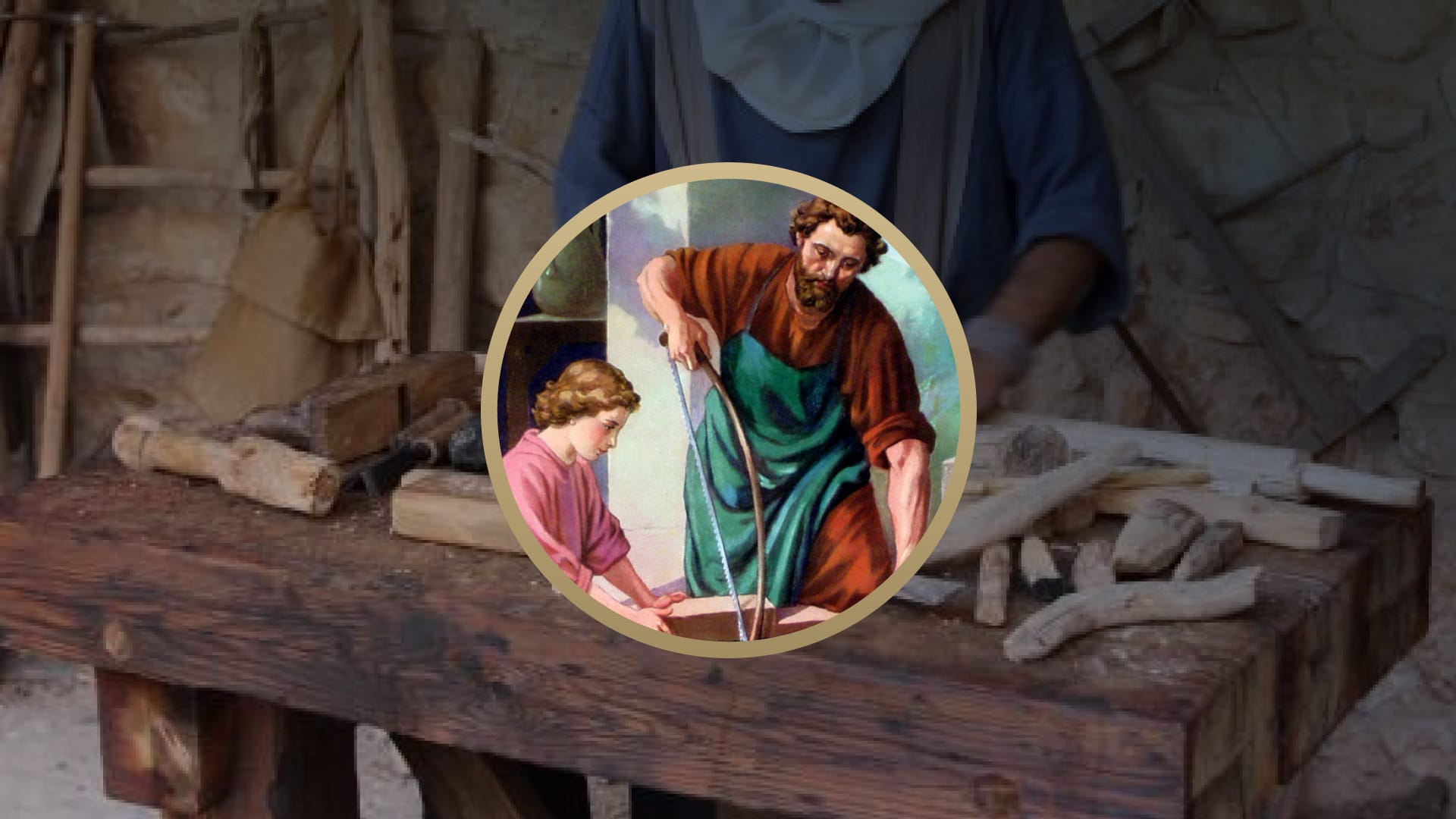
The New Testament account of the Messiah’s coming opens in an unlikely place. The setting is not in the Temple, nor is it in a palace. Rather, the narrative begins in a lowly carpentry shop. It was there that Joseph of Nazareth was called upon to lay aside his own natural reasoning and to act instead upon the Lord’s command.
Although Joseph was descended from a long line of kings and governors, he was a common worker who earned his bread by the sweat of his brow. However, the man had a notable heritage. Had there been an Israelite king in the days of the coming of the Messiah, it could very well have been Joseph! According to the genealogy recorded in Matthew 1, Joseph was a direct descendant from David and Solomon through the kings of Judah.
However, Joseph of Nazreth was not a king or governor. Instead, he was a carpenter. Not much information is given about Joseph in the Biblical record, but what is given about the man is admirable. Joseph is described in the Biblical text as “being a just man” (Matthew 1:19).
The little village of Nazareth was only 3½ miles away from the new bustling Roman city named Sepphoris. It was perhaps in this city that Joseph had the opportunity to ply his trade.
The Greek word τέκτων (tekton), usually translated as “carpenter,” is a very broad word that simply means “builder.” Joseph may have been a carpenter in the traditional sense, making yokes and plows of wood. He may have been a stone mason. Or, he may have been a skilled craftsman who could do any or all of these jobs as the need and opportunity provided.
When we first read about Joseph in Scripture, he was betrothed to a young maiden named Mary. Also, Joseph had just received the troubling news that his betrothed wife was “found with child” (Matthew 1:18). This news would have been a crushing blow to Joseph’s heart. Had Mary been unfaithful to the covenant of betrothal? The Gospel record gives only a glimpse at the agonies of Joseph’s position: “Then Joseph her husband, being a just man, and not willing to make her a public example, was minded to put her away privily” (Matthew 1:19).
What was he to do? At this critical moment as Joseph considered the agonizing decision to be made, God Himself intervened. “But while he thought on these things, behold, the angel of the LORD appeared unto him in a dream, saying, Joseph, thou son of David, fear not to take unto thee Mary thy wife: for that which is conceived in her is of the Holy Ghost. And she shall bring forth a son, and thou shalt call his name JESUS: for he shall save his people from their sins” (Matthew 1:20–21).
Sometimes, God’s will is something we have not even thought of yet. God’s revelation often conflicts with man’s reason. In this moment, Joseph was called upon to take a giant step of faith, to go against the customs of his times, and to take Mary as his wife.
We have the advantage of centuries of evidence that Jesus Christ is all that He claims to be: the virgin-born Son of God. Joseph did not have any of the advantages we enjoy.
The angel of the Lord gave Joseph a verse from the Book of Isaiah, “Behold, a virgin shall conceive, and bear a son, and shall call his name Immanuel” (Isaiah 7:14). For Joseph, this dilemma was no doctrinal discussion. This was life! A real man must believe a real angel who spoke to him a Scripture about a real woman. Human reasoning said, “It is impossible.” Faith said, “Adjust your mind, and believe the Lord instead.”
In Matthew 1:24 is given a splendid summary of the entire life of Joseph of Nazareth: “Then Joseph being raised from sleep did as the angel of the Lord had bidden him.” Swift obedience was the mark of Joseph’s life. On the basis of God’s Word, he and Mary remained betrothed.
Joseph was also obedient to the governing authorities. He submitted to Roman law. Thus, he and Mary journeyed to his ancestral village of Bethlehem to be enrolled in the census. There in Bethlehem, the Son of God entered the world, and Joseph was undoubtedly the first man to look into the face of the Savior of the world, the Lord Jesus.
According to Scripture, on the eighth day Joseph and Mary took Jesus to be circumcised and to offer a poor man’s offering for Mary’s purification. There at the Temple, Joseph heard the prophecy of Simeon, “Behold, this child is set for the fall and rising again of many in Israel; and for a sign which shall be spoken against; (Yea, a sword shall pierce through thy own soul also,) that the thoughts of many hearts may be revealed” (Luke 2:34–35).
Soon afterward, Joseph once again listened to God’s voice when the angel of the Lord warned him to flee from the wrath of King Herod. According to Matthew 2:13, he was told to take his family to the distant land of Egypt: “Arise, and take the young child and his mother, and flee into Egypt, and be thou there until I bring thee word: for Herod will seek the young child to destroy him.”
It would not have been easy for a carpenter who relied on local clients for patronage to suddenly pack up all the tools of his trade and make the long journey south to Egypt with a wife and young child. But Joseph did not hesitate, not even for a moment. He had heard the voice of God. He would obey and act accordingly. Before the sun had even risen, Joseph was on the move. “When he arose, he took the young child and his mother by night, and departed into Egypt” (Matthew 2:14).
After settling in Egypt for the time the Lord had appointed, Joseph once again heard God’s voice. The angel of the Lord appeared to Joseph in a dream, “Saying, Arise, and take the young child and his mother, and go into the land of Israel: for they are dead which sought the young child’s life” (Matthew 2:20). Again, Joseph obeyed immediately. They quickly arose, packed up, and he moved the family again as he was instructed to do.
Joseph’s intention was to return to his ancestral home in Bethlehem. However, his plans were changed by another message from the Lord. Joseph obeyed God’s direction to return to the little village of Nazareth in the hills of Galilee. It was in Nazareth the family settled, and Joseph became a witness of the growth of Jesus from a boy to a man. “And Jesus increased in wisdom and stature, and in favour with God and man” (Luke 2:52).
Joseph faithfully took his family to God’s Temple. He regularly took his wife and children up to Jerusalem to keep the feasts of Israel. It was in Joseph’s home and on at his workbench that Jesus became a man. Among the everyday events of the village people around Him, Jesus was furnished with the practical illustrations of life. He used these illustrations throughout His teaching ministry, for example: the plow, the coin, the door, the plumbline, the ledger, the ox, and the yoke.
By all evidence from Scripture, Joseph was deceased by the time that Jesus left the carpentry shop to begin His public ministry. There is no mention of Joseph in Jesus’ adult life. The fact that Jesus entrusted the care of his mother to the Apostle John is testimony to the fact that Joseph had already departed this life.
Yet, Joseph of Nazareth left behind a splendid example of how to hear and obey the voice of the Lord. May we all learn to be as Joseph was—to lay aside our own natural reasoning and instead give careful attention to the voice of God.