

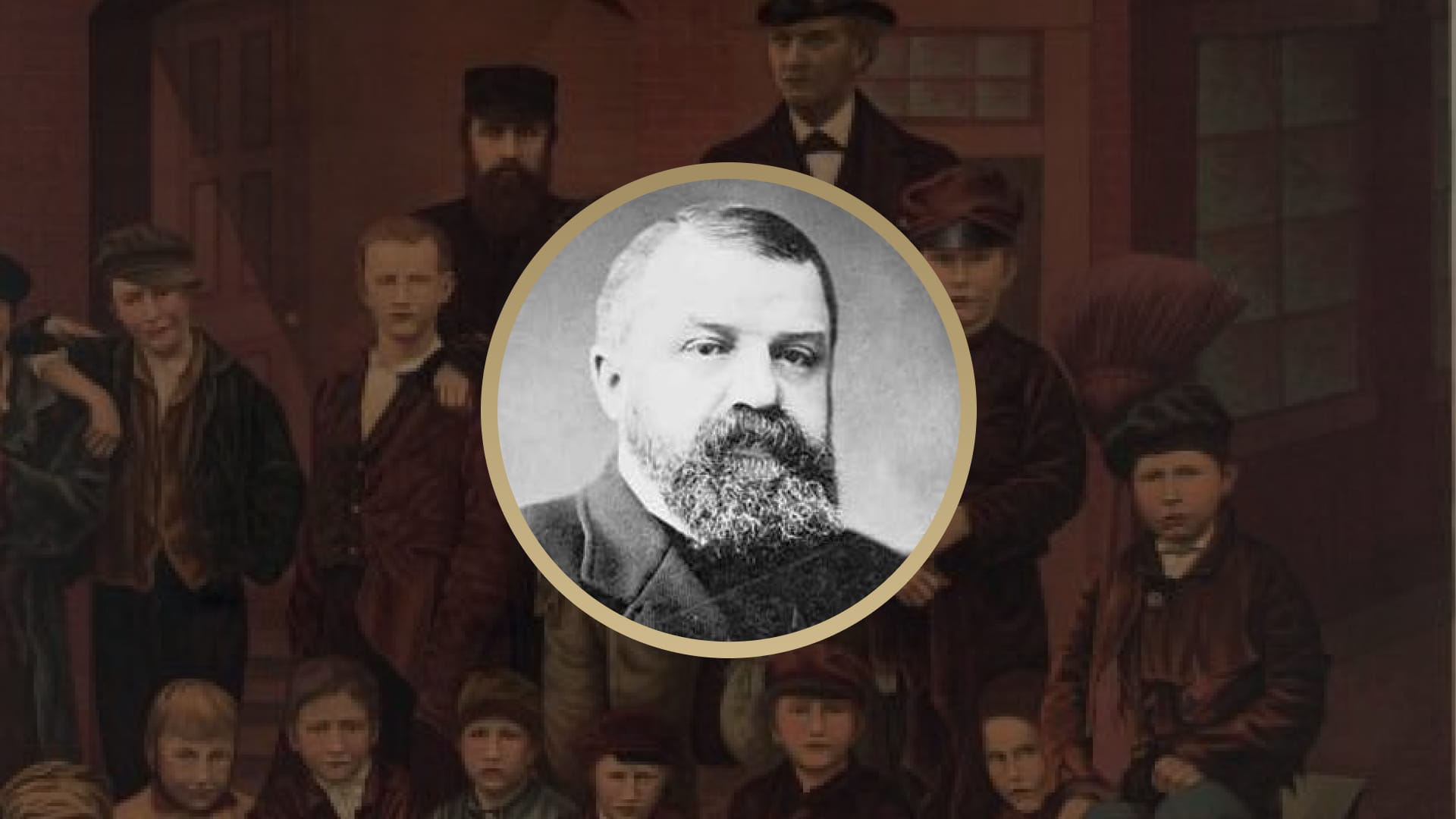
Every young boy has surely grumbled at a meal a time or two in his life. But for a young fatherless lad named Dwight, he thought he had ample cause for his complaint! His doleful fare consisted of a weak cornmeal porridge served three times a day. Day after day, week after week, month after month, with hardly any variation at all, he ate the cornmeal mush with milk.
Cornmeal porridge was served for breakfast. Cornmeal porridge was offered for lunch. And, after a hard day of labor, the fare served for supper was, once again, cornmeal porridge.
Life was difficult for Dwight L. Moody. He was born in Northfield, Massachusetts, on February 5, 1837. His father died when he was only four years old. His loving mother was left alone with nine children to raise, including twins born after the death of her husband. She was forced by necessity to send some of her children away to surrounding farms in rural Massachusetts to earn their room and board by hard work.
Finally, her son Dwight had had enough. He ran away from his farmhand home, and returned to his mother to complain to her of his hard lot in life with never-varying meals and daily drudgery. But when his mother discovered that her son had enough to eat, however plain the food, she sent her boy back to work again.
It is from such lessons that our character is formed. Dwight L. Moody honored his mother, returned to his place, swallowed his porridge, and became a man of God whose life and ministry changed the world.
Years later, while working as a shoe salesman with his uncle in Boston, his Sunday School teacher, Edward Kimball, earnestly sought him out to lead him to the feet of the Savior. Moody was a capable salesman. Life promised many great things for the enterprising teenager whose personal discipline and ability to talk to people won him many friends. But Dwight L. Moody came face-to-face with the reality of his own sin and his need for a Savior.
After his salvation, Moody moved to the growing city of Chicago, Illinois, in 1856, to advance in the business world. A bright future as a shoe salesman attracted his attention. But increasingly, Moody also had an interest in spreading the Good News. He started a Mission Sunday School and became an active volunteer in the Young Men’s Christian Association (YMCA).
In 1860, Moody entirely gave up selling shoes and devoted himself to the greater work of testifying of the free gift of salvation in Jesus Christ. His teachers and overseers saw clear evidence that God’s hand was upon him in a powerful way. His Sunday School grew in size to include over six hundred attendees!
By the time of the outbreak of the War Between the States, D. L. Moody was twenty-four years old and a prime candidate for military service. When President Abraham Lincoln issued his call for the raising of thousands of troops to invade the Southern states, Moody hesitated.
D. L. Moody was unsure about his own role in the war. He described his feelings and hesitation as being somewhat like “a Quaker.” Instead of military service, he opted for work with the United States Christian Commission of the YMCA. This charitable organization provided needed medical supplies and religious literature to the Union troops in the camps.
Moody worked long hours administering needed care to soldiers on the battlefront. He was on the field soon after the awful carnage at the Battle of Shiloh in the spring of 1862. He also labored among the troops during the campaign in the middle of Tennessee at Stones River.
During one of his breaks between visits to the Union Army, he married Miss Emma Revell, a native of England, who had assisted Moody by encouraging and teaching girls in his Sunday School in Chicago. The two were married on August 28, 1862. The Lord blessed them with a daughter, whom they also named Emma, and two sons that they named William Revell and Paul Dwight.
Emma Moody proved to be a quiet and faithful wife. She humbly served in the background as she cared for their children, kept the house during her husband’s long travels, and prayerfully assisted him in his labors.
Near the end of the war, Moody organized his growing Sunday School into a church. His efforts for the Kingdom of God reaped a spiritual harvest. The Lord mightily blessed during a period of awakening and revival as the nation recovered from years of war and devastation. Moody’s friendship with the gifted church musician Ira Sankey blossomed into a blessed partnership that lasted a lifetime as preacher and singer joined efforts for the cause of Christ.
Starting locally, Moody began to organize and conduct evangelistic campaigns. Increasingly, invitations to preach elsewhere came pouring in. The Great Fire of Chicago in 1871 burned Moody’s church to the ground. He later commented that he was only able to save his reputation and his Bible.
After the Chicago fire, Moody left the work in the city in other capable hands and moved to a small farm near his birthplace in Massachusetts. This home became his headquarters as he continued to travel and preach. Soon after the Great Fire, Moody accepted an invitation to go to England in 1872. His evangelistic efforts there were mightily blessed. Crowds came in droves to hear the preacher from America.
Moody formed a friendship with Charles Haddon Spurgeon. The famous London pastor invited the American evangelist to preach at the Metropolitan Tabernacle. While on a preaching tour in Scotland, Moody also formed a friendship with Andrew Bonar, a minister in the Free Church of Scotland. In spite of Bonar’s allegiance to exclusive psalmody and the Scottish Presbyterian tradition, Bonar saw that the Lord’s hand was upon his friend. Moody preached and Sankey sang his new compositions in Scotland; thousands were fed and blessed.
Returning to the United States, Moody soon received a flood of invitations from cities all across the North American continent. Often he preached to crowds in excess of 15,000. D. L. Moody preached in cities such as Boston and New York on the eastern coast, and all the way over to San Francisco and San Diego on the Pacific coast.
Moody’s tracts, sermons, and articles were printed and distributed around the world. He took a deep interest in the cause of foreign missions and became good friends with men such as Hudson Taylor, the intrepid missionary who opened the interior of China to the Gospel of Christ.
D. L. Moody was faithful to the end. He closed his eyes in this life just before Christmas, on December 22, 1899, as a new century was dawning. A pastor he had mentored, R. A. Torrey, continued Moody’s work as the head of the Chicago Evangelical Society (now known as Moody Bible Institute).
Moody’s life, preaching, and legacy have touched many lives all over the world. The boy who had honored his mother and had eaten obediently his simple porridge of cornmeal had grown up to honor the Lord and give the simple, nourishing Bread of Life to hundreds of thousands of souls across the globe.
Sources and Further Reference:
Dorsett, Lyle W. A Passion for Souls: The Life of D. L. Moody. Chicago, IL: Moody Publishers, 1997.