

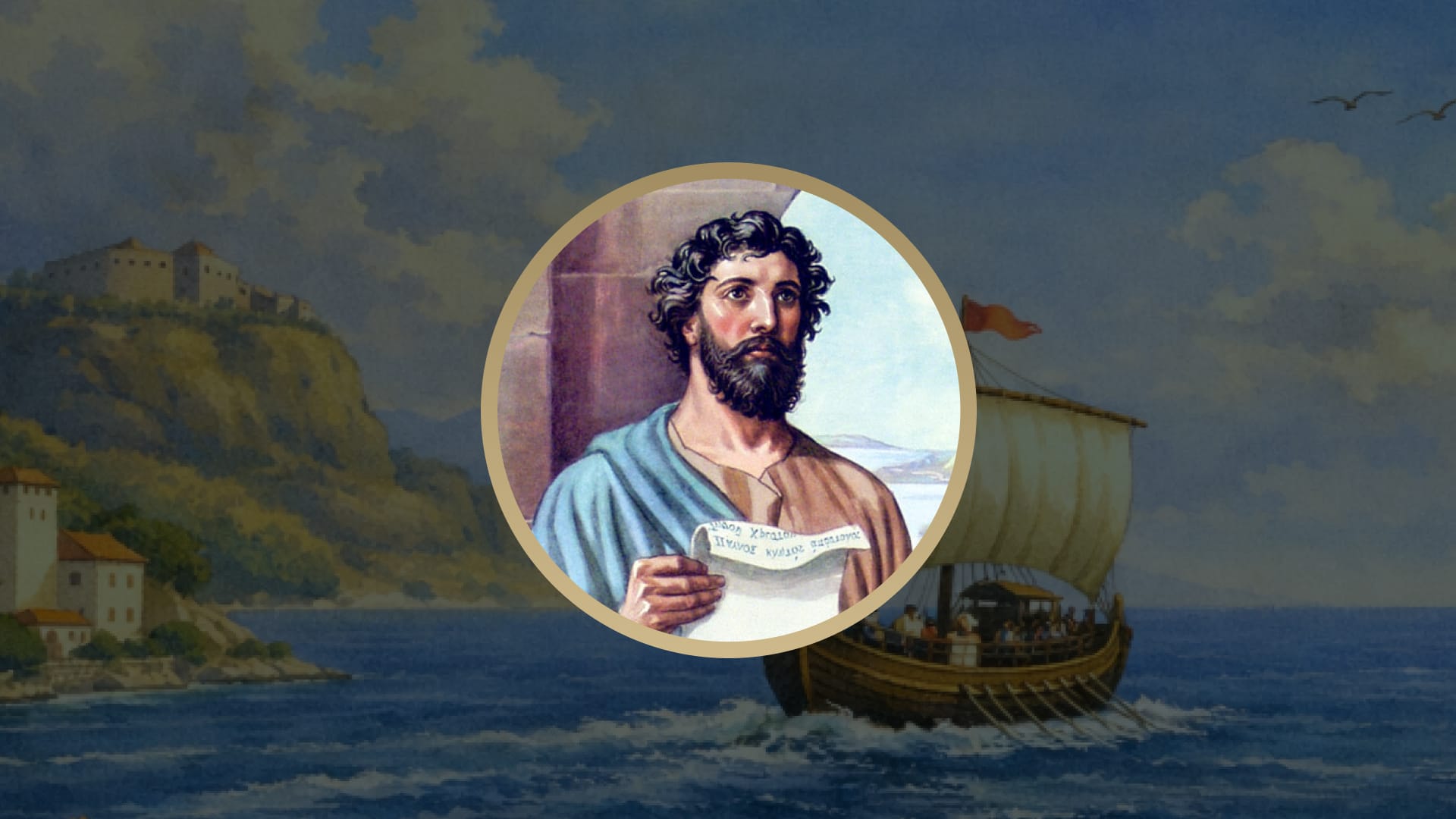
In the bustling city of Antioch, Apostles Paul and Peter encountered a delicate cultural situation. The matter occurred when they found themselves in a mixed assembly of Jewish and Gentile believers.
Since the controversies discussed at the Council of Jerusalem were still very fresh and painful, how would men of Jewish background interact with their uncircumcised brothers in Christ? Would Gentiles truly be welcomed into the communion of the saints apart from the traditional gateway of circumcision and conformity to the ceremonial and dietary laws of Moses? These questions still swirled in Antioch.
Although Peter was the man God chose in Joppa to first give the Gospel to the Gentiles in the house of Cornelius, the apostle still retained his natural upbringing and Jewish culture. Later, in a moment of weakness and fear, Peter disassociated himself with the new Gentile believers.
In his letter to the Galatian believers, Paul related the disagreement with Peter and how it was dealt with. “But when Peter was come to Antioch, I withstood him to the face, because he was to be blamed. For before that certain came from James, he did eat with the Gentiles: but when they were come, he withdrew and separated himself, fearing them which were of the circumcision” (Galatians 2:11–12).
Jesus had instructed His disciples to be willing to go to an offending brother face-to-face when there was an offense. In this encounter between Paul and Peter, we have a wonderful example of how to resolve a dispute between Christian brothers.
Both apostles were Godly men. Both of them had a Jewish background. Both of them loved the truth. However, Peter had withdrawn from his Gentile brothers when he thought he would be disdained by the Jewish brothers from Jerusalem. His brother in the Lord, Paul, was bold enough to confront Peter personally and show him the error of his ways.
It takes courage, humility, and moral courage to go to offenders with the purpose of bringing about correction and reconciliation. Paul was skilled in this practice. He has given an excellent example to follow in this tactful approach to reconciliation.
Paul, who was formerly Saul of Tarsus, was mightily used by the Lord as a preacher, missionary, and evangelist. But perhaps his greatest strength was his personal dealings with his brothers in the Lord. He had a superior education, as he had been taught by the famous rabbi, Gamaliel. Paul had noted that he was a “Hebrew of the Hebrews” and had all the credentials to rise to a promising career as a teacher of the Jewish law. Yet he wisely realized, “But what things were gain to me, those I counted loss for Christ. Yea doubtless, and I count all things but loss for the excellency of the knowledge of Christ Jesus my Lord: for whom I have suffered the loss of all things, and do count them but dung, that I may win Christ” (Philippians 3:7–8).
Confronted by Jesus Christ Himself in a dramatic encounter on the road to Damascus, Saul the persecutor was transformed by the power of Christ’s Gospel. The man laid aside his reputation, future, and career, and he threw himself into advancing the cause of Christ that he had once hindered with all his might.
At first, the converted man was held in suspicion by the Christians whom he had once persecuted. But Barnabas took Paul under his wing, and soon Paul was welcomed into the fellowship with other saints.
After a period of time that he spent in Arabia (see Galatians 1:17), Paul then returned to Damascus and visited his hometown of Tarsus (see Acts 11:25). He was sought out by Barnabas to assist with the Gospel work in Antioch, discipling the new Gentile converts to Christianity in that city.
Chosen by the Lord to go with Barnabas on the first missionary journey, Paul journeyed to the island of Cyprus, and then they traveled into the interior of Asia Minor (modern-day Turkey). There in Lystra, Paul was stoned; he realized firsthand what his service of Christ would cost (see Acts 14:19).
When the Council of Jerusalem met (see Acts 15), Paul participated and joined his testimony to the power of the Gospel to transform the hearts of men.
Over the course of the coming years, Paul would suffer many things for the sake of the Gospel. This was foretold by the risen Lord Jesus when He said that Paul “is a chosen vessel unto me, to bear my name before the Gentiles, and kings, and the children of Israel: For I will shew him how great things he must suffer for my name’s sake” (Acts 9:15–16).
Over thousands of miles of dusty roads and in every conceivable situation, Paul fulfilled Christ’s words and labored for the souls of men. The apostle summarized the afflictions he suffered for the cause of Christ in a letter to one church: “in labours more abundant, in stripes above measure, in prisons more frequent, in deaths oft. Of the Jews five times received I forty stripes save one” (II Corinthians 11:23–24).
He continued his account of his sufferings. “Thrice was I beaten with rods, once was I stoned, thrice I suffered shipwreck, a night and a day I have been in the deep; In journeyings often, in perils of waters, in perils of robbers, in perils by mine own countrymen, in perils by the heathen, in perils in the city, in perils in the wilderness, in perils in the sea, in perils among false brethren; In weariness and painfulness, in watchings often, in hunger and thirst, in fastings often, in cold and nakedness. Beside those things that are without, that which cometh upon me daily, the care of all the churches” (II Corinthians 11:25–28).
It was in these very afflictions that Paul found the truth of God’s promise: “My grace is sufficient for thee: for my strength is made perfect in weakness.” Finally, in his letter to the Corinthians, Paul completed his assessment of his sufferings and God’s grace. He summarized, on the basis of God’s promise, “Most gladly therefore will I rather glory in my infirmities, that the power of Christ may rest upon me” (II Corinthians 12:9).
This humility—this reliance upon the grace of God—gave the Apostle Paul the ability to confront and correct his brothers in the Lord when they erred. However, Peter was not the only Christian brother that Paul withstood “to the face” (Galatians 2:11).
When John Mark turned back on the first missionary journey, Paul “thought [it] not good” (Acts 15:38) to take John Mark on the second missionary journey. He strongly disagreed with Barnabas, who wanted John Mark to accompany them. The two men were in such disagreement over this issue that they parted ways.
This is another reminder how, in the service of Christ, two Godly men can come to a sharp disagreement. In the providence of God, John Mark grew in the faith and matured, no doubt having been edified as much by the rebuke of Paul as by the compassion of Barnabas. Paul later commended John Mark as “profitable to me for the ministry” (II Timothy 4:11).
When the Christians in the city of Galatia began listening to Judaizers who emphasized works over grace, Paul rebuked them boldly! He wrote, according to Galatians 3:1, “O foolish Galatians, who hath bewitched you, that ye should not obey the truth, before whose eyes Jesus Christ hath been evidently set forth, crucified among you?” As Christ commanded, Paul was able and willing to confront and rebuke those who had offended, turning them from error to truth.
In our own day of error and compromise, we need more Godly men like the Apostle Paul who have cultivated the skill of giving a proper and timely rebuke. Paul not only confronted offenders himself, he also encouraged his followers to do the same. He told Timothy, “Them that sin rebuke before all, that others also may fear” (I Timothy 5:20).
In his second letter to Timothy, Paul again instructed him to make rebuke a regular part of his essential ministry to the flock. According to II Timothy 4:2, Timothy was to “Preach the word; be instant in season, out of season; reprove, rebuke, exhort with all longsuffering and doctrine.”
Likewise, Paul wrote to Titus, “Looking for that blessed hope, and the glorious appearing of the great God and our Saviour Jesus Christ; Who gave himself for us, that he might redeem us from all iniquity, and purify unto himself a peculiar people, zealous of good works. These things speak, and exhort, and rebuke with all authority. Let no man despise thee” (Titus 2:13–15).
May God help us all to cultivate the compassion, courage, and skill of going to offenders and giving them correction with boldness and humility. When our Christian brother commits an offense against us or against another of God’s children, we are commanded by Christ and encouraged by the Apostle Paul to give a timely and proper rebuke.

 27:22
27:22