

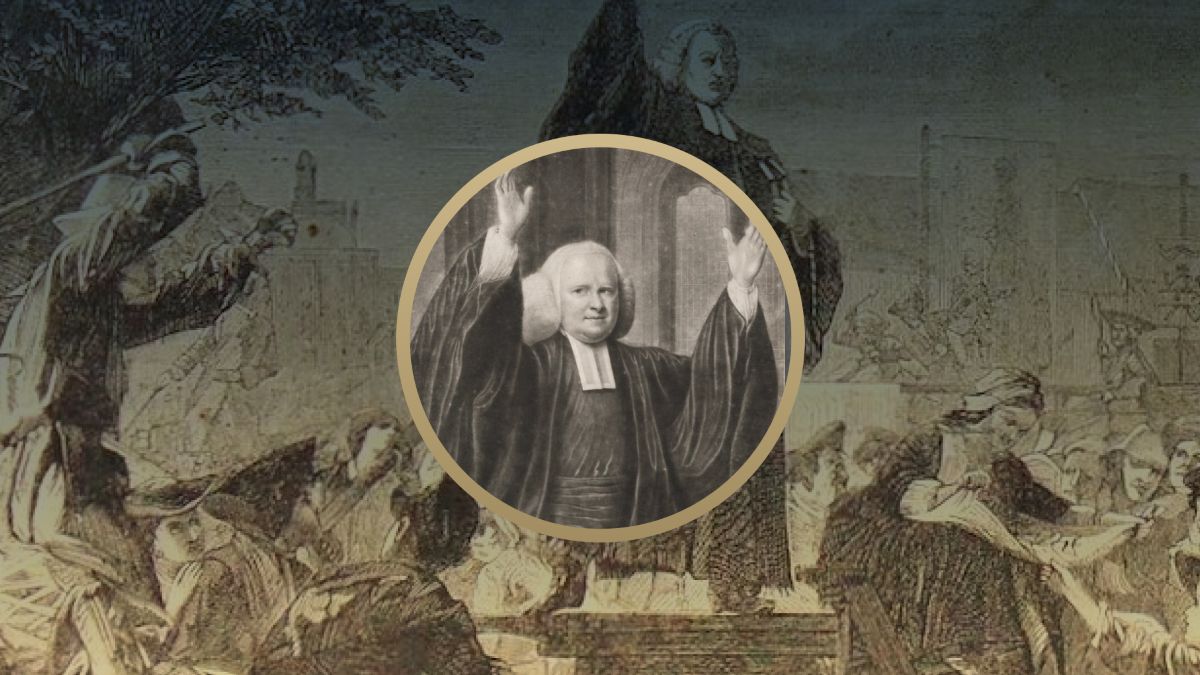
George Whitefield was born on December 27, 1714, in the English town of Gloucester. The venerable town already had an honorable heritage and was the native region of William Tyndale, the man whom God used to give His people an English Bible at the dawn of the Reformation. Similar to many worthy Christian heroes, George Whitefield was born into a poor family. His father died when he was still very young, and his mother did her best to support the family by keeping an inn. Young George assisted her at the Bell Inn on Southgate Street, but the inn failed, and the family fell into poverty.
In his youth, George Whitefield had very few religious influences. He developed a love for the theater and aspired for a time to the life of an actor. He later mourned over this period of his life, confessing that he was “addicted to lying, filthy talking, and foolish jesting.”
Through the intervention of friends, he was able to go to Oxford at the age of eighteen. He was a servitor (the lowest rank of the students at Oxford) and, as such, he was required to do menial service for wealthy students. These duties included cleaning their rooms and carrying their baggage.
During his days at Oxford, George Whitefield came into contact with John and Charles Wesley. Under the influence of these brothers and after reading the small treatise, The Life of God in the Soul of Man, the Holy Spirit began a work of mighty change in Whitefield’s heart. He became convicted of his sins, his need of God’s regenerating grace, and the hope of eternal life through Jesus Christ.
For a time, his new religious convictions were manifested in fasting and self-denial as he pursued holiness in external manifestations. He wore his hair unpowdered. He chose the plainest foods. His usual attire was a patched gown. He wore dirty, well-worn shoes in a conscious effort to deny the pleasures and pride of life. But gradually he realized that these efforts too were merely the efforts of man. He abandoned asceticism and mysticism as hindrances to genuine piety. Whitefield began to see the new birth as the gift of God by grace alone.
At the age of twenty-two, George Whitefield was ordained to the ministry of the Gospel. Few who witnessed his ordination would have guessed that this young preacher was destined to preach 18,000 sermons to at least 10 million people on both sides of the Atlantic!
Whitefield’s first pastoral charge was in London. He then pastored for a time in the rural parish of Dummer in England. Whitefield traveled to America for the first time in 1737, and preached in the colony of Georgia. During the course of his early ministry and travels, Whitefield became convinced that the churches were in desperate need of a genuine revival of God’s Holy Spirit.
Upon his return to England, Whitefield was viewed with distrust by the established clergy of the Church of England. Following the example of his Master, the Lord Jesus Christ, George Whitefield went out into the fields and meadows to preach the Gospel to the poor and unchurched. In February 1739, he began preaching one day to a small gathering of coal miners near Bristol. The crowd gradually grew as he preached from Christ’s Sermon on the Mount in Matthew 5. By the conclusion of his sermon, thousands of men, women, and children had assembled. Tears were coursing freely down the faces of coal miners, creating white streaks on faces blackened by coal dust.
Two months later, Whitefield began preaching in the open fields in London. Many thousands gathered to hear the simple Gospel proclaimed by Whitefield. He preached to the idle, the poor, the profane, the Sabbath breakers, and the widows and orphans. Soon, respectable church members were forsaking their comfortable pews to listen to Whitefield preach the Gospel in the open air.
Naturally, Whitefield aroused the wrath of some of the established clergy. He was denounced as a “sorcerer” and a “vain-glorious, self-seeking, puffed-up creature,” a “vagabond clergyman,” and even as “the antiChrist”!
Ignoring the taunts and sneers of the established clergy, Whitefield continued to preach the Gospel of Christ. The poor heard him gladly. Towns and entire communities were changed forever. Taverns closed. Marriages were restored. Idleness ceased. Sinners were converted by the hundreds and by the thousands.
From 1739 to his death in 1770, George Whitefield’s life became a life of only one purpose: to preach the Gospel of Jesus Christ. He was constantly about his Master’s business. Calls to preach were increasing on both sides of the Atlantic, and he crossed the ocean to America seven times.
He often preached thirteen sermons in a week. He would preach in private homes to small gatherings as well in open-air settings to many thousands. Benjamin Franklin, who became a warm personal friend of Whitefield’s, estimated that Whitefield could be heard distinctly by 30,000 people in the open air!
Having lost his own father while he was a young boy, Whitefield had a heart of compassion for orphans. He established Bethesda Orphanage in Georgia and pleaded everywhere for Christians to support orphans and widows in their need.
Whitefield endured much abuse for the sake of the Gospel. In addition to the slanders of the established church, he was sometimes physically attacked by mobs of sinners bent on mocking and silencing the man of God. Rotten fruit, raw eggs, and manure were often hurled at him as he preached. But he preached on without relenting. He was steadied by the Master’s promise that “In the world ye shall have tribulation: but be of good cheer; I have overcome the world” (John 16:33).
Throughout his ministry, Whitefield was supported by a generous English lady named Selina Hastings, the Countess of Huntingdon. Her kind and loyal patronage funded Whitefield’s travel expenses, and she was a major supporter of his orphanage.
In 1741, Whitefield married a Welsh widow named Elizabeth Janes. After four miscarriages, the Whitefields finally had a son born in 1743. However, the baby boy only lived four months.
After twenty-seven years of marriage, Elizabeth Whitefield died of a fever in August 1768. George Whitefield continued preaching. Despite fading eyesight and poor health, he kept up his busy schedule week after week and month after month. His preaching was earnest and heartfelt, and it honored Christ. The simple truths of the Gospel often moved him to tears, and he would weep openly as he urged sinners to repent and trust in the atonement of a crucified and risen Savior. Whitefield faithfully continued preaching to the end.
In September 1770, George Whitefield preached his final sermon. The message was from II Corinthians 13:5, “Examine yourselves, whether ye be in the faith.” After preaching for two hours to a great multitude assembled in the open fields near Newburyport, Massachusetts, he retired to his room for the night. After ascending the stairs, he turned and delivered a few words of exhortation to a small assembly of friends. He spoke until the candle in his hand had burned down to the socket. Then he retired to rest, never to rise again in this life.
One of the best tributes to the ministry of George Whitefield was given by a repentant sinner. The man approached Whitefield one day after he had finished preaching and said to him, “I came to hear you with my pocket full of stones, intending to break your head; but your sermon got the better of me, and broke my heart.”
Sources and Further Reference:
Dallimore, Arnold A. George Whitefield: The Life and Times of the Great Evangelist of the Eighteenth-Century Revival (2 Volumes). Carlisle, PA: Banner of Truth Trust, 1980.

 25:21