
Nicodemus appeared very early in the ministry of the Lord Jesus Christ, soon after the first miracle in Cana of Galilee. Shortly after the wedding, Christ went south to the city of Jerusalem. There He cast out of the Temple the people who were making financial profit from others’ worship. They did so by selling the animals needed for sacrifice at exorbitant prices to those pilgrims who came from many miles away. Christ made a scourge of cords and physically expelled those self-serving profiteers who polluted the House of God!
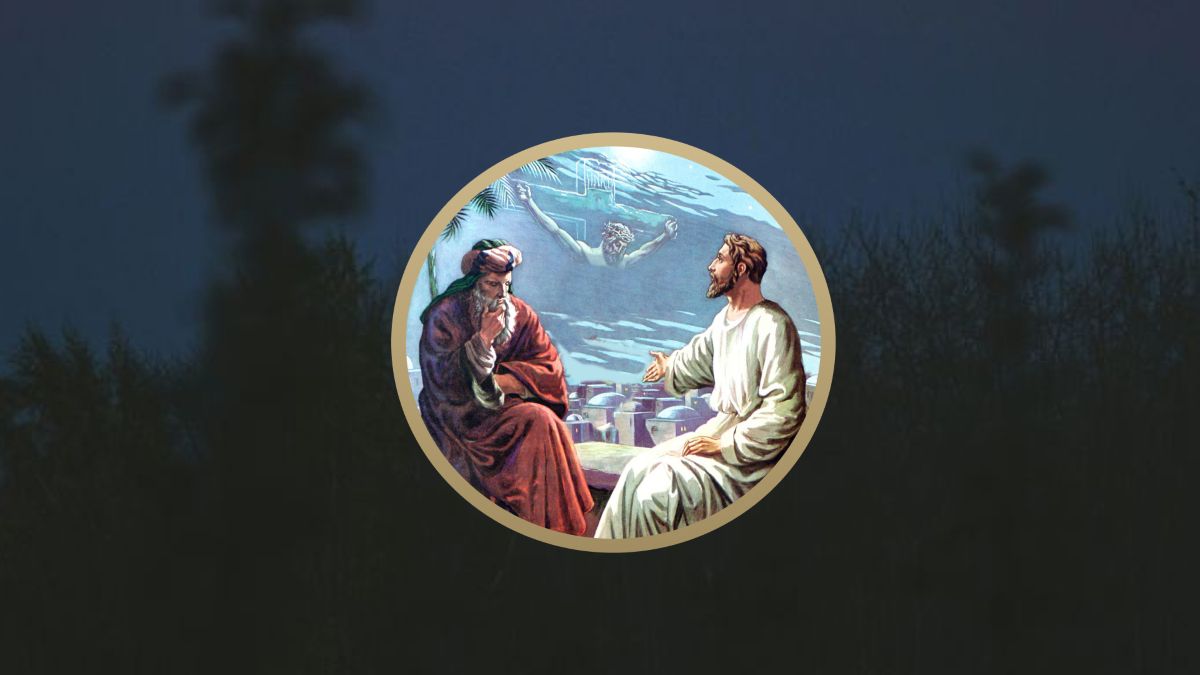
It was upon the conclusion of this purging of the Temple that Christ received a visit from the Jewish teacher Nicodemus. “There was a man of the Pharisees, named Nicodemus, a ruler of the Jews: The same came to Jesus by night, and said unto him, Rabbi, we know that thou art a teacher come from God: for no man can do these miracles that thou doest, except God be with him” (John 3:1–2).
We often err in assuming that every Pharisee in the Bible was a rascal—a scheming, deceptive, hypocritical, and impious man. However, this is a hasty generalization. The name Nicodemus is Greek and means “ruler of the people.” This Greek name marks Nicodemus as a Hellenistic Jew, of which there were not too many among the Pharisees. The Jews that were somewhat synthesized with Greek and Roman culture tended to be Sadducees or Herodians. So, this distinction makes Nicodemus unusual from the very start of this account in Scripture.
The term “ruler of the Jews” implies that Nicodemus was a member of the seventy-elder Sanhedrin, the highest tribunal of the religious system in first-century Judaism. Being in the Sanhedrin placed Nicodemus as one of the most prominent men in all of Israel. This standing is probably why Nicodemus visited Jesus at night. As a prominent rabbi and member of the Sanhedrin, he would have been very reluctant to openly visit such a man as Jesus Who had made such a stir in the Temple court. He would want no one to see him meeting with this Man!
The fact that Nicodemus addressed Jesus as “Rabbi” is astonishing. Pharisees had their own equivalent of what today is seminary training. There were two opposing schools of Pharisaical learning. One was founded by a man named Shammai, and the other was founded by a man named Hillel. Christ had attended neither of these schools, and thus He could not be properly designated as a rabbi. The word rabbi comes from the Hebrew word rabbah, meaning “great one.”
Nicodemus may have been forced by the simple truth of the miracles performed by Christ to confess what others in his class were unwilling to admit. Thus, Nicodemus was not, as he is often implied to be, a coward. At this point in the Biblical account, he may have been slightly timid and not yet willing to face his fellow Sanhedrin members as an open follower of Christ. But Nicodemus was courageous enough to accept the truth that Jesus must be a “teacher come from God” (John 3:2). This acceptance of truth is a good first step, but it is not salvation. Christ must take Nicodemus beyond this admission to something greater.
“Jesus answered and said unto him, Verily, verily, I say unto thee, Except a man be born again, he cannot see the kingdom of God” (John 3:3). This is the great need of every man, woman, boy, and girl: to be “born again” or “born from above.”
Nicodemus tried to understand the new birth with his human mind, but Jesus carefully led him from darkness to light. After Nicodemus wondered how could a man be born when he is old, Jesus responded, “That which is born of the flesh is flesh; and that which is born of the Spirit is spirit. Marvel not that I said unto thee, Ye must be born again” (John 3:6–7). There was nothing mystical or superstitious about what Jesus was saying. He was not inventing a new cult. He was not forming a new religion. His was the religion of the patriarchs Abraham, Isaac, and Jacob.
Certain things cannot be known with the human senses alone. Jesus told Nicodemus, “The wind bloweth where it listeth, and thou hearest the sound thereof, but canst not tell whence it cometh, and whither it goeth: so is every one that is born of the Spirit” (John 3:8).
In the next verse, Nicodemus confessed his perplexity: “How can these things be?” (verse 9). Nicodemus lived in a world that had plenty of religion. He was of the strictest sect of manmade Judaism, the sect that produced the massive, detailed, and sometimes contradictory Talmud. But all that religion in the world could not unlock for him the blessings of eternal life.
According to John 3:10, Jesus answered the question with another: “Art thou a master of Israel, and knowest not these things?” This question from the lips of a carpenter’s son must have driven a knife of the sharpest conviction into the heart of Nicodemus. Here he was—a scholar, a resident of Jerusalem, a Pharisee, a teacher of the Law, a member of the Sanhedrin—and yet he was ignorant of eternal life, of spiritual birth, and of the essence of Godliness!
The remainder of the passage is from the lips of Christ Himself. Nicodemus, stripped of the remainder of his religious pride, was left to listen and to ponder. Pointing the Jewish ruler to Moses’ serpent of brass lifted up in the wilderness, Jesus said that so also He must be lifted up. Jesus then gave those words which have been used by God to bring untold millions of men and women and children to an awareness of their need for the new birth: “For God so loved the world, that he gave his only begotten Son, that whosoever believeth in him should not perish, but have everlasting life” (John 3:16).
How did Nicodemus respond to these words? We are never told. Nor do we know how long that evening interview lasted. But when Nicodemus is mentioned later in John 7:45–51, it is not in a secluded chamber. Rather, this time he was in the halls of the Sanhedrin. This time it was not at night; it was in broad daylight. This time it was not in seclusion with Christ; it was in the presence of dozens of fellow Jewish doctors of the Law.
The time is believed to have been the Feast of Tabernacles in the autumn, which was before Christ was crucified in the coming spring. Two years had elapsed since Nicodemus first came to Jesus by night. A storm of controversy had, by this time, arisen in Jerusalem over the Person and work of Christ. Several attempts had already been made to either arrest or kill this troublemaker from Nazareth. According to John 7:30, “Then they sought to take him: but no man laid hands on him, because his hour was not yet come.” Christ could not be taken by the mere force of arms nor before the time appointed.
At this critical point, Nicodemus spoke out, according to John 7:50–51. “Nicodemus saith unto them, (he that came to Jesus by night, being one of them,) Doth our law judge any man, before it hear him, and know what he doeth?” Nicodemus showed great tact here. All he did was raise a point of procedure. He was referring to Deuteronomy 19:15, the law that required more than one witness in order to bring a conviction against a man.
In response, the others scorned Nicodemus. “Art thou also of Galilee? Search, and look: for out of Galilee ariseth no prophet” (John 7:52). In fact, several Old Testament prophets had come from Galilee! But blinded by their rage, the Sanhedrin overlooked the facts and relied on ridicule to overawe Nicodemus.
How Nicodemus responded is not known. But it is enough that he had stood up at a critical moment to put his fellow judges in check. His point was made. The meeting broke up with no further action against the Lord Jesus. According to John 7:53, “And every man went unto his own house.”
When Jesus was tried, condemned, and crucified, there is no mention of Nicodemus. Was he in that crowd who beheld Jesus afar off? If so, he may have remembered the words of the Master spoken to him that one night, “As Moses lifted up the serpent in the wilderness, even so must the Son of man be lifted up: That whosoever believeth in him should not perish, but have eternal life” (John 3:14–15).
Nicodemus is mentioned again for the third and final time in the Gospel record. “And there came also Nicodemus, which at the first came to Jesus by night, and brought a mixture of myrrh and aloes, about an hundred pound weight” (John 19:39). It would have been a highly unusual thing for a member of the Sanhedrin to touch a corpse, and especially during one of the feasts of Israel!
Nicodemus had made his stand with the followers of Jesus. He had laid aside the false security of empty man-made religion to experience the new birth that only Christ can give. Nicodemus was born of the Spirit. He would not perish, but would have, just as Christ promised, everlasting life!
 25:21