

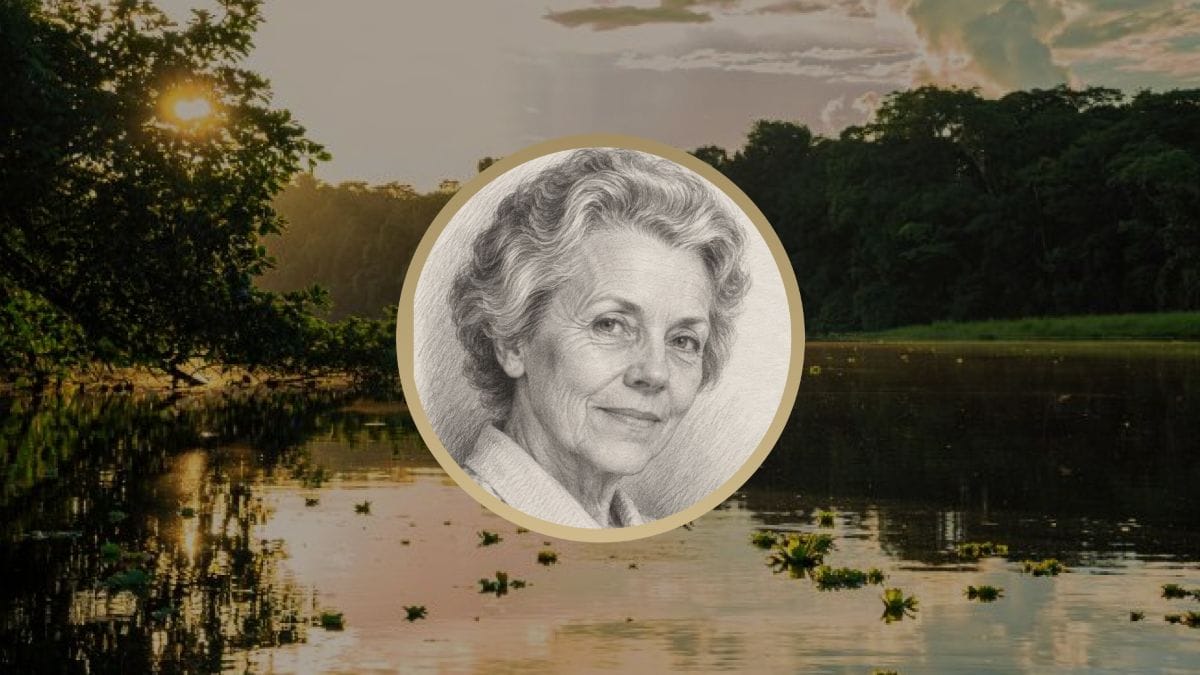
A little girl named Betty was dusting her father’s neat desk. The pad of paper was perfectly straight. The two sharpened pencils were set at an angle from the paper. Nothing else lay on the desk. As the girl dusted, she moved the pencils so that they were angled ever so slightly crooked, on purpose!
The front door opened, and a chickadee’s song warbled out as Betty’s father walked into the house. From the kitchen came an answering call! Betty’s father was a birdwatcher, and he had a special birdcall for each member of the family. In this way, he greeted his wife as returned to his home—the home that he had even named Birdsong.
Now came the moment Betty was waiting for! Her father walked over to the desk and put the pencils back to the perfect angle. Order and beauty were an essential part of Betty’s home.
Fast-forward many years later, and a grown Betty was sitting in a jungle hammock with her own little girl. She was writing to her father about the vibrant red, yellow, and blue birds of the Amazon jungle. Betty’s writing skills had developed from writing entries in their little family paper called “Chirps” to eventually becoming a best-selling author of a book titled Through Gates of Splendor.
Betty’s given name was Elisabeth. Her married name is well-known in many Christian homes—Elisabeth Elliot. She was one of the most influential Christian women of the twentieth century.
Jesus emphasized that the second great commandment in the Law was to love our neighbor. When the disciples of the first century thought of their “neighbor,” they thought of fellow Jews. But in the story of the Good Samaritan, Jesus taught them that their “neighbor” was anyone whom the Lord brought across their path! For Elisabeth Elliot, she had to learn that she must love some of the most unlovable people on the planet, even the murderers of her husband, Jim Elliot.
Elisabeth Elliot was born as Elisabeth Howard in 1926. Her parents, Philip and Katharine Howard, were missionaries in Belgium at the time of her birth. Katharine Howard was a skilled and frugal housewife. She taught all her children to be punctual and orderly in everything they did. Philip Howard was a Godly man and faithfully led family worship every day, no matter what. The Howard home was filled with Bible stories and teaching, theology, history, hymns, and love for God’s creation. While Philip and Katharine Howard were not outwardly affectionate, they were kind, and their six children knew that their parents loved them.
As a young girl, Elisabeth Elliot, then Betty Howard, knew personally another young lady also nicknamed Betty. That young lady, Betty Scott, would eventually be a missionary in China and marry John Stam. When the Howards heard of the deaths of John and Betty Stam, young Betty Howard was deeply impacted by her friend’s martyrdom. The prayer of Betty Stam became etched into Betty Howard’s heart: “Use me as Thou wilt, send me where Thou wilt, and work out Thy whole will in my life at any cost now and forever!”
Another influence on Betty Howard’s life came during her years at a Christian boarding school in Florida, far away from her New Jersey home, Birdsong. This influence was reading the books of another missionary, Amy Carmichael. Through Miss Carmichael’s writings, Betty Howard was drawn to the message of the cross, unconditional surrender, and discipleship. She admired Miss Carmichael’s “absolutely flintlike determination to be obedient.”
After graduating from the boarding school, Betty Howard entered Wheaton College. She excelled academically and was considered one of the more spiritually-minded young ladies in the school. One day, a speaker from Wycliffe Bible Translators came to the campus, giving a message about “pioneer” missionaries, those who brought the Gospel to people who had never heard it before. The presentation touched Miss Howard. She pondered what purpose the Lord might have for her in her life.
Betty Howard began to feel drawn to the mission field. She started studying Greek as a foundation for translation work. At Wheaton College, she met Jim Elliot, the one who would become her future husband. The two were very different in their personalities, but they each had strikingly similar intense desires: a commitment to follow Jesus and a determination to obey Him, at whatever cost to their lives on earth. Miss Howard wrote in her journal that Jim Elliot was “the finest fellow I have ever met.”
Jim Elliot and Betty Howard were attracted to each other, yet at the same time, they wanted God’s will for their lives above their own desires. It was clear that they were willing to deny themselves and lay their lives on the altar for Christ’s sake.
Gradually, both young people sensed a call to go to Ecuador as missionaries. Elliot believed he should at least begin missionary work as a single man and be unencumbered by domestic cares. They both went, separately, to Ecuador in 1952. That summer, the two young people worked closely together in Quito, helping veteran missionary, Dr. Wilfred Tidmarsh.
At the end of the summer, Jim Elliot and his friend, Pete Fleming, traveled southeast to the jungle at the headwaters of the Amazon basin. There they assisted with a boys’ school.
Meanwhile, Betty Howard felt called in the opposite direction—westward—to the Colorado Indians at San Miguel. Her goal was to learn their language and translate the Bible into Colorado. The Lord providentially provided Miss Howard an Ecuadorian believer named Don Macario who could help her. For many weeks she labored at the task. The progress was going well, until Macario was suddenly and needlessly murdered over a land dispute. This loss was a crushing blow to the missionary’s work. Miss Howard’s key to learning the language was gone, and for reasons she could not explain.
Still, she knew she must obey God. He had called her to the mission field. Whether or not she was ever successful on the mission field, she would press on.
As is well known, the two young people who began serving on the mission field singly eventually married. Jim Elliot and Betty Howard were married October 8, 1953, in Quito, Ecuador. They labored together for two years in Ecuador. The Lord blessed them with a daughter that they named Valerie.
Then, on January 8, 1956, the world was shocked by the news that Jim Elliot and his four companions—Pete Fleming, Ed McCully, Nate Saint, and Roger Youderian—had been brutally murdered in Ecuador by the Waorani Indians on the banks of the Curaray River. The missionary men had willingly laid down their lives for the Lord Jesus Whom they served.
The wives of these men were now suddenly widows. The women bore their own crosses bravely in spite of the heartbreak. Elisabeth Elliot, instead of returning home, remained in Ecuador with her young daughter Valerie. God had called her as a missionary, not just for her husband’s sake but for Jesus’ sake. She continued in Ecuador working, teaching, caring for sick people and helping mothers deliver babies. During those days she wrote Through Gates of Splendor, an account of the five missionaries’ martyrdom, and Shadow of the Almighty, Jim Elliot’s biography, which had already impacted countless lives in the United States.
Elisabeth Elliot was thrilled when later the opportunity came to live with the Waorani tribe, along with Rachel Saint, Nate’s sister. The work was not glamorous or easy, but similar to Amy Carmichael, Elisabeth Elliot was determined to be obedient. God began to work in the hearts of the tribesmen, and the very people who murdered the five missionaries became followers of Jesus!
In 1963, Elisabeth Elliot and her daughter returned to the United States. Her life took a different turn of service to the Lord, and never again did she return to the mission field. Elisabeth Elliot had learned that obedience to Christ was much more than following Him to a certain destination. God had been with her when she passed through deep waters and fiery trials, and He would be with her as she endured new challenges and sufferings back home. Elisabeth Elliot wrote of her trust in the Lord: “He leads us right on, right through, right up to the threshold of Heaven. He does not say to us, ever, ‘Here it is.’ He says only, ‘Here am I. Fear not.’”
Elisabeth Elliot did marry again, but she was widowed a second time when her husband died of cancer. Her third marriage lasted many years, and during that time she became a writer and speaker who influenced many women, young ladies, and girls to obey God’s voice, keep themselves pure, and endure suffering patiently. Then, in 2015, she herself passed “through the gates of splendor,” having done well as a good and faithful servant of the Lord and having served as an example of how to love our neighbor, even those who cause us pain.
Sources and Further Reference:
Elliot, Elisabeth. Through Gates of Splendor. Carol Stream, IL: Tyndale House, 1981.
Vaughn, Ellen. Becoming Elisabeth Elliot. Brentwood, TN: B&H Books, 2020.


 21:37