

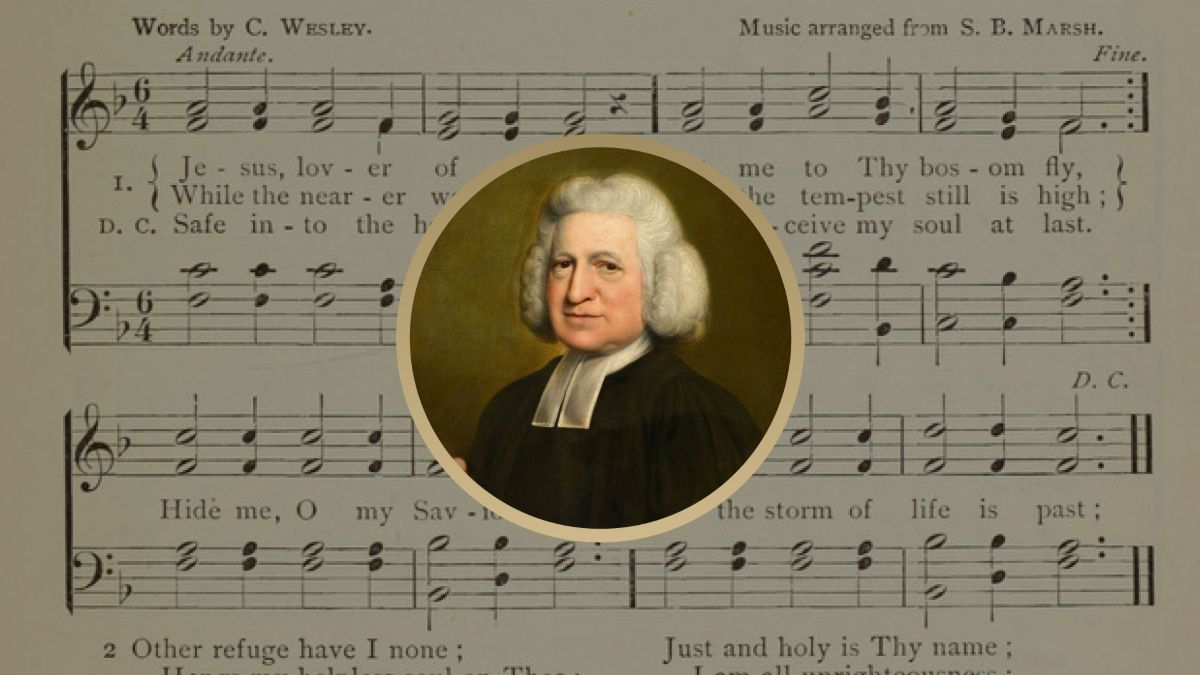
“Jesus, Lover of my soul, let me to thy bosom fly!” So begins one of the most beloved hymns ever written in the English language. The hymn gives utterance to some of the deepest feelings of the human heart, and yet it expresses them in a way that even a child can understand. “Vile and full of sin I am, Thou art full of truth and grace.” It is interesting to note that this couplet of fourteen words uses only single syllables!
The man moved by God to write this hymn was one of the most remarkable hymnwriters in church history. Charles Wesley authored more than 6,500 hymns, including such favorites as “Christ the Lord Is Risen Today,” “Hark! The Herald Angels Sing,” “And Can It Be,” “O for a Thousand Tongues to Sing,” and “Love Divine, All Loves Excelling.”
Charles Wesley was the eighteenth child born to Samuel and Susanna Wesley. Children have the potential to accomplish great things for God’s glory and to be a delightful crown to their parents; however, they also have the potential to bring heartbreak to a family. Charles Wesley was born prematurely, and his parents feared that their newest baby would die in infancy as so many of his brothers and sisters had previously. But the God Who has chosen the weak things of the world to confound the mighty saw fit to spare the weak infant to render a mighty service of praise.
A studious boy with a love for learning, Charles Wesley’s first eight years were spent under the loving instruction of his mother, Susanna. John Wesley was five years older than his brother, Charles, and the two of them were destined to later work together in the spread of the Gospel.
After studying at Westminster School for ten years, Charles Wesley entered Christchurch College, Oxford, in 1726. His older brother, John, had done so before him. John testified of his brother, Charles, “He pursued his studies diligently, and led a regular, harmless life; but, if I spoke to him about religion, he would warmly answer, ‘What? Would you have me to be a saint all at once?’ and would hear no more.”
A great change began in the heart of Charles Wesley as he and a group of like-minded fellow students started to take matters of religion seriously. In the spring of 1729, this band of Oxford students united to hold each other accountable to a strict routine of study, prayer, and rigorous mental and physical exercise. Their fellow students called them Methodists in derision of their devotion to their chosen “methods.”
At this time, Charles Wesley knew quite a bit about religion, but his striving after holiness was only an external effort, without a change of heart wrought by the power of the Holy Spirit. Charles Wesley graduated from Oxford in 1732, and he began tutoring younger pupils at the university. He was persuaded to accompany his older brother, John, who had been ordained to the ministry in the Church of England, on a missionary trip across the Atlantic to the colony of Georgia. Charles Wesley was ordained as a deacon, and the two brothers embarked for Georgia in 1735.
After a brief stay in Georgia while serving as secretary to Governor Oglethorpe, Charles Wesley sailed again for London. Mighty storms at sea shattered the tranquility of the voyage, and Charles Wesley never forgot the peaceful confidence of some Moravian Christians who sang hymns as the storm raged. Wesley realized that these believers had something that he lacked, despite all of his strict methods.
Upon reaching England, Wesley was laid low by a severe illness. During this time he thought much upon the Gospel of Christ, the simplicity of saving faith in the finished work of a crucified Redeemer apart from all human efforts. He sought out the teaching of the Moravian brethren who had so impressed him on the voyage across the Atlantic.
On May 21, 1738, Charles Wesley was born again as a child of God, abandoning all legalistic efforts to earn salvation and trusting simply in the righteousness of Christ. John Wesley was converted three days after his younger brother. Charles Wesley was seized with an irrepressible desire to share the message of the Gospel with all around him. This sentiment can be seen in his hymn, “O for a Thousand Tongues to Sing My Great Redeemer’s Praise.”
The two Wesley brothers began preaching wherever they had opportunity. Their zeal and evangelistic message was held in suspicion by the established Church of England, and the two men began preaching in the open air wherever audiences would give them a hearing. George Whitefield became their friend and fellow-laborer in the great cause of evangelism.
For ten years, Charles Wesley preached as an itinerant evangelist. At some point, he and John had a disagreement about whether or not to separate officially from the Church of England. John Wesley advocated a strict separation. Charles Wesley encouraged his friends in the growing Methodist movement to maintain their allegiance to the Church of England. However, the brothers’ disagreement never broke the close bands of unity between them, and they continued to aid and encourage one another in the work of the Lord.
John Wesley became especially known for his preaching. Charles Wesley became especially known for his hymns. It is believed that “Jesus, Lover of My Soul” was composed soon after his conversion. Phrases such as “while the nearer waters roll” perhaps were drawn from his experiences on the stormy Atlantic.
Many in the established Church thought that sentiments such as regarding Jesus as a “lover” were too familiar and not reverent enough for worship. Even his brother John excluded the hymn from his published hymn book! But Charles Wesley pointed to passages in the Song of Solomon as well as to the tender mercies of Christ displayed in the Gospel record as Biblical foundation for his text. A famous preacher of the following century, Henry Ward Beecher, once said, “I would rather have written this hymn of Wesley’s than to have the fame of all the kings that ever sat on earth.”
In 1749, Charles Wesley married Miss Sarah Gwynne, a Godly young lady who was almost half his age. She proved to be a faithful wife and loving mother to their eight children. Of these eight, only three survived their childhood: Charles, Sarah, and Samuel. Their two sons excelled in music, and their daughter was a poet like her father. Charles and Sarah Wesley had no fixed income for many years. They had to trust implicitly on God’s provision to meet the needs of their family.
Charles Wesley lived a long and fruitful life of service. When creeping old age prevented him from traveling any longer as an itinerant preacher, he settled down in Bristol and continued to preach as opportunity arose and to write hymns, even in times of illness. He lived to be eighty years old, and it is said that he wrote several lines of poetry each day. Charles Wesley lived and died testifying that the love of Christ extended freely to sinful men. He died on March 29, 1799, and entered the safe haven of the Christ Who loved him and gave Himself for him. “Safe into the haven guide, O receive my soul at last.”
Sources and Further Reference:
Tyson, John R. Assist Me to Proclaim: The Life and Hymns of Charles Wesley. Grand Rapids, MI: Eerdmans, 2008.

 23:57