

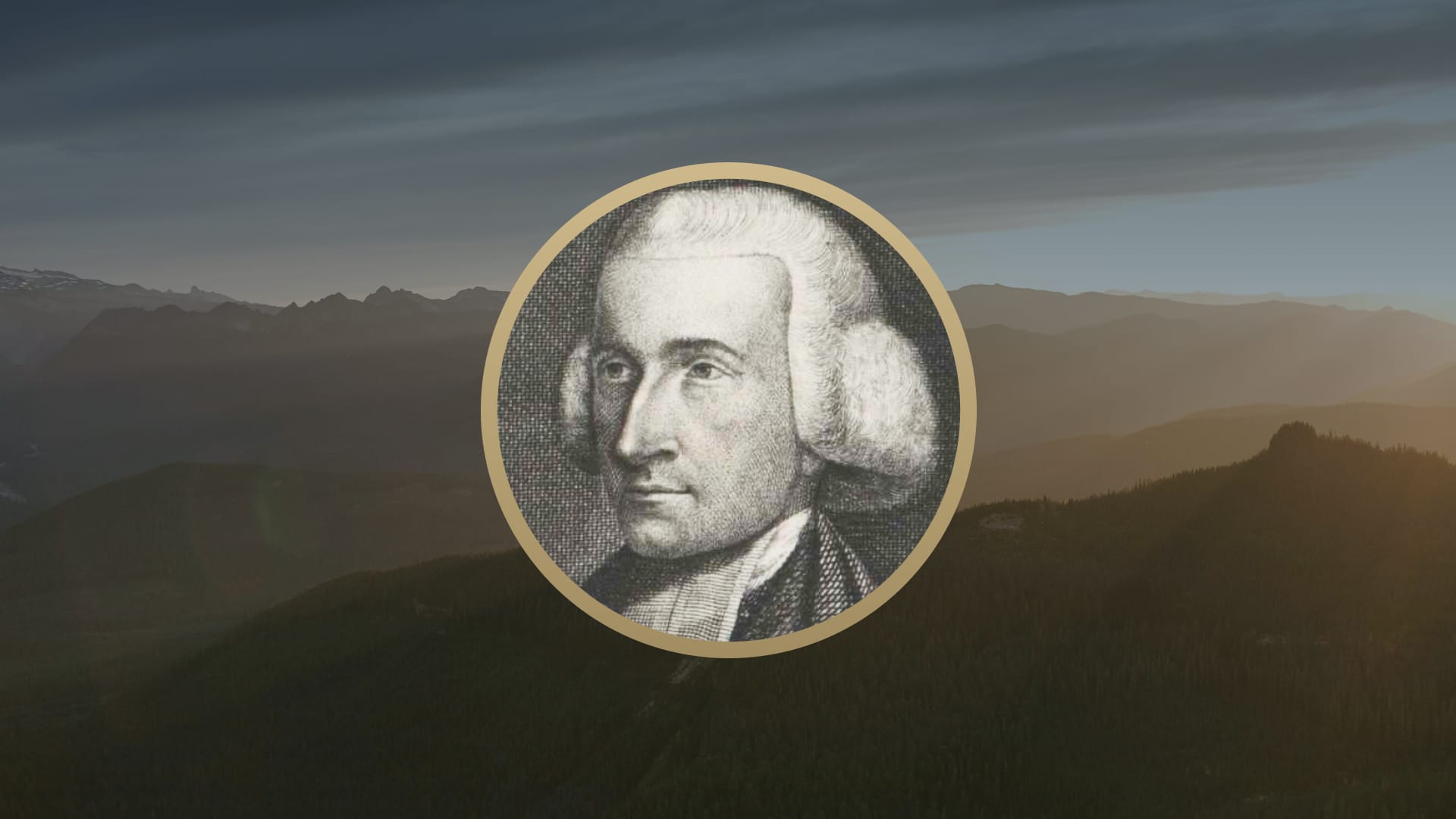
Augustus Toplady is best known for his famous hymn, “Rock of Ages, Cleft for Me.” Besides that hymn, he also authored 419 other hymns! In his many writings, it is very evident that he loved and treasured the mercy of God shown to sinful and undeserving men.
One of his hymns that is still sung today is “A Debtor to Mercy Alone.” In the following first stanza, he testifies to God’s wondrous mercy to him and the redeeming power of Christ’s shed blood to cover his sin.
A debtor to mercy alone,
of covenant mercy I sing;
nor fear, with Your righteousness on,
my person and off’ring to bring.
The terrors of law and of God
with me can have nothing to do;
my Savior’s obedience and blood
hide all my transgressions from view.
Augustus Toplady was born on November 4, 1740, in the English town of Surrey, a market town about 40 miles southwest of London. His parents were Richard and Catherine Toplady. His father was a respected officer in the British Royal Marines. His mother was a pious daughter of a churchman.
Wars between England and her rivals Spain and France were raging during Augustus Toplady’s boyhood. His father was called away to serve in the War of Jenkins’ Ear (so named for a British sea captain whose ear was disgracefully severed by Spanish officials). The war was fought mostly in the Caribbean. It is thought that Major Richard Toplady contracted yellow fever in the Caribbean. He died of the disease, leaving his young son Augustus to be reared by his mother and grandparents.
The fatherless lad was taken by his mother to be raised in London. There, Toplady attended a charity school in Westminster Abbey. At the age of fifteen, he entered Trinity College in Dublin, Ireland.
Although Toplady was reared in a Christian home by a Godly mother, he had not yet made a public profession of faith in the Lord Jesus. It was in Ireland that the Good News of God’s saving mercy made a lasting impression upon the heart of the young man.
The setting where Toplady made his decision for Christ was not an impressive nor elaborate one. In England, the young man was very familiar with religious surroundings, such as the lofty stonework of Westminster Abbey and the resonant, rich sounds of the organ and choir.
By contrast, the church service in Ireland was held inside a farmer’s barn. The preacher was an illiterate layman named James Morris. But, the man was empowered by God’s Holy Spirit, and he preached a soul-searching message of salvation! The text of his message was drawn from Ephesians 2:13, “But now in Christ Jesus ye who sometimes were far off are made nigh by the blood of Christ.”
Toplady later wrote of his conversion that day in the barn. “Strange that I, who had so long sat under the means of grace in England, should be brought nigh unto God in an obscure part of Ireland, amidst a handful of God’s people met together in a barn, and under the ministry of one who could hardly spell his name. Surely this is the Lord’s doing, and it is marvelous.”
In the second stanza of his hymn, “A Debtor to Mercy Alone,” Toplady again testified of God’s mercy in the saving and keeping of his soul.
The work which His goodness began,
the arm of His strength will complete;
His promise is yea and amen,
and never was forfeited yet.
Things future, nor things that are now,
nor all things below or above,
can make Him His purpose forgo,
or sever my soul from His love.
In 1760, Augustus Toplady graduated from Trinity College in Dublin. Afterward, he returned to London with his mother. He cultivated friendships with men such as George Whitefield and John Gill. For a time, he also had a friendship with John Wesley, but the two men later parted ways over differences concerning predestination and election. Sadly, they allowed their theological differences to become personal rather than being united in the important doctrinal truths they held in common.
In 1762, at the age of twenty-two, Toplady entered the ministry. He was already writing sacred poetry by this time. The young minister wrote his most famous hymn, “Rock of Ages,” when he was only twenty-three years old. According to some, he wrote these famous lines while taking shelter in a deep, rocky ravine near the village of Burrington as a violent thunderstorm raged around him. “Rock of Ages, cleft for me, let me hide myself in thee!”
In 1768, Augustus Toplady accepted the pastorate of a church in the small town of Broadhembury, a village in Devonshire. He never married, although he formed a close friendship with Catharine Macaulay, a lady who gained fame as an English historian. Toplady was also a friend of Selina Hastings, Countess of Huntingdon, who was a benefactor and generous supporter of the ministries of Whitefield and also John Wesley.
Toplady wrote on a wide variety of topics, both theological as well as scientific. He had a deep love for animals and wrote extensively about birds. He suggested in some of his writings that animals might very well be in Heaven in some form, seeing that God created them for His glory in the Garden of Eden.
A man who loves the mercy of God is usually a man who is merciful himself. Toplady wrote public essays against brutality to animals, and he warned that beating a horse or an ox was unethical and displeasing to God. “A righteous man regardeth the life of his beast: but the tender mercies of the wicked are cruel” (Proverbs 12:10).
Augustus Toplady died of tuberculosis in the summer of 1778. He died as he had lived, trusting in the mercy of God as revealed in His Son, the Lord Jesus Christ. Once more his hymn, “A Debtor to Mercy Alone,” spoke of his understanding of God’s enduring mercy, even to the end of earthly life—
My name from the palms of His hands
eternity will not erase;
impressed on His heart it remains,
in marks of indelible grace.
Yes, I to the end shall endure,
as sure as the earnest is giv’n;
more happy, but not more secure,
the glorified spirits in heav’n.
Sources and Further Reference:
Johnson, Guye. Treasury of Great Hymns and Their Stories. Greenville, SC: Bob Jones University Press, 1986.
Morgan, Robert. Then Sings My Soul. Nashville, TN: Thomas Nelson Publishers, 2003.

 23:50
23:50