

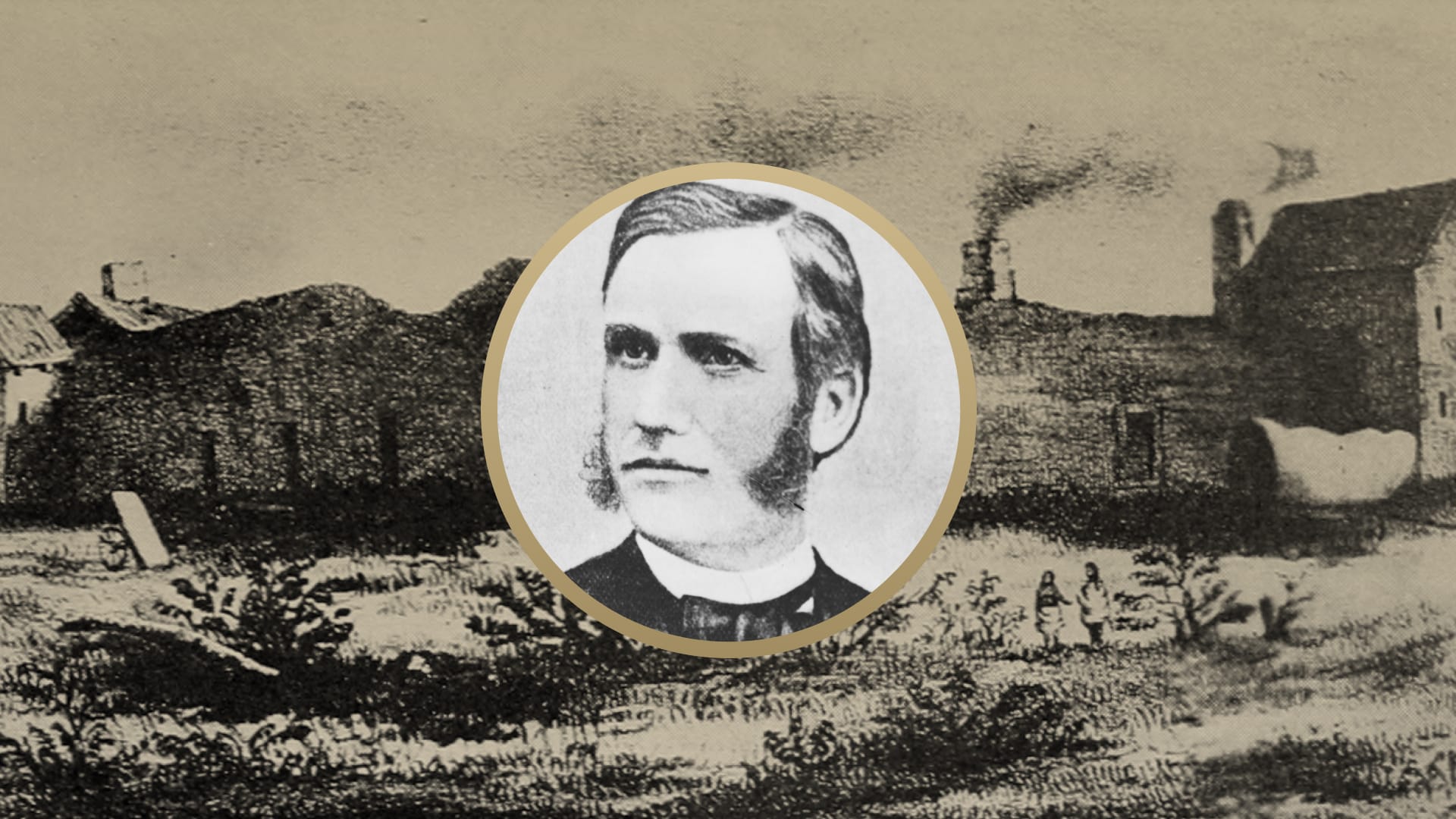
In the wee hours of the morning, Dr. Marcus Whitman rode into the mission compound at Waiilatpu, the “place of the rye grass.” Ten years earlier, the area had been a wilderness, inhabited only by wild beasts and wild men. Now there were cultivated fields, orchards, flocks of sheep, herds of cattle, and a gristmill.
This dramatically changed clearing had come to represent a clash between two cultures. On one side of the clearing were the lodges of the Cayuse, where even now could be heard the muffled death wail of a bereaved Indian family. On the other side were five covered wagons, posing a vivid picture of Westward expansion.
In the middle of these two cultures stood Marcus and Narcissa Whitman. They had left their homes in rural New York to come into this distant Northwestern wilderness with the Gospel of Jesus Christ. When they first arrived ten years earlier, some Cayuse had welcomed their influence, abandoned their pagan ways, and embraced Christianity. The Indians had ceased their witchcraft, their murders, and the horrid practice of burying alive their unwanted children. These Native Americans had learned to cultivate the ground, raise cattle, and love their children.
But some Cayuse had not appreciated the Whitmans’ sacrifice. Fear, resentment, and suspicion ran deep regarding the couple. In the last few weeks, muttered threats and secret powwows had broken out into open resentment. Indians were dying of a measles epidemic despite the best efforts of Dr. Whitman. The Cayuse custom was to kill a tewat (medicine man) if his patient died. Whitman knew that the Indians also resented the growing influx of white men from the East. But he could not change history. He could only do what he could to help the Indians adapt to a changing world.
Whitman dismounted his horse at the T-shaped mission house. The hour was late, and he was tired. He sent his wife, Narcissa, to bed so that she could get some needed rest. Little did either of them know that it was to be their last hours on earth. Whitman took his wife’s place and attended to the sick children, white and red alike, who needed his merciful aid through the rest of the night.
Perhaps a great flood of memories swept over Whitman that night. Possibly he recalled the day when he, as a young medical doctor sitting in a church in rural New York, first heard the missionary Samuel Parker tell of the tribes beyond the distant Rockies. Or maybe he reflected on the day that Narcissa Prentiss had agreed to become his wife. At their wedding, his bride had requested that the congregation sing the great missionary hymn, “Can I Leave You?” By the fifth verse, the song was stifled by sobs as his courageous Narcissa sang alone this stanza:
In the deserts let me labor,
On the mountains let me tell
How he died—the blessed Saviour—
To redeem a world from hell!
Let me hasten, Let me hasten,
Far in heathen lands to dwell.
They had already given so much. His wife Narcissa, so young and eager, was already broken in health. Whitman himself was worn with care and toil. Not far away, Alice Clarissa, their only child, rested in a shallow grave; she had drowned in the Walla Walla River at the tender age of two. The Whitmans had sacrificed wealth, home, family, friends, society, and their own health to come and labor here. But they still had one thing more they could give—their very lives—for the Indians they had come to love.
The next day, on the morning of November 29, 1847, a band of hostile Cayuse came to the main mission house and demanded medicine. As a caring doctor, Whitman could not deny their request for medicine for their sick children, so he reached for his medical bag. That action was his final act of mercy in a long life of merciful sacrifices. One of the Indian warriors slipped behind Whitman, drew a concealed tomahawk from his belt, and slammed the blade into the base of the doctor’s skull. A shot was fired, and instantly all was confusion.
Hearing the gunshot, Narcissa Whitman must have known what the sound meant. But she did not panic. Her first thought was not for herself, but for the little orphan girls of the Sager family who depended upon her. Bolting the door to her room, she gathered the children about her as a general massacre began outside. The fury of the murderers would not be restrained even by the sight of women and children. A gun was thrust into the window, and a bullet tore through Narcissa’s shoulder, wounding her severely.
Several of the immigrants from the East were slain in the yard. Andrew Rogers, a ministerial student, could have escaped, but instead he ran toward the compound to defend the women and children. As a result, he was mortally wounded. With his life’s blood ebbing away, Andrew Rogers fought on. Getting Narcissa and the Sager girls upstairs into a loft, he kept the murderers at bay for over an hour with the broken end of a gun barrel.
At last, the wounded Narcissa was lured out of the house by promises of safety. On the way out, she passed her husband lying in a pool of blood. Amazingly, he was still alive. Their conversation was brief, but the dying Whitman assured his wife of his love for her and his confidence in God’s eternal purposes. As Narcissa trustingly exited the house, a volley of shots rang out! She was instantly pierced by several balls.
Narcissa Whitman had given her all for the Cayuse. She had nursed the Indian children, taught them to read the Bible and how to pray. She had sung to them the name of Jesus. She had been faithful unto death and was to receive a crown of life.
The massacre did not end with the killing of the Whitmans. All the able-bodied men the Indians were able to find were massacred. Helpless women and children were savagely abused and held ransom for almost a month. Finally, the women and children were rescued by a series of thrilling events.
After a search that took several years, justice was eventually served upon all of the murderers. Some of the murderers were tracked into the Blue Mountains by a Christian Nez Perce chief, and some of the guilty Cayuse were slain in battle. Five of the murderers, including the two men who personally slew Marcus and Narcissa Whitman, were convicted and hanged for murder by a jury that included Indians.
What became of the martyrdom of Doctor and Mrs. Whitman? Was their sacrifice in vain? Did a young doctor and his bride waste their potential when they went “far in heathen lands to dwell”? The obscure mission station called Waiilatpu was obscure no more. Newspapers in the East were soon ablaze with the stirring account. In those days of slow mail delivery, the newspaper was how the relatives in New York first learned of the martyrdom of their loved ones in the far Northwest.
A great wave of interest in missions swept across the United States in the coming years. Boys and girls, inspired by the courage of the Whitmans, took up the banner of Christ. Henry Spalding, a steadfast friend of the Whitmans and one who had labored at the nearby Lapwai mission station, returned to the mission field following the tragedy. There he saw the reaping of a great harvest that had been sown among the Cayuse and Nez Perce. A converted chief named Timothy became a dedicated Christian. Spalding’s church in Idaho still exists to this day as a testimony to the martyred missionaries.
In the U.S. Capitol Building in Washington, D.C., stands a statue of Marcus Whitman, clad in buckskins. He holds a Bible in one hand and saddlebags filled with medical supplies in the other. His life and influence have not been in vain. Marcus Whitman had mercy upon the Cayuse even when his medical skill and compassionate care were spurned. But the merciful sacrifice of his own life was not in vain.
Sources and Further Reference:
Drury, Clifford. Marcus Whitman, M. D.: Pioneer and Martyr. Caldwell, ID: The Caxton Printers, 1937.

 21:37
21:37