

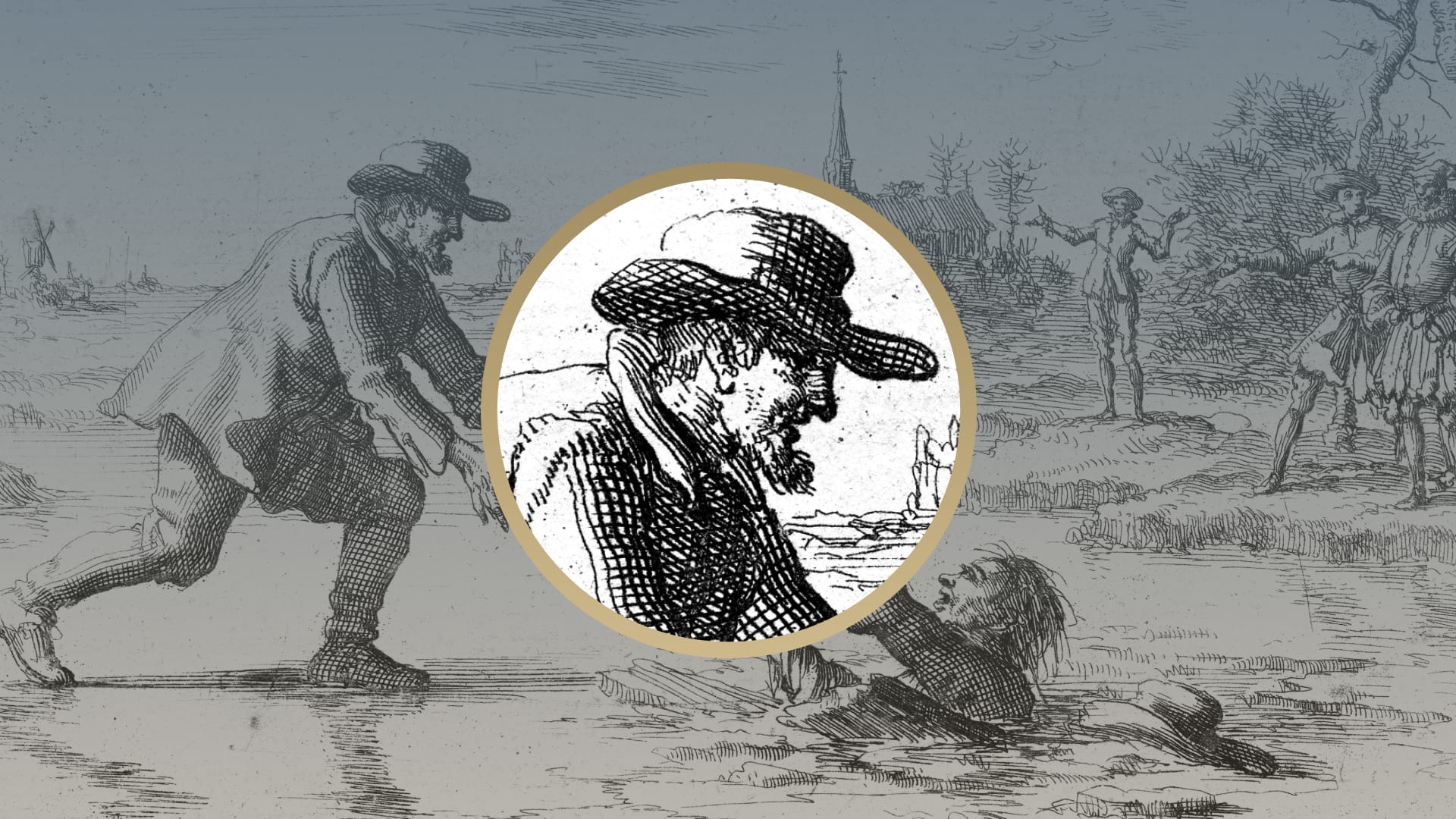
It was a cold day in the Duchy of Guelders. The year was 1569. A young man named Dirk Willems was imprisoned in the small town of Asperen in the country now known as the Netherlands. Like many of his Anabaptist brethren in the Netherlands, he was under persecution for his faith in Christ. How did he come to be here, a young man in prison?
A few years earlier, when he was a teenager living in Rotterdam, Willems had been convinced that no man could be saved apart from the Lord Jesus Christ. He had repented of his sins and trusted in Christ alone for salvation. At the age of eighteen, he had been rebaptized upon profession of faith in Christ and had endeavored to follow the Lord Jesus ever since.
During the sixteenth century, Anabaptists (so called for their practice of “rebaptizing” converts) were hunted and persecuted throughout Europe. A few years after his conversion, Willems was arrested for attending field conventicles (unauthorized church meetings in the open air) as well as welcoming other believers into his home. He had also committed the crime of hosting baptisms in his house!
By the decree of the Holy Roman Empire, which ruled the Netherlands at this time, the judges apprehended Willems and imprisoned him near his home village of Asperen. At this time in the Netherlands, the penalty for being an Anabaptist was death—by fire for men and by drowning for women. Here in prison is where our story continues.
Like any young man with his life stretched out before him, Dirk Willems hungered and longed for liberty. In prison, he secretly made a cord of knotted rags. One cold night, he let himself down from the prison wall by means of this “rope.” For a time, he was able to slip away unnoticed, but a guard noticed that one of the prisoners was escaping and began to give chase!
Young and strong as he was, Willems made good time! He swiftly fled on foot into the woods around the prison. Coming upon a body of water covered with a thin coating of ice, Willems set out carefully across the ice. He safely made it across to the other shore. His pursuer close behind, the guard started across the ice, assuming that if it held solid for the escaped prisoner, it would also hold him.
But alas! The guard was a heavier man than the prisoner he was chasing. With an ominous cracking sound, the ice gave way under the tread of the persecutor! Dirk Willems’s enemy slipped into the freezing water.
The open road lay before Willems! He was a free man now, and his pursuer would soon drown in the icy waters. But Willems stopped. Could he run away from a man in distress?
Our Lord Jesus told His disciples, “But I say unto you which hear, Love your enemies, do good to them which hate you, Bless them that curse you, and pray for them which despitefully use you” (Luke 6:27–28). Did this admonition apply to Willems? Did he need to love his pursuer? Should he do good to the very man who was seeking to do him harm?
Anabaptists have historically been known for their policy of non-violence. They do not take or bear arms in self-defense. Rather, they believe that Christians ought to suffer instead of committing any violence. It is one thing to hold this as a moral ideal. It is quite another to practice it when faced with the circumstances that Willems faced on that cold morning in 1569.
Dirk Willems made the difficult decision to have mercy upon his pursuer. He could not ignore the cries of his enemy for help. Turning back, he carefully started back out over the dangerous ice, now cracked and very treacherous. He assisted his pursuer in getting out of the treacherous water and safely onto dry land where he could change his dripping garments and be warmed by a fire.
By this time, other guards had arrived, attracted by the shouts of the drowning man for help. Dirk Willems was recaptured. Grateful that Willems had saved his life from the icy water, the guard asked that the prisoner be set free for his selfless act of mercy.
However, the guard’s request was in vain. The local burgomaster (chief executive of the village) refused to relent. He reminded the guard of the orders of the Emperor. Willems was returned to prison. There he was kept under close guard until the day of his official trial and sentence of death.
Tried before a party of seven judges, Dirk Willems was sentenced to be “executed with fire until death ensues.” He was held to be guilty of “persisting obstinately in his opinion.” The execution date was set for May 16, 1569.
On that date—a windy, spring day—Dirk Willems was taken outside of town. The place was not far from where he had done his merciful deed of saving his pursuer only a few months earlier. The crowd watched as the young man, in the prime of life, was bound fast to the stake.
The wind had picked up. Now a strong east wind was blowing. The fire was kindled, but instead of consuming the victim quickly, the fire was blown by the strong wind! The result was that Willem’s legs were savagely burned before the fire reached his upper torso.
The brave young man lashed to the stake and in the midst of the flames did not scream. Nor did he utter a single word of reproach against his persecutors. Instead, Willems followed the example of our Lord Who prayed in the midst of pain, “Father, forgive them; for they know not what they do” (Luke 23:34). So now, Dirk Willems likewise forgave his persecutors.
After a long while, the chief judge viewed the execution from astride his horse. Observing the young man’s pain and unable to bear the spectacle any longer, the judge turned his horse’s head away from the awful sight. The man also turned his back to the martyr’s torments. Then the judge ordered the executioner, “Dispatch the man with a quick death.”
The executioner stepped forward to obey. Very soon Dirk Willems was in the presence of His Redeemer. The one who witnessed the martyrdom and preserved this account for the benefit of other believers noted of Willems that “he remained immovable and steadfast unto the end.”
Sources and Further Reference:
Van Braght, Thieleman J. Martyrs Mirror. Scottdale, PA: Herald Press, 1950.


 23:50
23:50