
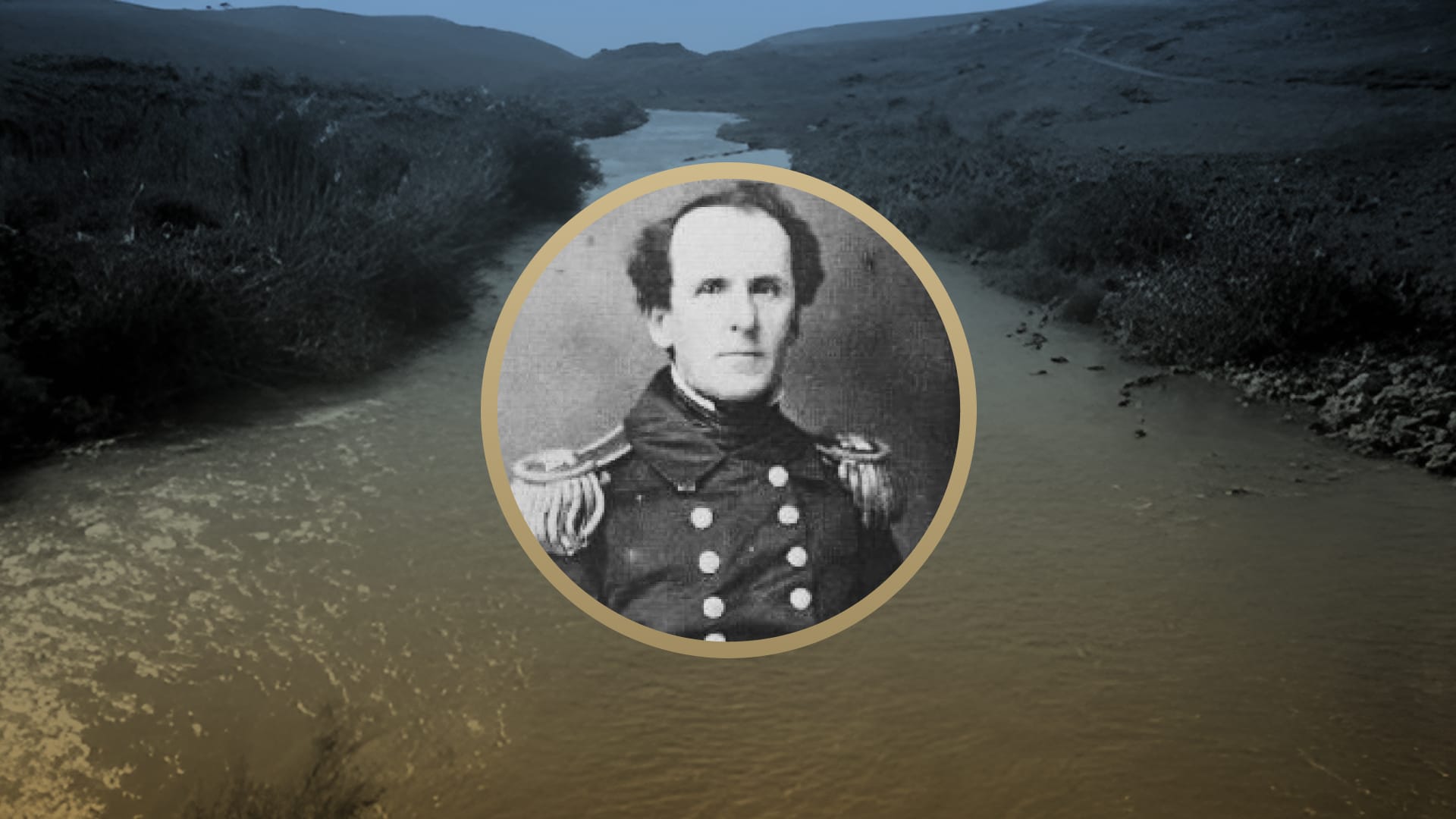
Gloom settled upon the river as the sun began to slip behind the trees. The young American naval officer, weary from a long day of river travel, peered through the gathering darkness and wished that he had already found a place to spend the night.
The young lieutenant, William Francis Lynch, had been commissioned by his superiors to explore this river and to make observations on its chemical content, width, depth, and navigability. The team also noted the flora and fauna along the river banks. The year was 1847, and the burgeoning United States of America was seeking to make her mark in the cause of exploration.
This particular river was of special interest. Rich with history, its banks were crowded with the memories of worldwide significance. Along the river, the animals and plants were of great variety, yet little scientific research had been done in this area. For this reason, Lieutenant Lynch had been commissioned to embark upon this expedition. Already he had traveled many miles and was several weeks into his expedition. But he was nearing a place that he had looked forward to visiting for a long time. He hoped to camp there that night.
Hostile tribes were on the prowl in the area. Already the expedition had been subject to occasional threats from the natives. Thus, as the men searched for a landing place, the entire party was wary. The American soldiers plied the water with their oars, their rifles and pistols at the ready. Even the native guides were very nervous as darkness fell. Soon, howling animals in the thickets added an even more imposing gloom. As the sun set, jackals barked in the woods. Dangerous animals were known to inhabit these parts, including large bears and big cats!
Finally, at about 9:30 at night, long after the sun had set, the party approached a clearing on the bank. For fifteen hours, the explorers had been on the river. They were wet, cold, and very hungry. The eyes of Lieutenant William Lynch gleamed with delight as the pale light of the moon reflected off the river. He looked upon the cleared bank with a smile of relief. They had made it!
The river was none other than the Jordan River—the same Jordan River of Biblical times. The site that Lieutenant Lynch sought was where the miracle crossing of the Jordan occurred, as mentioned in the Book of Joshua. Indeed, in 1847, Lieutenant Lynch had been given permission to outfit an expedition to explore the Jordan River, from its sources at the base of Mount Hermon, down to the Sea of Galilee, and further south to the dry wastes along the shoreline of the Dead Sea.
After he had made a blazing campfire, posted a guard of sentries around the perimeter of the camp, and had eaten a filling meal, Lieutenant Lynch pulled out his Bible and began to read again about the events that had happened here long ago.
The ground on which he was camping was the same ground on which Joshua had camped just before the children of Israel passed over the Jordan River to enter the Promised Land. Near the same spot, John the Baptist had baptized the Lord Jesus Christ in the waters of this river. An infinite God had taken on human flesh in a finite and very real world to be made like unto His brethren. The lieutenant marveled at the wonder of standing on the banks of the Jordan. From his journal we read:
My first act was to bathe in the consecrated stream, thanking God, first, for the precious favor of being permitted to visit such a spot; and secondly, for his protecting care throughout our perilous passage. For a long time after, I sat upon the bank, my mind oppressed with awe, as I mused upon the great and wondrous events which had here occurred. Perhaps directly before me, for this is near Jericho, “the waters stood and rose up upon an heap.”
Tradition, sustained by the geographical features of the country, make this also the scene of the baptism of the Redeemer. The mind of man, trammeled by sin, cannot soar in contemplation of so sublime an event. On that wondrous day, when the Deity veiled in flesh descended the bank, all nature, hushed in awe, looked on, and the impetuous river, in grateful homage, must have stayed its course, and gently laved the the body of its Lord.
Duties called Lieutenant Lynch onward from his musings. There was much work still to do.
In one of the most forgotten, yet intriguing research expeditions ever made by the United States military, Lieutenant William Lynch of the Navy and his party of officers and men explored the Jordan River. They studied the river’s entire course, from the mountain springs that gush forth carrying the water that the Bible describes as “the dew of Hermon” (Psalm 133:3), along every winding mile of its long descent, and its emptying into the Dead Sea.
The lieutenant and his men made observations and collected valuable specimens of animals, birds, plants, and rocks. The group sounded the depth of the Jordan River as well as the lakes they encountered. These men were the very first expedition to make a thorough, scientific analysis of the waters of the Dead Sea, the chemical content of the mud, and the nature of the minerals that the sea contained.
Lieutenant Lynch’s travel narrative is full of exciting adventures. He titled his work Narrative of the United States’ Expedition to the River Jordan and the Dead Sea, and it was published in 1850. William F. Lynch was not only a pious Christian officer, but he was also an expressive writer. He aptly described the sights and smells of Jerusalem with vivid eloquence. He wrote in detail about the flowers, trees, and birds he observed on this research expedition.
Lieutenant Lynch spoke of the way that he and his men made the mistake in Jerusalem of giving backshish (charity) to some poor beggars who sat near the holy places. In doing so, suddenly from seemingly nowhere, the Americans were surrounded by throngs of blind, lame, and other crippled people! At this point, their Arab guide “plied his stick vigorously.” Lieutenant Lynch later recorded that the stick “truly seemed to be gifted with miraculous powers, for the blind saw and the lame walked” as they fled from the guide’s wooden weapon!
The details of Arabian dress and food are described in exquisite detail. While he enjoyed most Arab dishes and was absolutely delighted with Turkish coffee, he took exception at the Bedouin style of making cheese. He described how they allowed the milk to curdle in the hot sunshine inside leather bags. The bags were then kneaded and squished until the sour curds oozed out.
Lieutenant Lynch decried the stubbornness of the camel and longed for the ordinary but steady American ox. Regarding the camel he wrote, “This clumsy-jointed, splayfooted, wry-necked, vicious camel, with its look of injured innocence, and harsh complaining voice, is comparably the most disagreeable.”
On the whole, the lieutenant was greatly impressed with the countryside. He took the time to meditate in the Garden of Gethsemane and to pray under the ancient olive trees. He envisioned, with almost prophetic precision, a day when the deserts would again blossom as a rose under careful cultivation.
Long before the modern state of Israel, he spoke of his hope that the Jews would once again have the strength to inhabit the land that God had promised and that the cruel, wasteful hold of the Ottoman Turks would be broken. He also hoped for the advancement of the Gospel among Jews and Arabs alike, longing for the day that all men would recognize the Lord Jesus Christ as the only Prince of peace and Desire of the nations.
The U.S. naval expedition commanded by Lieutenant Lynch paved the way for further study in the region and opened the way for American military influence and study in the land of the Bible. He went on to conduct explorations in west central Africa.
When Virginia, his native state, seceded from the Union in 1861, Lieutenant William Francis Lynch resigned his commission and served as a naval commander in the Confederate States of America (CSA) Navy. He served faithfully in the defense of Vicksburg and then along the North Carolina coast in an effort to hold those vital ports for the Confederacy.
Lieutenant Lynch died in October 1865, shortly after the War Between the States ended. This devoted Christian man is a forgotten hero of American exploration and Biblical scholarship. Yet his travel narrative remains as one of the most fascinating accounts of the land of the Bible at the dawn of the modern era.
Sources and Further Reference:
Lynch, William Francis. Narrative of the United States’ Expedition to the River Jordan and the Dead Sea. Philadelphia, PA: Lea and Blanchard, 1850.