

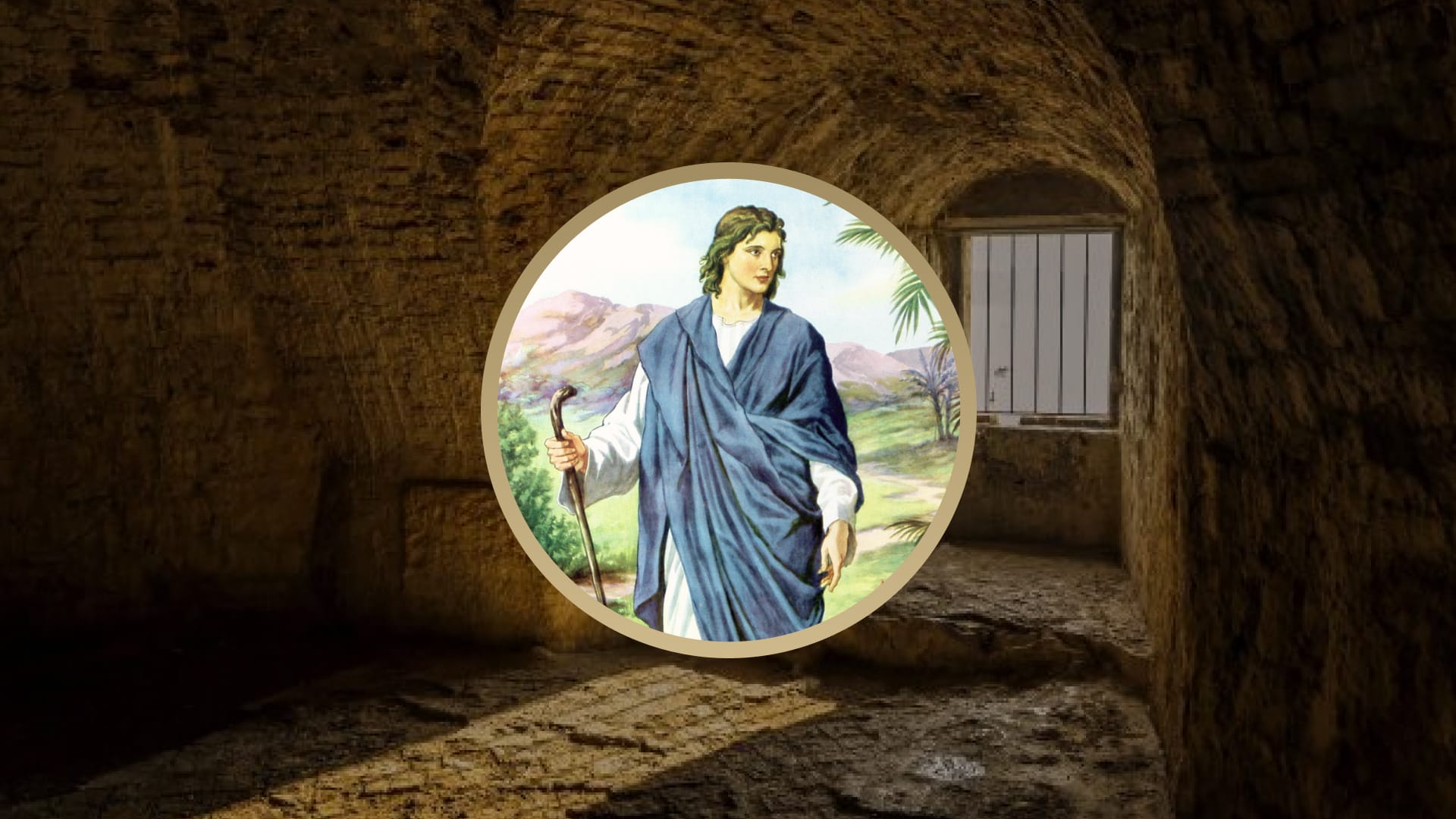
Have you ever considered the life and ministry of Onesiphorus? Except for his sacrificial service to Paul at a time of desperate need, we might not know at all of this exceptional man. Onesiphorus is a good example of a follower of Jesus who truly fulfilled the “Golden Rule”—to do unto others as they would have you to do unto them. This humble Christian is mentioned at the very end of Paul’s life, around the year A.D. 67, in II Timothy 1.
When Paul wrote his final epistle to Timothy, he was in Rome, during his second imprisonment. During Paul’s first imprisonment, he was held in a generous state of house arrest. But after his subsequent release and rearrest, the apostle was put in much harsher confinement. Paul’s letter to Timothy gives us a vivid picture of his sufferings. He spoke of metal chains and his being cold, thus desiring his cloak to be brought to him. He dreaded the coming winter.
Probably, Paul was held in the infamous Mamertine Dungeon in Rome. The cells of this dungeon were very dark, cold, and filthy. Mold grew freely on the rock walls. Rats abounded in such an environment, feeding on garbage. Initially a cistern carved out of rock, the dungeon was so low that water carrying sewage would often fill the cells.
From his cell, Paul wrote his Second Epistle to Timothy. At the time, Timothy was pastoring at Ephesus. Paul knew the end of his life was near. In this letter he wrote, “For I am now ready to be offered, and the time of my departure is at hand” (II Timothy 4:6).
What were Paul’s thoughts fixed upon as he approached martyrdom? The man was passing on his heritage to the next generation. He was opening his soul to Timothy. He was commanding Timothy to commit the Gospel “to faithful men, who shall be able to teach others also” (II Timothy 2:2). He was charging Timothy to “endure hardness, as a good soldier of Jesus Christ” (II Timothy 2:3). But before Paul launched into these weighty matters, he paused first to relate the example of a Christian who refreshed his soul while in his Roman dungeon.
In II Timothy 1:15, Paul reminded Timothy that, “this thou knowest, that all they which are in Asia be turned away from me; of whom are Phygellus and Hermogenes.” God had revealed to Paul “how great things he must suffer for my name’s sake” (Acts 9:16) at the hands of the Jews and Gentiles, of unbelievers and believers. Perhaps this latter group was who had dealt Paul some of his most difficult disappointments. Even in the first century, not all Christians were faithful.
For example, Demas had forsaken Paul, having “loved this present world” (II Timothy 4:10). So it also was with some believers from Asia Minor, now Turkey, who had traveled with Paul in Rome for a time. But Paul says that they turned away from him. He specifically named two of the deserters, Phygellus and Hermogenes. Then, in contrast, after giving the bad examples, Paul said, “The Lord give mercy unto the house of Onesiphorus; for he oft refreshed me, and was not ashamed of my chain” (II Timothy Onesiphorus 1:16).
When all abandoned Paul, at least was faithful. His name means “the profit-bearer” in Greek, and Onesiphorus lived up to his name. Paul prayed God’s blessing down upon the generous head of Onesiphorus, and not only upon him but also his whole household.
Who was this profit-bearer named Onesiphorus? First, from the context of this letter, he was probably an Ephesian Christian, from the very church where Timothy was serving as pastor.
Second, Onesiphorus was the head of a Godly family. Paul prayed for God’s blessing not only upon the father, but also upon his entire house—his wife, children, and his domestic servants. This commendation presents an admirable picture of a first-century family, who, by their combined labors, brought profit to all the lives that they touched.
Third, from the wording here in the epistle, it may be a hint here that Onesiphorus might have recently died at the time that Paul was writing this letter. The wording is quite unusual. If Onesiphorus was still alive, it seems that Paul would have greeted “Onesiphorus and his house,” rather than the wording “the house of Onesiphorus.” Whether dead or alive at the time of this letter, Paul recorded the man’s noble deed in his epistle to Timothy.
“He oft refreshed me, and was not ashamed of my chain: But, when he was in Rome, he sought me out very diligently, and found me” (II Timothy 1:16–17). The language here implies that it was not an easy task to locate Paul. Apparently, Onesiphorus was in Rome for some reason already, probably on business. However, while he was there, he made a point to look for Paul in order to refresh his soul. Paul noted that Onesiphorus had to enquire “very diligently” to find him!
It was not a light thing to search for Paul in the dungeons of Nero. Onesiphorus risked much to do this. Paul said emphatically of this courageous Christian man, “he was not ashamed of my chain.” To openly identify one’s self with a man suspected of treason against Nero was deadly! Roman history records that Nero was an extremely violent man. He was cruel, wicked, and angry; in fact, many believed the man to be insane. Paul wrote that Onesiphorus was not ashamed of being associated with a prisoner. He willingly risked his own life to go and visit Paul in the dungeon.
Note that this visit was not a one-time occurrence! Paul wrote in verse 16, “he oft refreshed me.” Time and again, while Onesiphorus was in Rome, he would make his way to the prison to supply Paul’s wants, to pray with him, sing psalms with him, and bring the aged apostle bread, a clean tunic, or an extra blanket. The word refreshed literally speaks of a “cool breeze,” ἀνέψυξεν (anepsuxen). The word vividly pictures the refreshment that Onesiphorus would have brought to Paul.
There were not many refreshing breezes in the Mamertine prison! The stench of human excrement and vomit filled the cold prison halls. The dungeon was very populated when Nero sat upon the Imperial Throne. “Refreshing breezes” were few and far between. But seeing the familiar face of Onesiphorus appearing in his cell was to Paul as a cool ocean breeze on a sweltering day. Paul’s soul was refreshed.
Paul had been so benefited by the sacrifice of this profit-bearing Christian that he lifted a prayer for the man’s family. “The Lord grant unto him that he may find mercy of the Lord in that day” (II Timothy 1:18). Here Paul used the optative Greek mood as the strongest desire and hope that could be expressed.
Paul utilized a play on the word find here in his hope for Onesiphorus. Onesiphorus had sought very diligently to “find” Paul. Now Paul asked that the Lord might grant unto Onesiphorus that he might “find” mercy of the Lord in that day! This is how God deals with His servants. Those who grant mercy are granted mercy. Christ taught His disciples this same principle in the fifth beatitude: “Blessed are the merciful: for they shall obtain mercy” (Matthew 5:7).
Paul closed his commendation of Onesiphorus with this comment to Timothy, “and in how many things he ministered unto me at Ephesus, thou knowest very well” (II Timothy 1:18). Timothy was likely no stranger to the ministry of Onesiphorus. As his pastor, Timothy perhaps knew of Onesiphorus and his service better even than Paul himself. The testimony of this “profit-bearing Christian” was a bright and shining example to all around him of courageous and profitable Christian service.
How did Onesiphorus contribute to the Kingdom of God? It was not because he was a dynamic preacher. It was not because he evangelized many cities or even the world for Christ. As far as the record goes, Onesiphorus never did anything momentous, anything that a typical modern Christian would consider important. He never planted a church. He never wrote a book. He never became a leader of men, but he was a humble soul, a father, a husband, a man who earned his living by hard work. The man was a profit-bearer: he was a cool breeze to the Christians around him. He refreshed their souls by doing unto others simply what he would desire them to do if he had been in their condition.
May the Lord give us the grace to follow the example of Onesiphorus, that we would be “profit-bearers” who bring refreshment—a cool, encouraging breeze of fresh air—to the Christians around us!


 31:19
31:19