

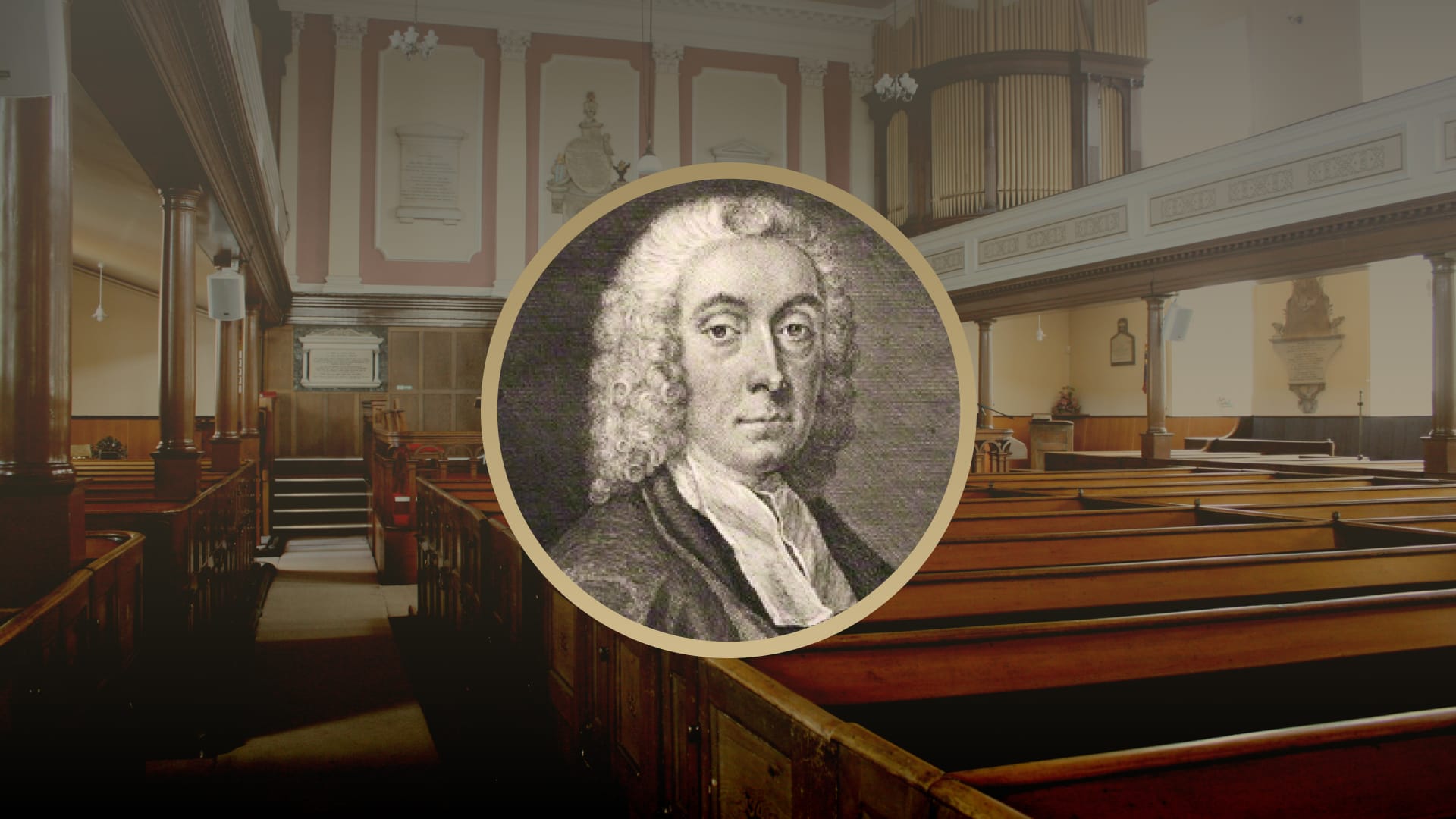
Philip Doddridge was the twentieth child born of his parents. Sadly, of the first nineteen children in the Daniel Doddridge family, eighteen of them had died in infancy. Then, when this baby boy arrived on June 26, 1702, he appeared to be stillborn. The newborn’s small body was limp and seemingly lifeless. But when the baby was laid aside, he startled all those in attendance by crying out! While it was not a strong cry, it was a cry—a cry of life!
The baby’s mother, Monica Doddridge, determined that God had given her a son and that she would raise that son for the service of the Lord. And she did.
Not only at birth, but as a child, Philip Doddridge was weak and sickly. His father was an oilman in London, in that he dealt in bottled oils and in pickles. But Philip’s paternal grandfather had been a minister of the Gospel, one of those faithful and courageous Dissenters who were ejected from their pulpits in 1662 for choosing to obey God rather than men. Philip’s maternal grandfather had also been a preacher, a Lutheran pastor from Prague.
Philip’s parents taught him to love the God of his fathers. Young Philip spent many hours sitting upon his mother’s knee, tracing the words of Scripture with his fingers. From earliest memory, he desired to become a minister of the Gospel. But his frail frame and weak lungs gave little hope of a long life or successful ministry.
When he was eight years old, Philip’s mother died. His father died four years later when Philip was twelve. Now an orphan, Philip had to rely only upon the grace of God to establish, strengthen, and settle him upon his course of life. The twelve-year-old orphan wrote in his journal, “God is an immortal Father, my soul rejoices in him; He hath hitherto helped me and provided for me; may it be my study to approve myself a more affectionate, grateful, and dutiful child.”
Adding to his sorrow, Philip’s appointed guardian squandered his small inheritance. The sickly orphan was left completely destitute. Some of Philip’s advisers told him to abandon his pursuit of the ministry and to be content with a profession that did not require so much education. In response, the young man resolved to set aside a day for earnest prayer to seek God’s face and direction. The day came, and while he was in the very act of praying, a letter arrived. The letter’s news proved that the grace of God had opened a way!
Grace! ’tis a charming sound
Harmonious to my ear;
Heaven with the echo shall resound,
And all the earth shall hear.
In the letter, a kind pastor named Samuel Clarke offered to take the orphan under his wing, give him a place to stay, educate him, and encourage his pursuit of the Gospel ministry. Philip accepted the gracious offer.
Eventually, after much labor, Philip Doddridge finished his studies and prepared to take up the ministry of the Word of God. At the age of 27, he was asked to accept a post in Northampton and to undertake the training of other young men. Yet, he thought himself too young, too weak, and too inexperienced for the task. Pondering his own weakness while walking one day, in a window above as he passed by, he heard a child reading from Deuteronomy 33:25, “As thy days, so shall thy strength be.”
Philip Doddridge determined that the voice he overheard reading Scripture was God speaking to him. The twenty-seven-year old decided to accept the call to minister in Northampton in 1729. He pastored the local congregation of Dissenters at Northampton in addition to conducting the academy for young preachers. Also, besides his weekly sermon preparation and preaching, he taught young men in the disciplines of Hebrew, Greek, algebra, trigonometry, logic, philosophy, and theology.
Grace first contrived the way
To save rebellious man;
And all the steps that grace display
Which drew the wondrous plan.
A year after taking the post at Northampton, the Lord blessed him with a wife, Mercy Maris, who was the daughter of a baker. The Lord then blessed the couple with nine children. Sadly, only four children survived to adulthood.
A man gifted with an ability with words, Doddridge often wrote hymns for the expressed purpose of accompanying the sermons that he was preparing to preach each week to his congregation. Among his most beloved hymns is the one given here in this article, stanza by stanza, extolling the grace of God. Philip trusted that the God Who had extended His grace to him as an infant would sustain him all the way!
Grace taught my wandering feet
To tread the heavenly road;
And new supplies each hour I meet,
While pressing on to God.
Doddridge is perhaps best known to history as the author of the book The Rise and Progress of Religion in the Soul. This book has aided and blessed countless believers as they seek to grow in grace and in the knowledge of the Lord Jesus. Charles Spurgeon called Doddridge’s volume “that holy book.”
Over the course of his life, Doddridge wrote more than 400 hymns. Some of the best known of these works include “O God of Bethel,” “Hark, the Glad Sound,” “Do Not I Love Thee, O My Lord?” “O Happy Day,” and “Grace! ’Tis a Charming Sound.” This last mentioned hymn closes in a stanza that testifies of the triumph of grace.
Grace all the works shall crown,
Through everlasting days;
It lays in heaven the topmost stone,
And well deserves the praise.
Doddridge was afflicted with tuberculosis for several years before his death. As his lungs grew weaker and weaker, many friends were concerned for his health. When Lady Huntington, a friend and generous patron, offered to him a voyage to Lisbon for the sake of his health, he gratefully accepted her offer with the comment, “I can as well go to heaven from Lisbon as from Northampton.”
Shortly after arriving in Portugal, on October 26, 1751, Philip Doddridge went to be with the Lord he dearly loved and faithfully served. He was not yet fifty years old. The final stanza of his hymn, “O God of Bethel,” expresses the longing of the weary traveler for rest in the arms of a gracious God.
O spread thy covering wings around
till all our wanderings cease,
and at our Father’s loved abode
our souls arrive in peace.
Sources and Further Reference:
Johnson, Guye. Treasury of Great Hymns and Their Stories. Greenville, SC: Bob Jones University Press, 1986.
Morgan, Robert. Then Sings My Soul. Nashville, TN: Thomas Nelson Publishers, 2003.



 21:37
21:37