
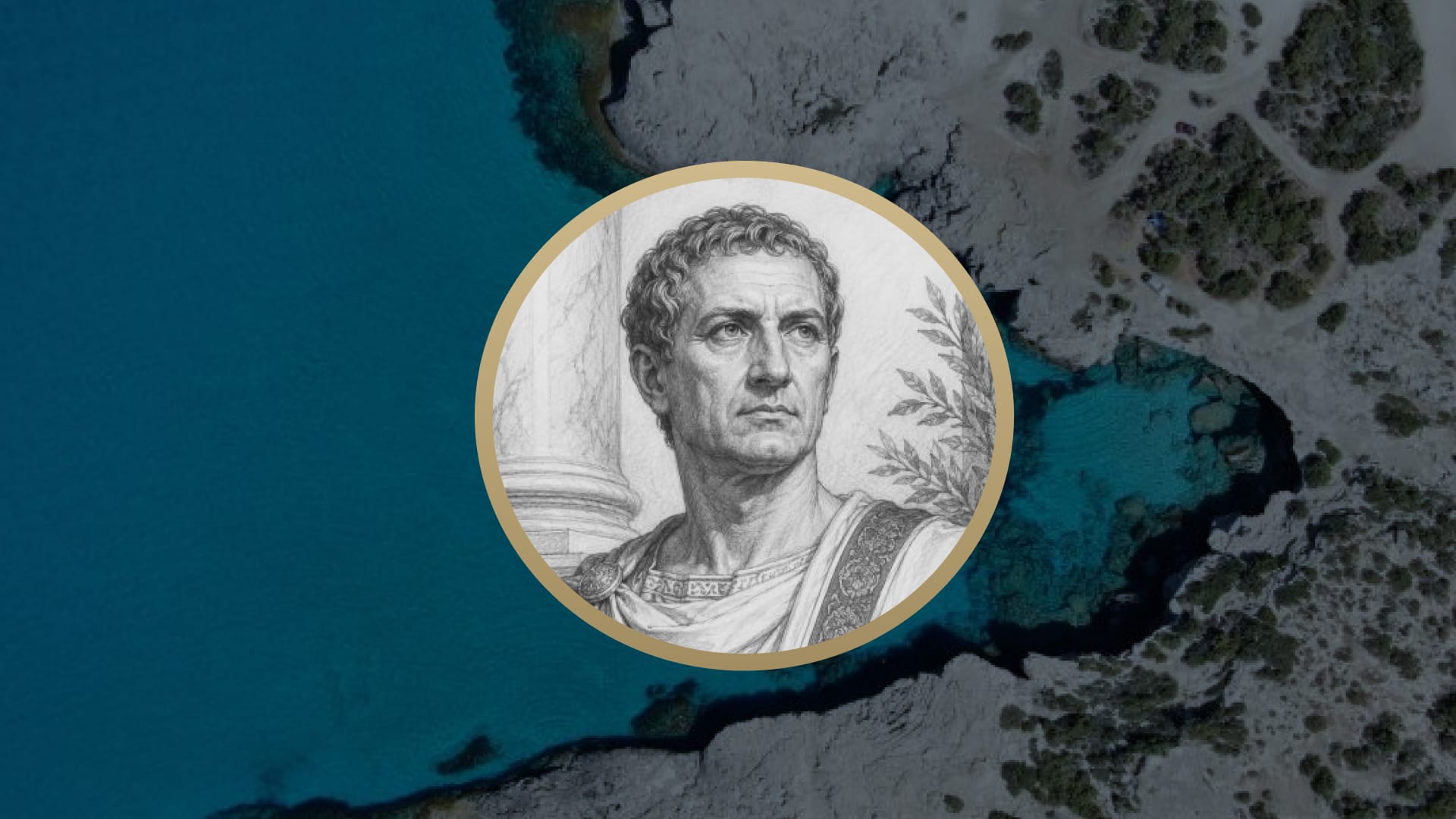
One of the most prominent converts in the Book of Acts was, without question, the highest ranking official whose salvation is recorded in the New Testament. The man was Sergius Paulus, Roman proconsul of the island of Cyprus. As such, he was of a higher rank than Pontius Pilate, Festus, Felix, or even Herod Agrippa.
Agrippa was merely a petty king, holding his title only at the grace of Rome. Pilate, Festus, and Felix were procurators, governing a district of the province of Syria. But Sergius Paulus was proconsul of the entire senatorial province of Cyprus. Thus, he was the highest official on the island, answerable only to the Roman Senate in the capital in Rome.
Recorded in Acts 13 is the account of his conversion. The Gospel of Jesus Christ knows no social bounds. From lowly slaves to high government officials, all are brothers in the Lord Jesus.
The prophet Isaiah spoke of the day when the pagan islands of the sea would come to recognize the God of Israel as King and His Word as law. “He shall not fail nor be discouraged, till he have set judgment in the earth: and the isles shall wait for his law” (Isaiah 42:4). The island of Cyprus was opened to Christianity when this Roman proconsul was converted to Christ.
As mentioned earlier, the account of this man is presented in Acts 13. The date was A.D. 46, in the first months of the first missionary journey of Paul and Barnabas. The church at Antioch was flourishing. According to Christ’s promise, the church had, by this time, spread from Jerusalem, throughout all Judea, and even to Samaria. Only one step remained—the uttermost parts of the earth!
Barnabas and Paul were selected by the Holy Spirit to embark upon the first missionary journey. The island of Cyprus was the home country of Barnabas, and it was only natural that he would go first to his own people with the Gospel.
Recorded in Acts 13:5 is the progress of the first missionary journey. “And when they were at Salamis, they preached the word of God in the synagogues of the Jews.” Salamis was a city on the eastern side of the island of Cyprus. As always, Barnabas and Paul preached the Gospel initially in the synagogue, “to the Jew first.”
After preaching in Salamis, Paul and Barnabas traversed the entire island. “And when they had gone through the isle unto Paphos [the Roman capital city on the western side of the island], they found a certain sorcerer, a false prophet, a Jew, whose name was Barjesus” (Acts 13:6). This sorcerer’s name in Aramaic was “son of Yeshua,” a common name having nothing to do with Jesus of Nazareth.
This sorcerer Barjesus was in the employ of the Roman proconsul. In pagan nations, rulers often employed sorcerers as counselors. Many of these men were astrologers and magicians who also had connections with evil spirits. They would use divination and consult witches in order that they might give supernatural help to their employers. Regarding this particular sorcerer, he was “with the deputy of the country, Sergius Paulus, a prudent man; who called for Barnabas and Saul, and desired to hear the word of God” (Acts 13:7).
Here we are introduced to Sergius Paulus. His name was Latin, and he was probably not from Cyprus. Rather, more likely he was a native Italian, sent from Rome to govern this province.
Often these posts were given to retired Roman army officers. There were two kinds of provinces in the Roman empire. First, there were imperial provinces, which were ruled by a governor who was appointed directly by the emperor. Syria was an imperial province, of which Judea and Samaria were only districts. Second, there were senatorial provinces. These were headed by a proconsul who was appointed by the Roman senate. Cyprus was of this second type.
Thus, Sergius Paulus was a man vested with authority by the Roman senate, and he was the supreme ruler on the island of Cyprus. At this same time that he was in power, the Gospel had come to his own city! According to Scripture, the proconsul here was “a prudent man” (Acts 13:7). This word prudent is the Greek word συνετῷ (suneto); it literally means “put together mentally.” The Romans were pagans, but they were knowledgeable and skilled at leading.
The Roman senate chose carefully the men who would be over their provincial interests. Sergius Paulus was prudent. He carefully weighed every decision. So, when he heard about these Jewish preachers who had entered his city, Luke recorded in Acts 13:7, “he called for Barnabas and Saul.” The verb called carries the middle voice in Greek, implying the man’s personal, rather than political, interest. Sergius Paulus called Barnabas and Saul unto himself because he “desired to hear the word of God.”
At this point, his call to hear them was probably a matter of curiosity. What was this doctrine that had caused such a stir on his island? What were the Cyprian people hearing from these two Jewish preachers? God had begun to stir in the heart of this Roman proconsul. But wherever God is at work, Satan is often nearby to oppose it!
The opposition reared its ugly head. “But Elymas the sorcerer (for so is his name by interpretation) withstood them, seeking to turn away the deputy from the faith” (Acts 13:8). According to the preceding verse, this sorcerer was with the deputy. Probably, Elymas (which means “wizard”) was the official counselor of Sergius Paulus.
The spiritual battle lines were drawn. The prize was the soul of Sergius Paulus and the dominion of Cyprus. God had sent His witnesses, Paul and Barnabas. Satan had sent his opposition, as Elymas was “seeking to turn away the deputy from the faith” (verse 8).
Then, an astonishing climax occurred! “Then Saul, (who also is called Paul,) filled with the Holy Ghost, set his eyes on him. And said, O full of all subtilty and all mischief, thou child of the devil, thou enemy of all righteousness, wilt thou not cease to pervert the right ways of the Lord? And now, behold, the hand of the Lord is upon thee, and thou shalt be blind, not seeing the sun for a season. And immediately there fell on him a mist and a darkness; and he went about seeking some to lead him by the hand” (Acts 13:9–11).
Consider the reaction of Sergius Paulus to this event! “Then the deputy, when he saw what was done, believed, being astonished at the doctrine of the Lord” (Acts 13:12). The Divine truth triumphed, and Satanic opposition was conquered!
What became of Sergius Paulus? The Bible does not say. We are left only to wonder what became of this eminent believer on the island of Cyprus. Probably he continued on as the proconsul of Cyprus and possibly joined the assembly of believers there.
Barnabas and John Mark returned to Cyprus about four years later, in A.D. 50. By that time, they apparently enjoyed perfect liberty to preach the Gospel on this island. As seen from this account about Sergius Paulus, the Gospel of Jesus Christ has the power to transform lives, governments, and societies for God’s glory.
As a newly Christian proconsul, Sergius Paulus had an ongoing duty to fulfill his obligations to advance Roman interests and policies. His duty was to render unto Caesar what was Caesar’s. However, as a follower of Christ, Sergius Paulus now had a new additional duty: to render unto God what was God’s. As a Christian, he could be a better, wiser, and more effective magistrate. May we all pray for our leaders, that they will find salvation in Christ and rule in the fear of God, knowing that “righteousness exalteth a nation” (Proverbs 14:34).
 31:19
31:19