
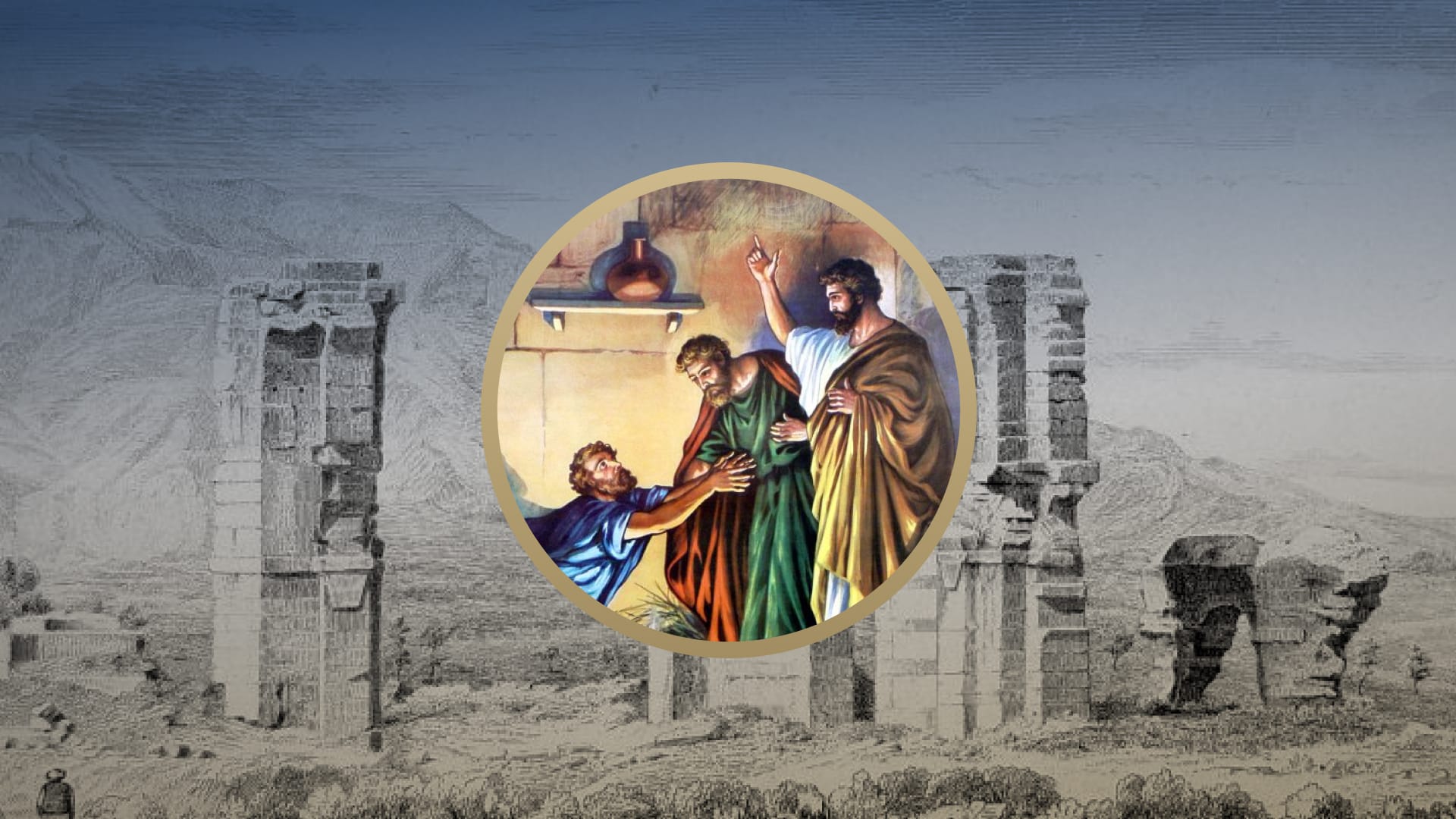
It was a dark night in the prison in the city of Philippi. Two visiting preachers from Asia Minor had been savagely beaten and placed in stocks. Blood still oozed from their open wounds. The caked, dried blood from earlier caused their ankles and wrists to stick uncomfortably to the iron bands that held them in place.
The two men’s crime? Freeing a demon-possessed girl from the clutches of Satan. The girl’s owners had been very angry at the loss of their profits because of the men’s actions. They had charged the two preachers with creating a domestic uproar.
At midnight, the two men—Paul and Silas—“prayed, and sang praises unto God” (Acts 16:25). It is not easy to sing praises when we are sad, let alone when we are in the midst of pain and utter misery. But Jesus had commanded His disciples to “rejoice and be exceeding glad” when they suffered persecution for the sake of His name. “Rejoice, and be exceeding glad: for great is your reward in heaven: for so persecuted they the prophets which were before you” (Matthew 5:12).
Silas stands in Scripture as a man who learned the value of rejoicing in the midst of persecution. He was a man of deep, sincere humility, often appearing in second place. He was named seventeen times in the Bible, sometimes by his Greek name, Silas, and sometimes by his Latin name, Silvanus.
This disciple is mentioned in five New Testament books. Silas was not at all a minor player in New Testament events; in fact, he was noted to be one of the “chief men among the brethren” (Acts 15:22). He was esteemed by Peter, and Silas was handpicked by Paul as his right-hand man during his second missionary journey. Yet, always, we find Silas taking the humble station.
We first meet Silas in Acts 15 in connection with the council at Jerusalem, which took place shortly after Paul’s first missionary journey with Barnabas. The council was called to decide a vital question: whether or not it was necessary for a converted Gentile to be circumcised and keep the ceremonial laws of the Mosaic Covenant.
The Judaizers spoke. Peter spoke. Paul commented too. James the brother of Jesus gave his verdict. By insight from the Holy Spirit and by Scriptural application, the elders at the council came to a spiritual decision regarding the application of God’s Word to the matter. James uttered the decision for the church: “Wherefore my sentence is, that we trouble not them, which from among the Gentiles are turned to God: But that we write unto them, that they abstain from pollutions of idols, and from fornication, and from things strangled, and from blood” (Acts 15:19–20).
When this decision was declared, according to Acts 15:22, “Then pleased it the apostles and elders with the whole church, to send chosen men of their own company to Antioch with Paul and Barnabas; namely, Judas surnamed Barsabas and Silas, chief men among the brethren.” Here we meet Silas for the first time. He is called here, along with Barsabas, one of the “chief men among the brethren.” This is no small compliment! Even among these spiritual giants, such as James, Peter, and Paul, Silas is called one of the “chief men” of the church at Jerusalem.
This mention of Silas has caused many to wonder if he was among the seventy who had been chosen and sent out by the Lord Jesus to teach and preach during His ministry in Galilee. Obviously, Silas was held in high esteem very early on in the Book of Acts record.
In this same passage, Silas is called a prophet, a proclaimer of truth. After Judas Barsabas went back to Jerusalem from his assignment at Antioch, “it pleased Silas to abide there still” (Acts 15:34). It was in Antioch that the Apostle Paul chose Silas to accompany him on his second missionary journey.
There were many fine men in Antioch. They are listed in Acts 13. This congregation is the splendid church of the New Testament at this point. But of all the qualified men at Antioch, Silas was the man the Lord led Paul to choose. Silas was uniquely qualified for the work he had before him for several reasons.
First, Silas was a Jew. He was a member of the church at Jerusalem. As such, he would have credibility in the synagogues where Paul planned to go. Second, Silas was experienced. There is good evidence that Silas was saved during the ministry of Christ and was perhaps one of His seventy disciples. Thus, Silas was no stranger to missionary work. In fact, he was more experienced than Paul at this point! Third, Silas was a free Roman citizen. This fact would be beneficial to him in traveling throughout the Roman world. With these qualifications, Silas would be accepted among Jews, Greeks, and Romans alike.
His name symbolizes this ability to avail several cultures. Silas is the Greek version of the Hebrew Saul. The Latin version, Silvanus, occurs often in Scripture also. Thus, he was Saul to the Jews, Silas to the Greeks, and Silvanus to the Romans.
Silas was with Paul throughout the second missionary journey, acting as his second man. This position was a remarkable station of humility. Silas had probably been a believer longer than Paul. He was more experienced than the apostle, as well as he was an esteemed member of the church at Jerusalem. Yet Silas submitted to Paul, the one whom God had placed in authority.
Returning to the beginning of this account, we find Silas with Paul in prison in Philippi, having been arrested and beaten. As the two men sang praises to God while in the prison, the Lord demonstrated His approbation by sending an earthquake that shook the foundations of the prison and loosened their bands.
Previously, Silas had shared in the joy of Lydia’s conversion. He had rejoiced when the Philippian jailor was saved. Silas had worked at Thessalonica and ministered to the brethren at Berea, as well as when opposition forced Paul to leave the city. Silas and Timothy stayed behind in Berea to nourish the young church. Later, Silas rejoined Paul at Athens. Thereafter, Paul sent Silas to return to Macedonia. Then Silas rejoined Paul again at Corinth. In Corinth, he worked with Paul, and they stayed in the home of Aquila and Priscilla.
For a glimpse of the activity of these days, we look at II Corinthians 1:19. “For the Son of God, Jesus Christ, who was preached among you by us, even by me and Silvanus and Timotheus, was not yea and nay, but in him was yea.” Silas was not just a tagalong. He had an active share in the work, preaching the Gospel alongside Paul.
With the close of Paul’s missionary work at Corinth, a curtain falls over the life of Silas. He is not mentioned again in the record of the Book of Acts. Paul does mention him in both epistles to the Thessalonians and in the Second Epistle to the Corinthians. He mentions Silas warmly and lovingly. But Silas is not seen again in the action in the Bible.
Scripture would be totally silent regarding Silas if it were not for one more reference. The Apostle Peter wrote to the saints, mentioning Silas’s ministry. “By Silvanus, a faithful brother unto you, as I suppose, I have written briefly, exhorting, and testifying that this is the true grace of God wherein ye stand” (I Peter 5:12).
Note that little phrase, “as I suppose.” While the phrase sounds like it is just a conjecture, as in “I suppose so,” it is actually much more than that. The word rendered in English as “suppose so” is, in fact, a very strong verb in Greek. It is the word λογίζομαι (logizomai), the word from which we get our word logic. Essentially, Peter said, “I have reckoned it up carefully,” or “I have considered it, and I deem that Silas is a faithful brother.”
Peter said that he wrote his letter “by Silvanus.” This implies much more than is apparent on the surface. He was not merely saying that he sent the letter by Silvanus’s hand. What then did Peter mean by his statement?
Consider that Peter was a mere fisherman. His native tongue was the rough Aramaic of Galilee. So rough was his speech that at the trial of Jesus, those standing by knew that Peter was a Galilean because of his accent. Yet his epistle is written with a very polished Greek style. How did Peter’s words get into Greek? Some have supposed that Peter dictated the letter in Aramaic, and that it was Silas that set it down in the Koine Greek of the day. Thus, Peter wrote his letter “by Silvanus,” also known as Silas.
Silas served joyfully and humbly in second place to Paul. Then he served humbly alongside Peter. In fact, we never find Silas in the forefront in the entire New Testament. He always served quietly, rejoicing in hope and patient in tribulation.
Can the same be said of you as was written of Silas? Do you rejoice in persecution? Do you serve humbly when you are not in the limelight? Are you willing to sing praises to God, even in dire situations, such as in prison? May God give us all the grace to follow the worthy example of Silas.
 29:15
29:15