
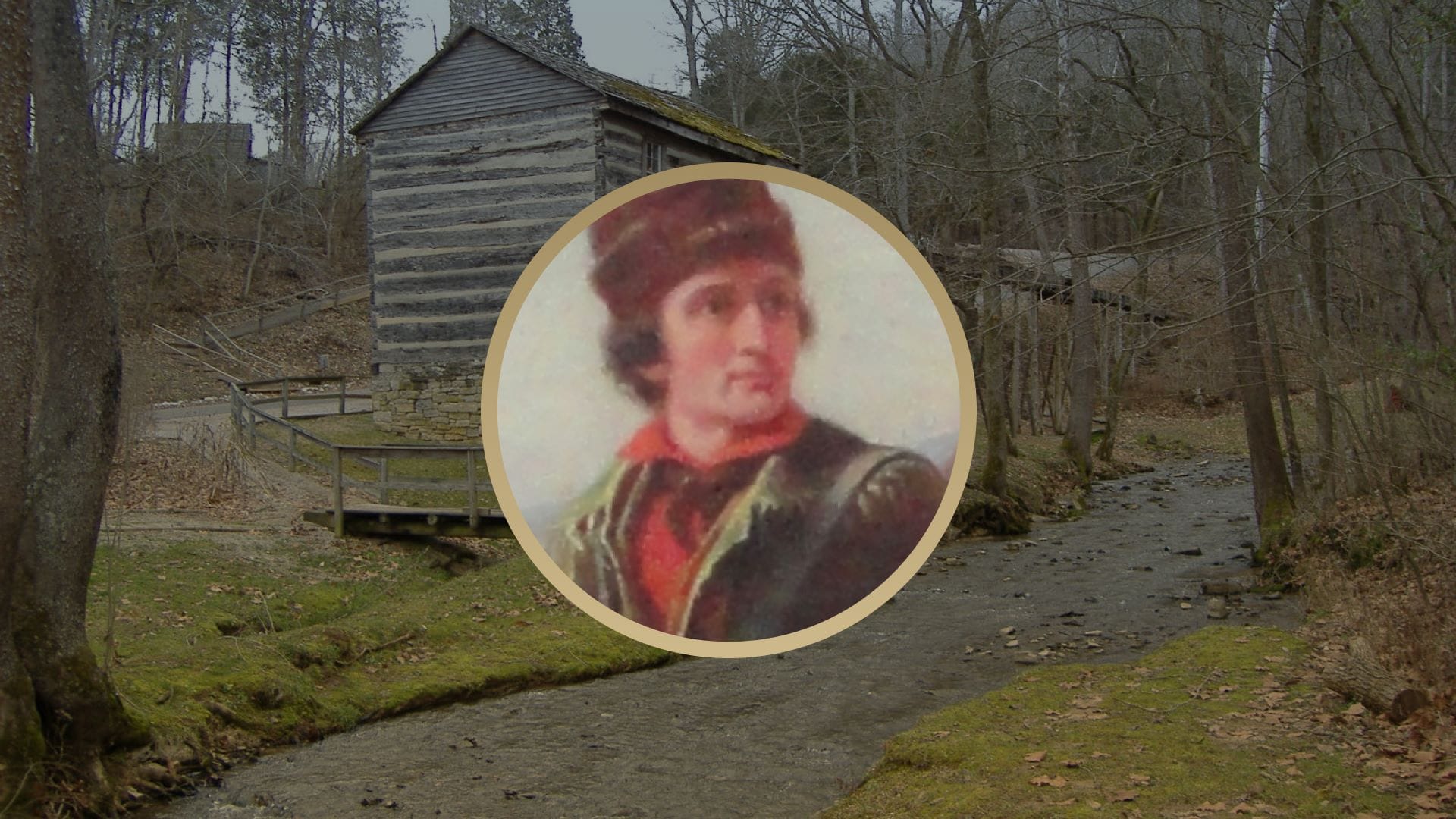
It is not easy to be the little brother of a famous man. Many worthy and honorable siblings of noteworthy men have faded into the mists of history. So it was with the little brother of Daniel Boone.
Squire Boone was born on October 5, 1744, about ten years after his famous older brother. Squire was the tenth of the eleven children of his parents, Squire and Sarah Boone. The family was originally part of the Quaker community in Pennsylvania. When Squire was still a young boy, the Boone family moved down the great wagon road through the Shenandoah Valley into the valley of the Yadkin River in what is now North Carolina.
At the age of fifteen, Squire was apprenticed to a relative back in Pennsylvania named Samuel Boone, a riflemaker. In this apprenticeship he learned the important craft of gunsmithing. Squire became a skilled gunsmith over time, and even made the famous rifle “Tick Licker” for his older brother, Daniel. Daniel Boone named the rifle with that moniker, claiming that he could “lick” a tick off the back of a deer with it!
Like most of the Boone boys, Squire yearned for the wilderness. Before his apprenticeship was completed, he was off again for the frontier settlements of the Yadkin valley. He married his sweetheart, Miss Jane Van Cleave, when he was twenty-one, and she was only fifteen. Although Jane was young, she was strong, smart, pretty, and brave! Above all, she feared God and loved her husband. Jane willingly moved into a cave with her new husband while he completed the construction of the log cabin that would be their home.
Soon after his marriage to Jane, Squire accompanied his brother, Daniel, into the wilderness of Kentucky for the first time. Over the course of the next several years, Squire and Daniel made several “long hunts” over the mountains in the rich lands filled with elk, buffalo, deer, and black bears.
Kentucky was not only rich with game, but it was also jealously guarded by various native tribes that hunted there too. Of the eight men who first entered Kentucky to explore and hunt, only two survived to return to the settlements. Those two were Daniel and Squire Boone.
One of the most remarkable events in these early long hunts was the reunion of Daniel and Squire in 1770. In the spring, Squire left Daniel alone in the wilderness. The two brothers agreed to meet later in the summer in a specific clearing. The date decided upon was July 27, 1770.
Squire took the furs they had prepared back to the settlements to trade for new horses, gunpowder, and lead. On the way home, he was robbed by the Indians, but he escaped with his life. He enjoyed a few days with his wife, Jane, and his growing children. He assured his sister-in-law that all was well with Daniel. Then he set off again into the wilderness.
At noon on the appointed day, Daniel stepped into a clearing from one side. Squire stepped into the clearing from the other side. The two brothers had a joyous reunion and exchanged news and supplies. Many historians over the years have marveled at this reunion. Amazingly, with no maps or modern navigational equipment, Daniel and Squire met on the exact day and at the exact place they had agreed upon months earlier.
In 1775, the Boone brothers, along with others such as Simon Kenton, opened the wilderness road through the Cumberland Gap. This venture blazed a trail into Kentucky that would be followed by thousands of pioneers heading westward. They came as families, and, as soon as possible, Daniel and Squire themselves brought their wives and children into Kentucky, bravely facing the dangers of the frontier.
Frontier life included many hardships. Daniel lost his firstborn son James near the Cumberland Gap; the sixteen-year-old was tortured to death by the Shawnee.
Squire was also wounded while living on the frontier. In dozens of fights with Indians, he suffered injuries eleven times. In 1775, he had his head bashed in by a tomahawk outside the gates of Harrodsburg. To help his injured younger brother, Daniel took two boards and wrapped them with cloth to bind the skull so it could heal. From this injury Squire would carry a scar on his forehead for the rest of his life.
At Boonesboro in 1778, Shawnee chief Blackfish and over 400 of his warriors surrounded the wooden stockade where the frontiersmen lived with their families. In that assault, Squire was severely wounded by a bullet in the shoulder during a parley that turned treacherous. Older brother Daniel dug the bullet out of his younger brother’s shoulder with his hunting knife. During his convalescence, Squire organized a little group of children to shoot “squirt guns” made from broken rifle barrels. The children fired their liquid “artillery” onto the burning shingles atop the blockhouses to extinguish the Shawnee’s flaming arrows, thwarting the enemy’s intention of burning down the fort!
Eventually, Squire and his family settled near present-day Shelbyville, Kentucky. The frontiersman became widely respected as an expert hunter, skilled surveyor, and honored minister of the Gospel. Always deeply reverent, Squire became a Baptist minister. He performed the first wedding in Kentucky, and he organized churches wherever he settled.
For a few years, Squire went west to Missouri where his brother, Daniel, had settled with his family. Squire and his family also lived for a time near present day Vicksburg, Mississippi. Like his older brother Daniel, Squire loved to rove far and wide, always looking for a better situation for his wife and children.
Squire finally settled down in Indiana near a cave where he had once taken refuge from pursuing Indians. He always sensed that this cave was a token of God’s protection, and it was his desire to live the final days of his life near this cave.
Squire wrote a poem and inscribed it on the walls of the cave. The poem expressed his gratitude for God’s mercy extended to him over the course of life. The title of this biographical sketch springs from the third line.
I set and sing my soul’s salvation
And bless the God of my Creation!
My God my life hath much befriended
I’ll praise Him till my days are ended!
Squire Boone and his sons built a gristmill together. He was content to have his family about him. The couple’s children included a daughter, Sarah, and four sons: Jonathan, Moses, Isaiah, and Enoch. In addition to the mill and their home, Squire and his boys built the first Baptist church in Indiana. It was called “Old Goshen Church.” Squire preached there regularly to an attentive congregation.
Squire Boone died of heart failure in August 1815 at the age of seventy. Per his request, his sons buried him in the very cave where God had once spared his life. Squire’s cave in southern Indiana is now called “Squire Boone Caverns” and is open to visitors. In later years his body was found in the cave and positively identified by the marks of the tomahawk injury on the skull. Squire’s bones were then placed in a new walnut coffin, and his body lies today in the cave, awaiting the dawn of Resurrection Day.
Sources and Further Reference:
Conway, W. Fred. The Incredible Adventures of Daniel Boone’s Kid Brother, Squire. New Albany, IN: FBH Publishers, 1992.

 21:37
21:37