
When reading the Gospels, the Apostle Andrew tends to be overshadowed by other men, such as his brother Simon Peter and also the two sons of Zebedee, James and John. Andrew was a fisherman from Galilee and an early follower of John the Baptist. He was the first of the twelve disciples to make a bold statement concerning Christ’s identity: “We have found the Messias” (John 1:41).
Andrew’s shining characteristic was that he made it his constant duty—his chief ambition and his first priority—to bring other men to the Lord Jesus Christ. He brought his brother Simon Peter to the feet of Jesus. He brought the Gentiles to Jesus. He brought the lad who had five loaves and two fishes to Jesus. And after the resurrection, he spent the remainder of his life bringing men and women and boys and girls to faith in the crucified, risen, and ascended Lord Jesus Christ. This is a worthy ambition for us all.
Little is revealed concerning the life and ministry of this splendid man. According to John 1:44, Andrew was a fisherman from the city of Bethsaida. The Aramaic name Bethsaida means “house of fishing.” As such, Bethsaida was indeed a small fishing village on the northern shore of the Sea of Galilee. It was located approximately three miles east of the city of Capernaum and was situated near the point where the Jordan River empties into the Sea of Galilee.
Andrew’s father was named Jonas. Both Andrew and his brother Peter lived the typical life of fishermen in their youth and early manhood. In the first century, small fishing boats plied the waters of the freshwater lake of Galilee, catching fish to supply the demands of their own village as well as marketing fish in the growing Roman cities, such as Tiberias, which was located on the other side of the lake. The fish caught in Jesus’ day are the same species that are abundant still today in the lake 2,000 years later!
At some point in Andrew’s early manhood, his young mind was strongly influenced by reports coming from the south. John the Baptist had emerged from the dry deserts of Judea, preaching the message of repentance. Andrew and his friend, John the son of Zebedee, were among the multitudes that came down from Galilee to attend the preaching of this new prophet whom some were calling “Elijah,” in fulfillment of the prophecy of Malachi 4:5, “Behold, I will send you Elijah the prophet before the coming of the great and dreadful day of the LORD.”
Leaving his brother Simon Peter behind, Andrew traveled south, accompanied by John. For an unspecified length of time, probably a few weeks, they listened to the preaching of John the Baptist. The Apostle John gave an account of those stirring days: “Again the next day after John stood, and two of his disciples; And looking upon Jesus as he walked, he saith, Behold the Lamb of God! And the two disciples heard him speak, and they followed Jesus” (John 1:35–37).
According to the next verse in John’s Gospel, the Carpenter from Nazareth addressed the fishermen from Galilee. “Then Jesus turned, and saw them following, and saith unto them, What seek ye? They said unto him, Rabbi, (which is to say, being interpreted, Master,) where dwellest thou?” These two young men were not being nosy! Instead, they were indicating their desire to be more than mere casual acquaintances of this Teacher.
In the culture of that day, by asking this question, Andrew and John were indicating their desire to become the disciples, or students, of the Nazarene. Education in Bible times was much more than mere lecturing. Paul described his own education as being brought up “at the feet of Gamaliel” (Acts 22:3). Education embraced all of life, and the teacher lived with, ate with, and traveled with his students.
Jesus answered Andrew and John’s question. “He saith unto them, Come and see. They came and saw where he dwelt, and abode with him that day: for it was about the tenth hour” (John 1:39). After just one interview with this Teacher from Nazareth, Andrew was fully convinced that this Man was indeed the Messiah of Israel, the anointed One promised by the Hebrew prophets.
Enthusiastically, Andrew hurried back to his hometown to share his discovery with his family, leaving John alone with the Lord Jesus. “One of the two which heard John speak, and followed him, was Andrew, Simon Peter’s brother. He first findeth his own brother Simon, and saith unto him, We have found the Messias, which is, being interpreted, the Christ” (John 1:40–41). This is the first time in the Gospel record that Jesus was explicitly called the Messiah.
The angel Gabriel had called the unborn Babe Immanuel (“God with us”) and had proclaimed that He would be called “the Son of the Highest” (Luke 1:32). His earthly parent Joseph named Him Jesus (“Jehovah is the Savior”). Mary the mother of Jesus called Him “my Savior.” Zacharias the priest called Him “the dayspring from on high.” John the Baptist’s mother Elisabeth was the first to call Jesus “Lord.” Simeon called Him “A light to lighten the Gentiles, and the glory of thy people Israel” (Luke 2:32). John the Baptist called Him “the Lamb of God.”
But it was Andrew who was the first in the Scriptures to bestow upon Jesus the exalted title Messiah, “the anointed one,” rendered into Greek by the word Christos, “the Christ.” Significantly, Andrew “first found his own brother Simon.” In this passage, Andrew’s zeal, his love for his own kin, and his enthusiastic desire to share with them the wonder that he had discovered is very evident.
Andrew’s life reveals how much fruit one faithful witness can have. Due to Andrew’s witness to his own brother, not only was Simon Peter converted, but the fruit of Peter’s ministry can rightfully be shared with his noble brother Andrew. The 3,000 souls converted on the day of Pentecost under Peter’s preaching, as well as the two Epistles written by him, are very real tributes to the faithful witness of Andrew.
A few weeks after Andrew and Peter’s initial meeting with Jesus, Jesus traveled north to Galilee and called the two brothers to make a permanent break with their old life and follow Him full-time. The conversation, as recorded in Matthew 4:18–19, went thus: “And Jesus, walking by the sea of Galilee, saw two brethren, Simon called Peter, and Andrew his brother, casting a net into the sea: for they were fishers. And he saith unto them, Follow me, and I will make you fishers of men.”
At the occasion of the feeding of the 5,000, Andrew again brought someone to Jesus. This event occurred not too far from Andrew’s home village of Bethsaida, just a little way around the shore to the south and east. The area was a sparsely settled region. Jesus was teaching the people on the grassy Golan Heights.
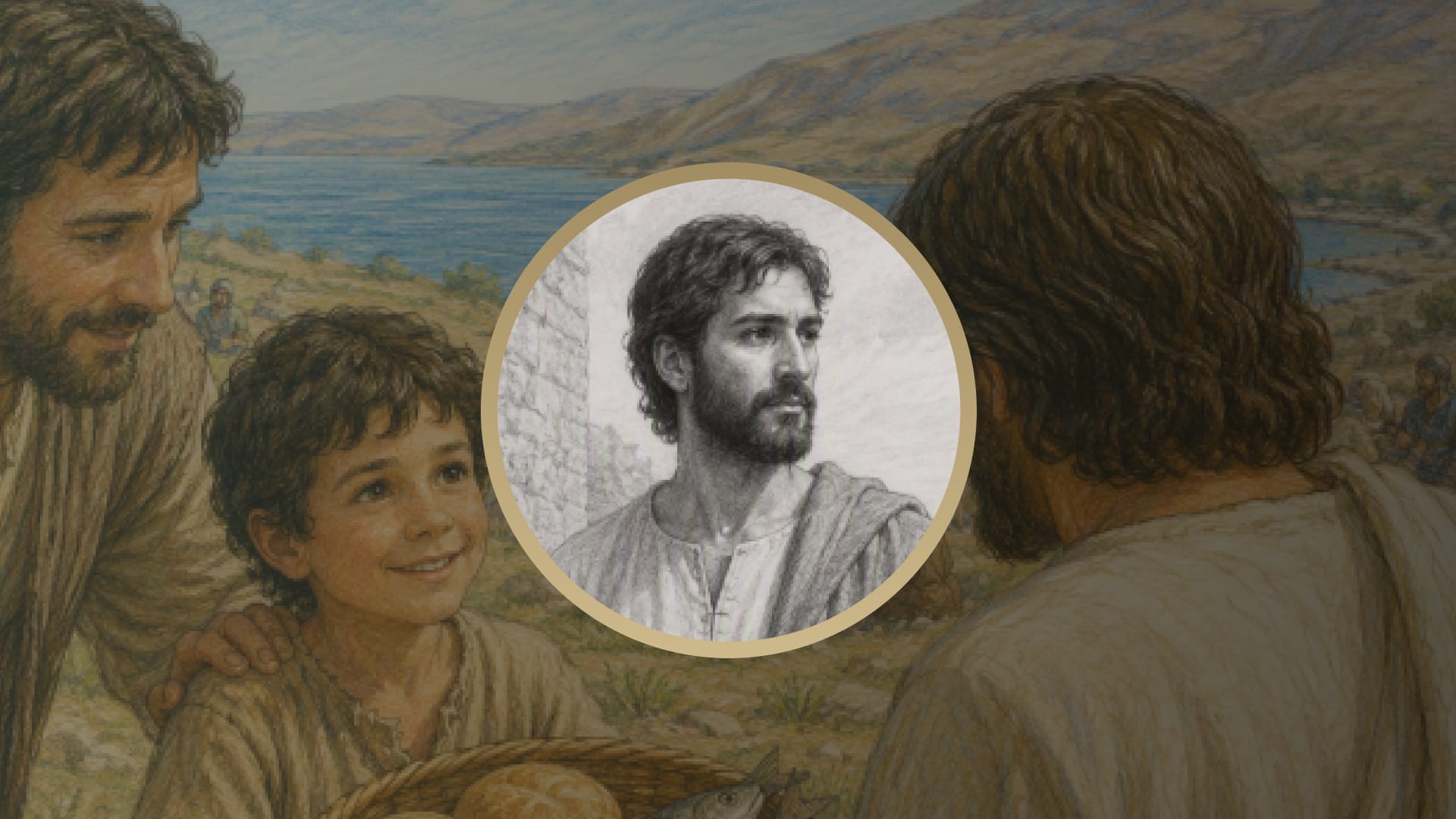
Philip, Andrew’s boyhood friend, had observed that 200 pennyworth of bread, approximately 200 days of wages, was not sufficient to feed the multitude gathered there to hear Jesus teach. “One of his disciples, Andrew, Simon Peter’s brother, saith unto him, There is a lad here, which hath five barley loaves, and two small fishes: but what are they among so many?” (John 6:8–9). Just as Andrew had brought his brother Simon Peter to Jesus, so now he brought the little boy to Jesus. Christ took what Andrew and the little boy offered. As a result, 5,000 men, plus more including women and children, were fed and filled.
Andrew continued to bring people to Jesus. In Jerusalem, not long before Christ’s crucifixion, he did so again. Of the Gospel writers, only John recorded what happened. “And there were certain Greeks among them that came up to worship at the feast: The same came therefore to Philip, which was of Bethsaida of Galilee, and desired him, saying, Sir, we would see Jesus. Philip cometh and telleth Andrew: and again Andrew and Philip tell Jesus” (John 12:20–22).
Again, Andrew was bringing people to the feet of his Master, Jesus Christ. This seemed to be his lifelong mission as a fisher of men. After this account, Andrew is not mentioned again specifically by name in the Biblical record. But his deeds are noted in the historical accounts of the early church.
After almost four decades of evangelical labors, in the year A.D. 70, the same year that Jerusalem was destroyed by the Romans, Andrew met a heroic martyr’s death in the city of Edessa, near the shores of the Black Sea. There, the pagan Roman governor named Aegaeas, exasperated at the preaching of the Gospel, angrily threatened Andrew with crucifixion.
The Apostle Andrew is said to have looked into the eyes of the enraged governor and replied, “Had I feared the death of the cross, I should not have preached the majesty and gloriousness of the cross of Christ.” The fortitude and courage of Andrew so impressed the governor’s wife, Maximillia, that she was converted to the Gospel. But Aegaeas would not be persuaded. He commanded that Andrew be crucified. An X-shaped cross was erected, outside the city. Even in his final testimony, Andrew was introducing people to the Savior of all mankind.
When Andrew was led to the cross, he reportedly said, “O beloved cross! I have greatly longed for thee. I rejoice to see thee erected here. I come to thee with a peaceful conscience and with cheerfulness, desiring that I, who am a disciple of Him Who hung on the cross, may also be crucified.”
 27:22
27:22