

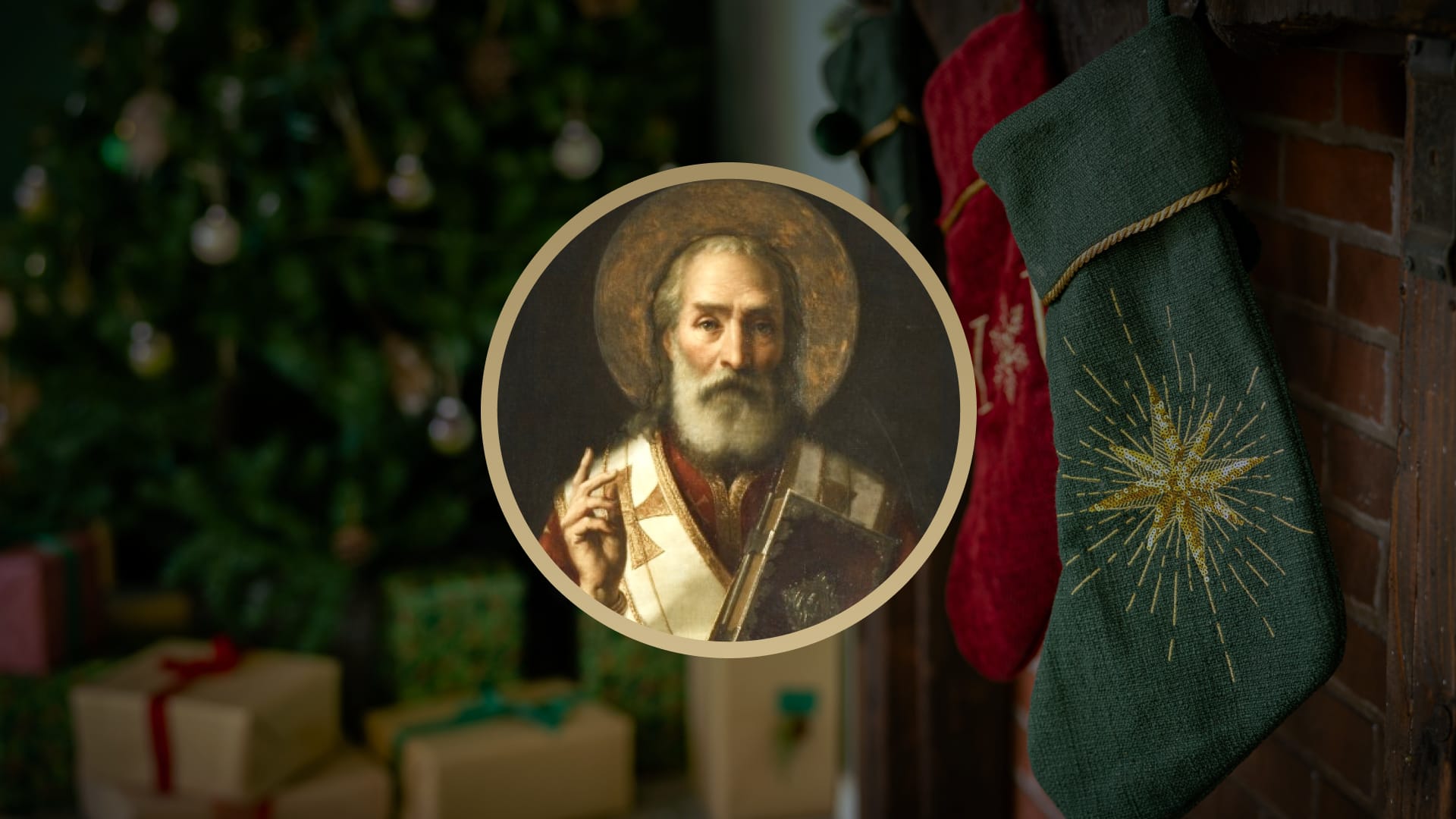
You probably were not expecting a biographical sketch of jolly old Saint Nicholas on this Christmas morning! The British know him as Father Christmas. The Dutch call him Sinterklaas. In German regions, he is referred to as Weihnachtsmann, meaning “Christmas Man.” Most Americans simply know him as Santa or Santa Claus.
There are certainly some pagan elements in ancient Norse legends of a white bearded man coming from the frozen regions of the North, bringing blessings at yuletide. But if we patiently peel back centuries of myth, tradition, and religious superstition, we will find a very real Christian man named Nicholas who, like every other true saint, loved the Lord and served Him faithfully in his generation.
Nicholas of Myra was born in A.D. 270, in the city of Patara on what is now the modern-day Turkish coast. His native region was Pamphylia; it is mentioned in Acts 14:24 as evangelized by Paul and Barnabas on their first missionary journey.
The parents of Nicholas were wealthy Greek Christians who lived during a very turbulent time in Roman history. At the time of the birth of Nicholas, Diocletian was rising through the ranks as a victorious Roman commander, a cruel man who would later become known as one of the most ardent persecutors of Christians in the decades to come.
When Nicholas was in his teens, his parents died. One of Nicholas’s uncles was a bishop in the church at Myra. The uncle took his nephew into his care and instruction.
Nicholas inherited a large fortune upon which he could have lived comfortably his entire life. Yet, he was captivated by the words of our Lord Jesus Who had taught His disciples to give to the poor, deny themselves, and take up the cross to follow Him. Thus, Nicholas resolved that he would put the words of Christ into living action. He found ways of secretly giving away his vast wealth to the poor so that the recipients of his generosity never knew the source of the gifts. For this reason, “gift giving” has been long associated with Saint Nicholas. He gave generously, consistently, and without thought of personal gain.
The story most commonly associated with his charity relates to a time that he gave a large gift to a family in desperate need of aid. The circumstances of the story are somewhat obscure, but these are the basic facts that we know from history. A father who had once been a wealthy man had been reduced to poverty by difficult circumstances. The man had three daughters, but he could not afford to pay dowries for their marriage. Reduced to utmost poverty, the father was considering allowing his daughters to become prostitutes in order to provide income.
Nicholas heard of the family’s plight, and he resolved to help. One night after dark, Nicholas crept up to the house under the cover of darkness and threw a heavy purse filled with gold into the open window of the house. He slipped away before the surprised father could investigate the source of the generous gift.
The father arranged a wedding for his first daughter, using the gold so generously provided. Some time later, Nicholas repeated his nighttime visit with a purse full of gold for the second maiden, who was likewise married in due time.
One more visit was made to the home since there was yet one final daughter. The young woman’s father began watching while wondering if there would be another provision for a dowry. Sure enough, one night a bag of gold came sailing through the window! The father burst out the door and discovered Nicholas! The grateful father fell at Nicholas’s feet, thanking him for his generosity. Nicholas ordered the man not to tell anyone about the gifts.
It is believed that while he was still a relatively young man, Nicholas visited the land of Israel. The ship that he sailed upon from Turkey to the Holy Land was caught in a terrible storm. As the legend goes, Nicholas stood on the deck of the ship and rebuked the waves, bringing the storm to an end.
While on his pilgrimage to the Holy Land, Nicholas took up residence in the village of Bethlehem, living in a small cave on a hillside overlooking the fields where the shepherds saw the angels. The St. Nicholas Greek Orthodox Church now stands upon the site which is near Beit Jala, a village where Christian Arabs still reside today.
After his pilgrimage to the Holy Land, Nicholas returned to Myra, the city where his uncle had once served as bishop. His uncle was deceased by this time, and the bishopric was vacant. Unbeknownst to Nicholas, the pastors in Myra had decided that the first priest to enter the church on a certain morning would be chosen as bishop. Nicholas indeed happened to go to the church early that morning; thus, he was chosen to be bishop of the church of Myra. The city of Myra is mentioned in Acts 27:5 as a location where Paul changed ships on his long voyage to Rome.
Nicholas served the people of Myra for many years. His acts of generosity and kindness continued for the remainder of his life. During a great famine in Myra, Nicholas asked some sailors to unload part of their cargo of wheat to help feed the starving people of the city. The sailors donated enough wheat to supply the city for two years! Nicholas promised that the sailors would not suffer loss for their generosity to God’s people. To the astonishment of the sailors and wheat merchants, when the ship arrived at its destination, the weight of the load had not changed a bit! The men’s large gift to the city had not hurt their profits at all.
During the savage Roman persecution, often called the “Great Persecution,” under Emperor Diocletian, Bishop Nicholas was imprisoned and tortured. He survived his torture and was eventually released by orders of the Emperor Constantine. Now an elderly man, Nicholas attended the famous Council of Nicea in A.D. 325. There, he staunchly supported orthodox Trinitarianism (that God is a triune God) against the heresies of Arianism. During heated debate at the meeting, the aged Bishop Nicholas is reported to have slapped the face of Arius, another in attendance and a contender that Jesus was only a man!
Nicholas of Myra died on December 6, 343. His feast day is called Saint Nicholas Day and is still remembered in early December throughout Europe. Because of the man’s generous giving, his temporary residence in Bethlehem, and his devotion to the eternal Sonship of Jesus Christ at the Council of Nicea, he has been associated with Christmas and all its adornments.
Centuries of tradition and legend have created the character that we know as Santa Claus, but the mists of time should not cause us to forget the very real man who lived and served his Lord faithfully and generously so long ago. The very name Santa should remind us as believers that we are all saints. As such, we should cultivate and emulate the perfect generosity of our Lord Jesus.
Sources and Further Reference:
Michael the Archimandrite. St. Nicholas of Myra Life. Bibliotheca Hagiographica Graeca: 1348. Translated by John Quinn and Bryson Sewell, 2014. Sections 1-11 are published by and copyright the St. Nicholas Center under the Creative Commons Attribution – NonCommercial-NoDerivatives 4.0. Sections 12-52 were commissioned by Roger Pearse, Ipswich, and are released by him into the public domain.

 22:09
22:09