

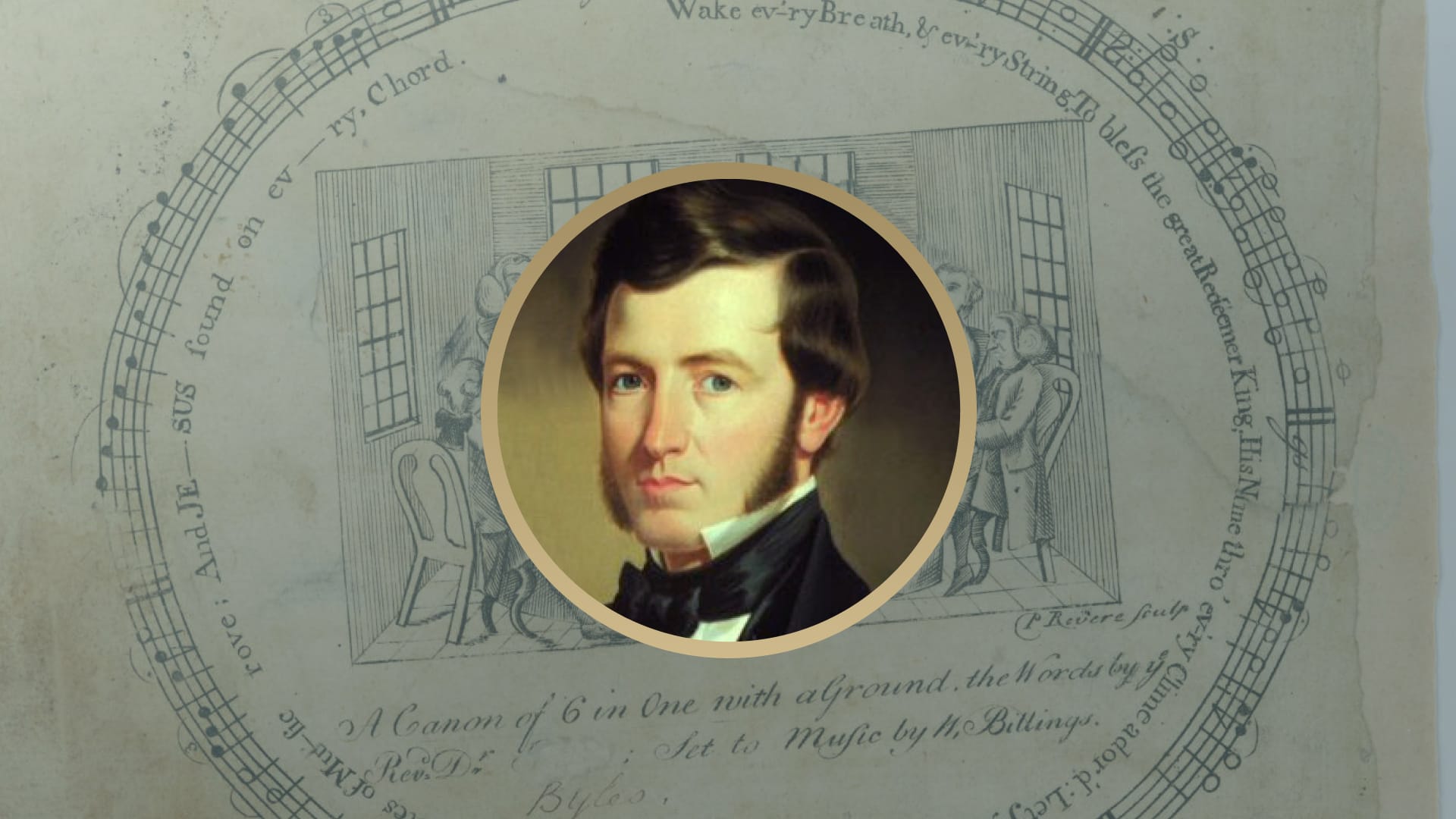
A cold wind swept through the streets of Boston. By the light of the lanterns, a man, stooped with age, made his way slowly along the streets. He had a broom in his hand, for his employment was a street sweeper. The man was blind in one eye, and one leg was shorter than the other, causing him to limp along his nightly route.
Here and there, up and down the Boston streets, families sat around cheery fires in their warm homes, singing Christmas carols. Among the most popular anthems of the day was a Christmas carol that began “Methinks I see an heav’nly host of angels on the wing.”
One of the memorable stanzas of this particular carol contains these lines about the incarnation:
Seek not in courts or palaces,
Nor royal curtains draw;
But search the stable, see your God
Extended on the straw.
The author of this carol and the composer of the stirring, four-part tune to which it was set was none other than the aforementioned humble street sweeper, William Billings. In the days before copyright laws, Billings, one of the greatest musicians of all time, hardly gained even a penny from his masterful compositions. Called the “Father of American Choral Music,” William Billings died in poverty. But his contributions continue to shape American composition to this day.
Billings was born in Boston on October 7, 1746. From childhood, he had a keen interest in music. He was mostly self-taught. His father died when William was fourteen years old, ending the young man’s opportunities for further education. He was apprenticed to a tanner and learned the skills of tanning leather.
While working long hours in the tanning shop, texts and tunes would take shape in his heart and mind. By the age of twenty-two, he was teaching a “singing school,” which was a short course of instruction in the skill of singing parts. By the time he was twenty-four, he had published his first book of choral compositions, titled The New-England Psalm-Singer.
Many of the texts and tunes that Billings wrote in the days of his youth were first penned on scraps of leather in the tanner’s shop where he apprenticed. One of his earliest pieces is also one of his best known. For the words penned by another writer, Billings skillfully composed the music as a canon of four lines; as a result, the song can be sung as a round, each line harmonizing perfectly with the other melodic lines so that all four lines can be sung simultaneously. This sort of composing is a very difficult musical feat. However, the resulting haunting combination of text and tune is never forgotten once heard.
When Jesus wept, the falling tear
In mercy flowed beyond all bound.
When Jesus groan’d, a trembling fear
Seiz’d all the guilty world around.
In physical respect, William Billings was not an attractive man. Besides blindness and a shorter leg, he also had a withered hand. Plus, while his deep bass voice was strong, it was not especially melodic nor resonant.
Yet, William Billings’s music took deep root in New England. Singing schools sang his tunes with enthusiastic vigor. Other composers began to imitate his style. Billings published a second collection in 1778, titled The Singing Master’s Assistant.
William Billings married a lady named Lucy, and the Lord blessed the couple with six living children over the course of their marriage. Throughout these years of writing, composing, publishing, and leading singing schools, Billings supported his family as a tanner. In those days, it was very difficult for a musician to support himself solely by his creative compositions.
Billings was an ardent American patriot. Living during the stirring days of the Boston Tea Party and the battles in nearby Lexington and Concord, Billings wrote many patriotic pieces. It is said that the famous patriot and silversmith, Paul Revere, sang bass in one of the choirs conducted by Billings.
“Chester” is the most well-known of the patriotic songs composed by Billings. He wrote both the tune and the text, ascribing to God the victories achieved by the American forces during the War for Independence. The song attained a status as the unofficial first national anthem of the United States. Played by fife and drum corps for many years, it is still occasionally performed by the United States Marine Corps Band.
Let tyrants shake their iron rod,
And Slav’ry clank her galling chains,
We fear them not, we trust in God,
New England’s God forever reigns.
An unwavering patriot and a devout Christian, Billings took special interest in the incarnation of the Son of God. Living in a time of rising Unitarianism and religious skepticism, William Billings closed his most famous Christmas carol, “Methinks I See an Heav’nly Host,” with this firm affirmation of the Trinity:
To God the Father, Christ the Son,
And Holy Ghost ador’d:
The First and Last, the Last and First,
Eternal praise afford,
Eternal praise afford.
Several of Billings’s most familiar songs are Christmas carols. His poetic wording brought fresh insight to many well-known passages about the birth of our Lord. One such rendering in his Christmas carol that is the title of this biographical sketch placed the innkeeper in a harsher depiction. Billings called the man in one of the stanzas “ungen’rous soul of savage mould, and destitute of grace.”
A memorable line from another Christmas hymn says of the beasts in the stall: “The oxen are near him and blow on your God.” Coming from a lowly station in life himself, Billings delighted to portray the Son of God in the humble circumstances of a stable. He described the infant Jesus as “extended on the straw” among the cattle blowing warm air on the face of the Son of God:
Then learn from hence, ye rural swains,
The meekness of your God,
Who left the boundless realms of joy
To ransom you with blood.
William Billings was a steadfast, committed Christian. He faced all of life’s hardships with a firm faith in the Lord Jesus. His beloved wife died in 1795, and he was left a widower to care for six children, all under the age of eighteen. For a time, he was reduced to such poverty that he supplemented his meager income by being employed as a street sweeper in Boston.
Five years after Lucy’s passing, he followed her in death on September 26, 1800. William Billings’s compositions are being studied again in modern times by music scholars. Growing traditions, such as the Sacred Harp music (also known as “shape note singing”), continue today to sing his pieces with gusto and gratitude throughout the world.




 21:37
21:37