

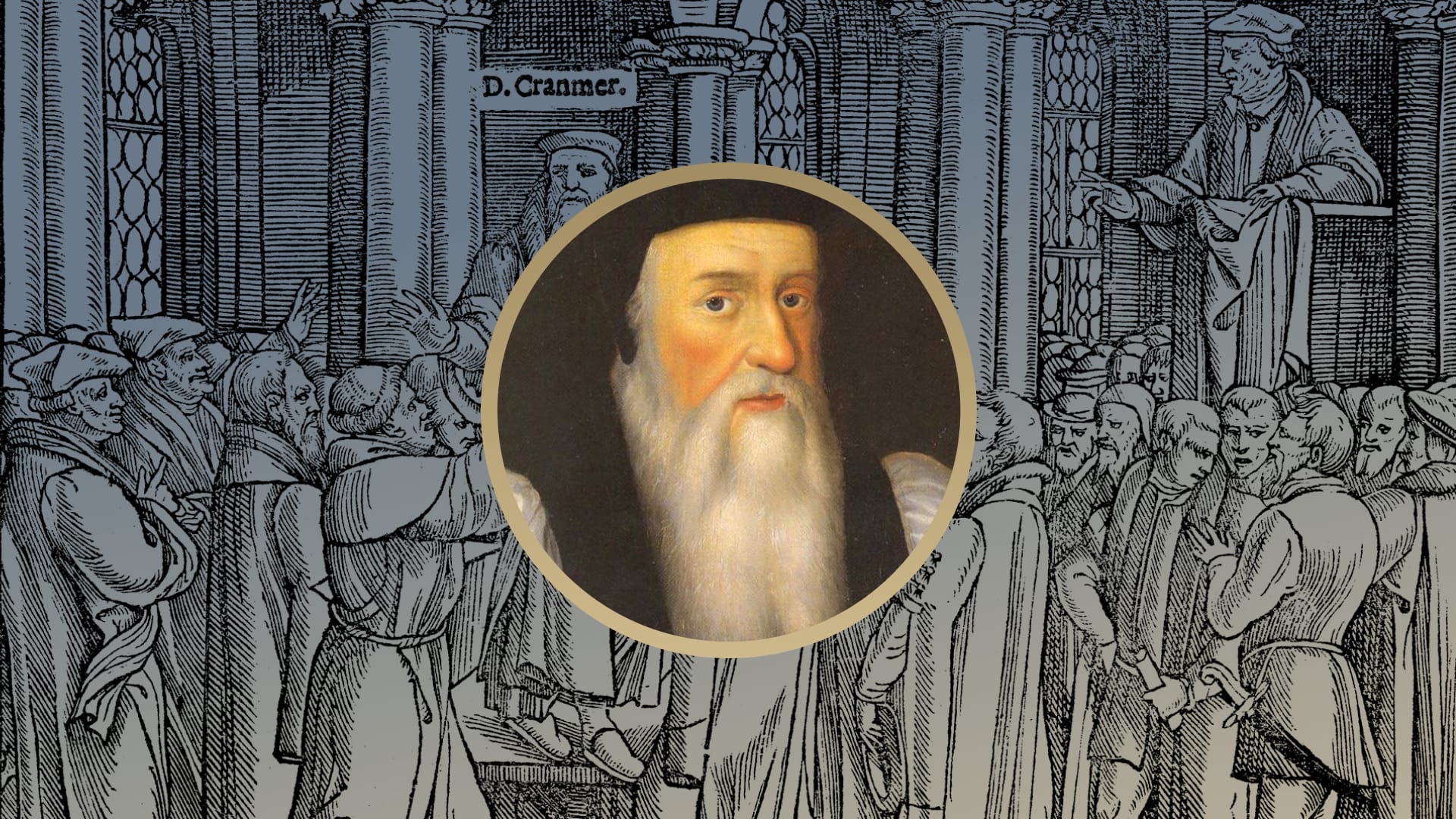
The Book of Hebrews speaks of men of faith “who through faith subdued kingdoms, wrought righteousness, obtained promises, stopped the mouths of lions, Quenched the violence of fire, escaped the edge of the sword, out of weakness were made strong” (Hebrews 11:33–34).
These words apply well to the life and death of Thomas Cranmer, Archbishop of Canterbury. Unlike the typical bold, fiery Reformer such as Martin Luther or William Farel, Thomas Cranmer was a gracious man of peace, a gentle soul, a warm friend, and a man who earnestly shunned controversy. Thomas Cranmer was the Primate of All England, the respected protector of kings, the trusted friend of queens, a loving husband, devoted father, trusted churchman, and the author of the beloved Book of Common Prayer.
But the year 1556 saw Cranmer at the great crisis of his life. We will journey back through history and peek into the cell of his prison. Just like those witnesses listed in the Book of Hebrews, let’s see how “out of weakness” Thomas Cranmer “was made strong.”
A gloomy light filtered into the dark prison cell where Thomas Cranmer sat. The feeble shaft of daylight illuminated a piece of paper. Cut off from aid or help of his friends, separated from his wife and children, his weary heart pondered his options.
Only two options were before Cranmer. First, he could assert the truths he believed: Christ was the head of His Church; the mass was an innovation; purgatory was unbiblical, and salvation is by grace alone in Christ alone. Or, second, he could give in to the pressure of the age (accommodating the compromises with Rome demanded by Bloody Mary) and hope to retain his position as Archbishop of Canterbury.
Only weeks before, two of his very dear friends, Hugh Latimer and Nicholas Ridley, had chosen the first option. They boldly stood for the truth and, as a result, they had been burned to death at the stake. From the window of his cell, Cranmer could look down the street and see the place where his two friends had suffered such a cruel death. Now, if he persisted in his beliefs, their fate would be his also.
Cranmer’s mind churned. What good came of their death? Latimer and Ridley were gone. Their voices were forever silent. He could avoid their fate simply by signing that piece of paper in front of him, recanting his “errors.” But he sincerely believed the truth, and he also knew that Jesus had said, “But whosoever shall deny me before men, him will I also deny before my Father which is in heaven” (Matthew 10:33).
For many decades now, Thomas Cranmer had survived when others had died. When popular current had run against the Gospel, Cranmer, like a reed blown by the wind, had bowed over until the storm had passed. He had survived by keeping a low profile and speaking only when it seemed that the truth would be received. He had always been a gracious peacemaker.
Now Cranmer was an old man. Could he endure burning at the stake for his beliefs? Would it not be easier to die in a comfortable bed like a respectable man, rather than in open shame like a criminal?
There, in the quietness of his cell, he made his decision. With a trembling hand, he signed the paper confirming his recanting of truth. Like the Apostle Peter many centuries before, Thomas Cranmer denied his Lord in the hour of trial.
For a time, Cranmer was relieved. He would retain his honor. A date was set in which he was to enter the church and renounce his errors before the assembled throng. But as the awful day of public recantation approached, Cranmer’s heart began to smite him with reproach and guilt. His Lord’s words again throbbed in his heart and mind: “But whosoever shall deny me before men, him will I also deny before my Father which is in heaven” (Matthew 10:33).
Indeed, Cranmer had denied his Lord Jesus. The deed was done. Oh, if he could only recall the ink of that written confession! If only that quill pen could remove the writing similarly as it had released the ink onto the paper to form those condemning words. But it was too late. The recantation was submitted. The date was set for him to deny the Gospel publicly.
We dare not enter the sacred ground where the old penitent sought pardon of his God. What were the agonies of his soul? How many were the tears that etched their way down those aged cheeks? But had not Peter also denied his Lord? Had not Peter also afterward sought and obtained the grace of God?
Perhaps in those sacred moments, Thomas Cranmer turned with sorrowful eyes to the very words that he had composed in brighter days, words from the Book of Common Prayer:
Almighty and most merciful Father, we have erred and strayed from thy ways like lost sheep. We have followed too much the devices and desires of our own hearts. We have offended against thy holy laws. We have left undone those things which we ought to have done, and we have done those things which we ought not to have done and there is no health in us. But thou, O Lord, have mercy upon us miserable offenders. Spare thou them, O God, who confess their faults. Restore thou them that be penitent, according to thy promises declared unto mankind, in Christ Jesus our Lord.
The day finally came for the public recantation. With fixed resolve, the aged penitent entered the pulpit in the cathedral. Many people had assembled to hear the public recantation of the heretic. Some were there who had once been earnest followers of his preaching, those he had led in days past. Now, they had come to hear him deny his Lord. Their earnest faces gave the penitent new courage.
Looking upon the assembled throng, old Cranmer addressed the people in carefully crafted words, proclaiming the duty of the people to live as Christians, to shun error, to be loyal to true religion. Soon he neared the end of his speech.
Up to this point, all the people still assumed that he would now recant his former preaching. Cranmer then said, “I come to the great thing that troubleth my conscience more than any other thing that ever I said or did in my life, and that is the setting abroad of writings contrary to the truth: which here now I renounce and refuse.”
A moment of tense silence filled the room as concerned believers and triumphant bishops alike looked to the pulpit with fixed eyes, waiting for him to recant. Cranmer then said, “I have written many things untrue. And forasmuch as my hand offended in writing contrary to my heart, therefore my hand shall be first punished; for if I come to the fire, it shall be first burned.”
The gracious man still hated controversy, but his hour had come. He had bent to the wind far too long. He squared his shoulders and continued, “And as for the Pope, I refuse him as Christ’s enemy and anti-Christ, with all his false doctrine. And as for the Sacrament . . .”
Here a violent outcry interrupted Cranmer! His speech was cut short by the enraged bishops. As with the first martyr in the Book of Acts, so his enemies gnashed their teeth, pounced upon him, and hauled him away to his death.
Soon, Thomas Cranmer, once the Primate of All England, the Archbishop of Canterbury, the leader of the English Reformation, was chained to a rough wooden stake. His wife and children were far away, safe in Germany; they would not learn of his death until the crisis was past.
Cranmer stood in the same place where his two friends had recently gone before him. A mixed crowd was present, a vast concourse of people. They recognized that before them stood none other than the highest churchman in the land of England!
The fire was kindled and the flames leaped upward. True to his promise that his offending hand that had penned the recantation would first be punished, Cranmer resolutely held his right hand directly into the fire. Cranmer did not die until the right hand was burned all the way to the stump. The old man then lifted his eyes triumphantly to Heaven. His face was ringed with flames but filled with peace. He cried out, “Lord Jesus, receive my spirit!”
In his lifetime, by the grace of God, Thomas Cranmer had indeed been as one in the Book of Hebrews, a hero of faith. He had “subdued kingdoms, obtained promises, and wrought righteousness.” Now, by the grace of God, in his death, he “quenched the violence of fire” and “out of weakness was made strong.”
Sources and Further Reference:
Foxe, John. Foxe’s Book of Martyrs. Peabody, MA: Hendrickson Publishers, 2011.
Loane, Marcus. Masters of the English Reformation. Carlisle, PA: Banner of Truth, 2005.


 21:37
21:37