

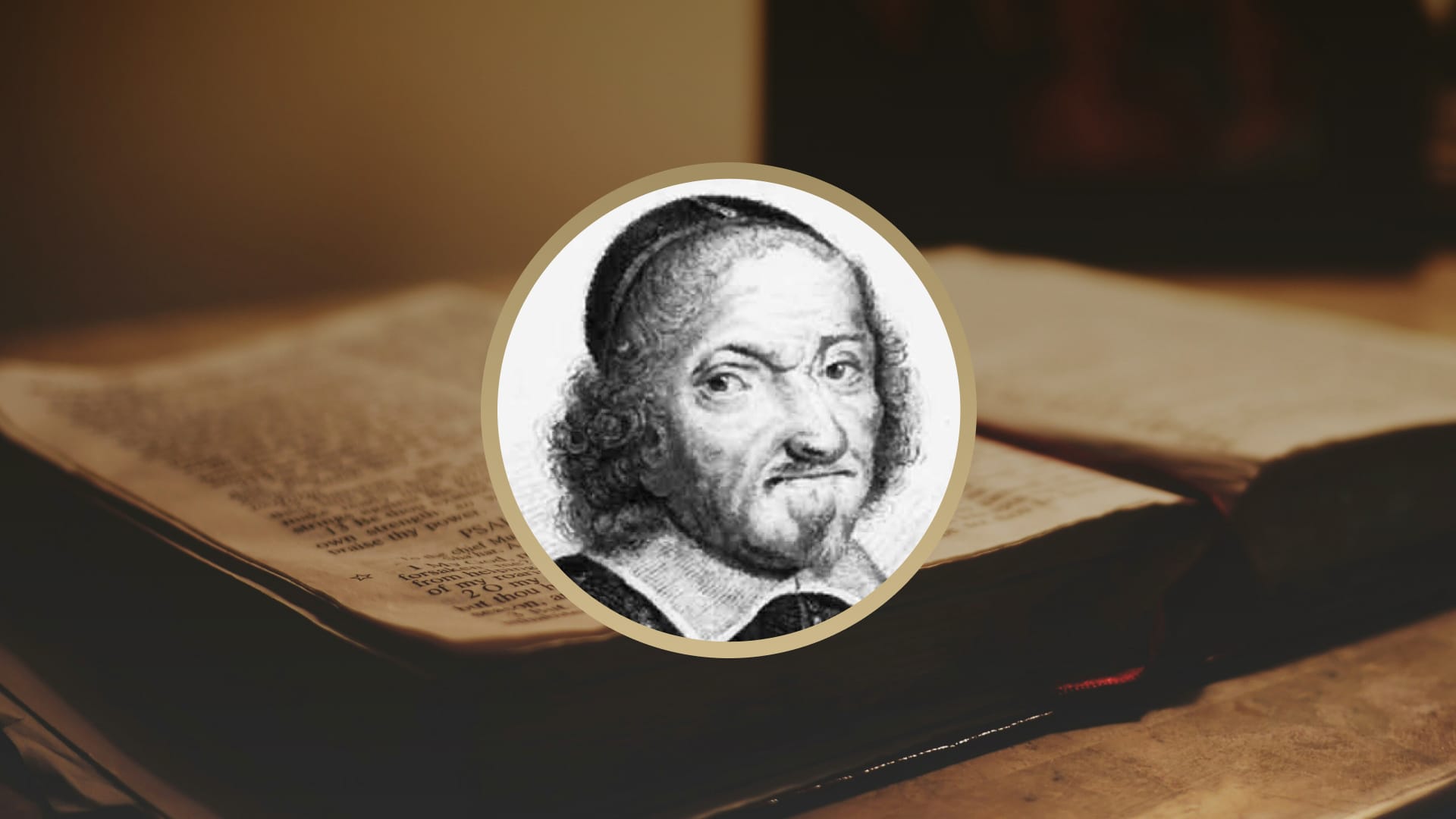
William Tyndale, the courageous translator of the English Bible, was being bound to the stake on the morning of October 6, 1536. In the midst of this torturous persecution, he lifted up his eyes to Heaven with one final prayer: “Lord, open the King of England’s eyes!”
Upon those words, the rope was drawn tight and Tyndale’s body was burned to ashes. But God heard the dying prayer of His faithful martyr. Two years later, King Henry VIII granted his royal benediction upon the printing and distribution of the English Bible!
This remarkable change of events was providentially orchestrated by the God of Heaven. The humble servant of the Lord whom God selected to complete Tyndale’s important work was Myles Coverdale. While Tyndale’s name and contributions to Bible translation are widely recognized and appreciated, the faithful labors of his friend Myles Coverdale are often unknown to many Christians today.
Myles Coverdale was born in Yorkshire in 1488. Upon completing his studies at Cambridge, he was ordained as a priest and became an Austin friar, an English scholastic order marked by their black robes and hoods.
Coverdale was a friend and follower of Robert Barnes, an early English reformer who was condemned as a heretic by Cardinal Wolsey and burned to death. Other close friendships that Coverdale formed were with men such as reformers Thomas Bilney and Hugh Latimer.
Influenced by his reformer friends, Coverdale left the friars in 1527. He started wearing ordinary clothing, and he began preaching the simple truths of the Reformation—that salvation is by grace alone in Jesus Christ alone. The young scholar also began translating some of the works of Continental Reformers, such as Martin Luther, into English.
Although the Church of England had separated from the papacy, the church’s doctrine was still far from reformed. King Henry VIII had selfish, personal reasons for separating from papal authority, but the king clung tenaciously to the superstitions of the Roman sacraments.
Meanwhile, persecution was intensifying against those who preached reform. Thus, Myles Coverdale deemed it wise to flee England for the Continent near the end of 1528. He lived for a while at Antwerp, assisting William Tyndale in his work of translating the Scriptures from Hebrew and Greek into English. When Tyndale was betrayed by a man he had kindly befriended, Coverdale steadfastly continued Tyndale’s work alone, laboring faithfully to complete this English translation.
Coverdale used Tyndale’s entire New Testament along with portions of the Old Testament that Tyndale had finished before his death. The latter were namely the five Books of Moses and the Book of Jonah. Coverdale used other sources, such as the German Bible of Martin Luther and the Latin Vulgate, to complete the English Old Testament, hoping one day to strengthen his own knowledge of Hebrew.
Another important accomplishment of Coverdale’s was to produce an English psalter. His psalter became an important part of The Book of Common Prayer. He also translated many of Martin Luther’s hymns into English and published the entire collection under the title Ghostly Psalms and Spiritual Songs. Coverdale’s careful work on the psalter influenced all subsequent English psalters and emphasized the importance of congregational singing in the Protestant Reformation.
As the tide began to turn in favor of the Reformation, Coverdale found a valuable friend in Thomas Cranmer. The Godly Cranmer encouraged Coverdale in his work and gave official approval from the head of the English Church. The title page of the Coverdale Bible urged readers to “take these words into thy heart, and be not an outward hearer but a doer.”
In 1539, Coverdale returned to England to assist the efforts of the other English reformers and continue his translation work. Subsequent additions of the English Bible, known as the Matthew’s Bible and the Great Bible, utilized the Hebrew skills of Coverdale’s friend, John Rogers.
During this time in England, Myles Coverdale married Elizabeth Macheson. When the tide of the king’s vacillating opinions began to turn again. As a result, the marriage of priests was made illegal, and Coverdale and his new bride again took refuge on the Continent, settling in Strasburg.
While in his second exile, Coverdale preached to other English exiles. He also continued his work of translating important German books into English; at this time he also studied Hebrew to give him a better grasp as he labored to complete the translation of the Old Testament.
Coverdale returned to England in 1548, upon the ascension of Edward VI to the throne. This was a time of great progress for the cause of reform. Coverdale became Royal Chaplain, and was appointed to be the almoner (distributor of money) to the surviving widow of Henry VIII, Queen Catherine Parr.
In 1551, Myles Coverdale was appointed Bishop of Exeter and took the pulpit of that important seat of ecclesiastical influence. He used his bishopric not to enrich himself, but to promote the cause of truth throughout his charge.
A sudden change of royal power occurred just two years later, from King Edward to Queen “Bloody Mary.” This power shift brought Coverdale into grave danger. He was summoned before the Privy Council. They formally ejected him from his bishopric and placed him under house arrest. Coverdale fully expected to be burned at the stake. But the timely pleading of his brother-in-law, who was chaplain to King Christian III of Denmark, spared his life. The King of Denmark himself wrote to Queen Mary and urged her to spare Coverdale.
Coverdale and his wife left England for a third exile and sailed for Denmark. From there, they moved south and settled in Geneva. There, Coverdale assisted other Marian exiles (a name given to those who fled from England during the reign of Bloody Mary) in the translation of the Geneva Bible. His experience in translation work was of great assistance to the translation team in Geneva.
In 1559, after the death of Queen Mary and the ascension to the throne of Elizabeth I, Coverdale returned to London. He had adopted the Genevan views on ceremonies and vestments, and he was considered one of the early Puritans. His stance on ceremonies prevented his re-installment as Bishop of Exeter, but he cared more for truth than for fame or power.
Myles Coverdale outlived his first wife Elizabeth. The widower remarried in 1565. His second wife was a Godly lady named Katherine, and she sweetened the sunset of his remaining days. Four years later at the age of 80, the reformer and translator died, a man poor financially and almost forgotten.
However, by the time of his death, the English Bible was available to “every plowboy”—Tyndale’s expression of his desire for the Scriptures to be translated so even the ordinary person could read and understand it. Also, due to Coverdale’s tireless work for the edification of others, homes and churches were filled with men, women, boys, and girls singing the psalms and hymns that he had collected. This is the legacy of Myles Coverdale, a humble servant of the Lord who faithfully finished the work that others were forced by necessity to leave undone.

 23:50
23:50