
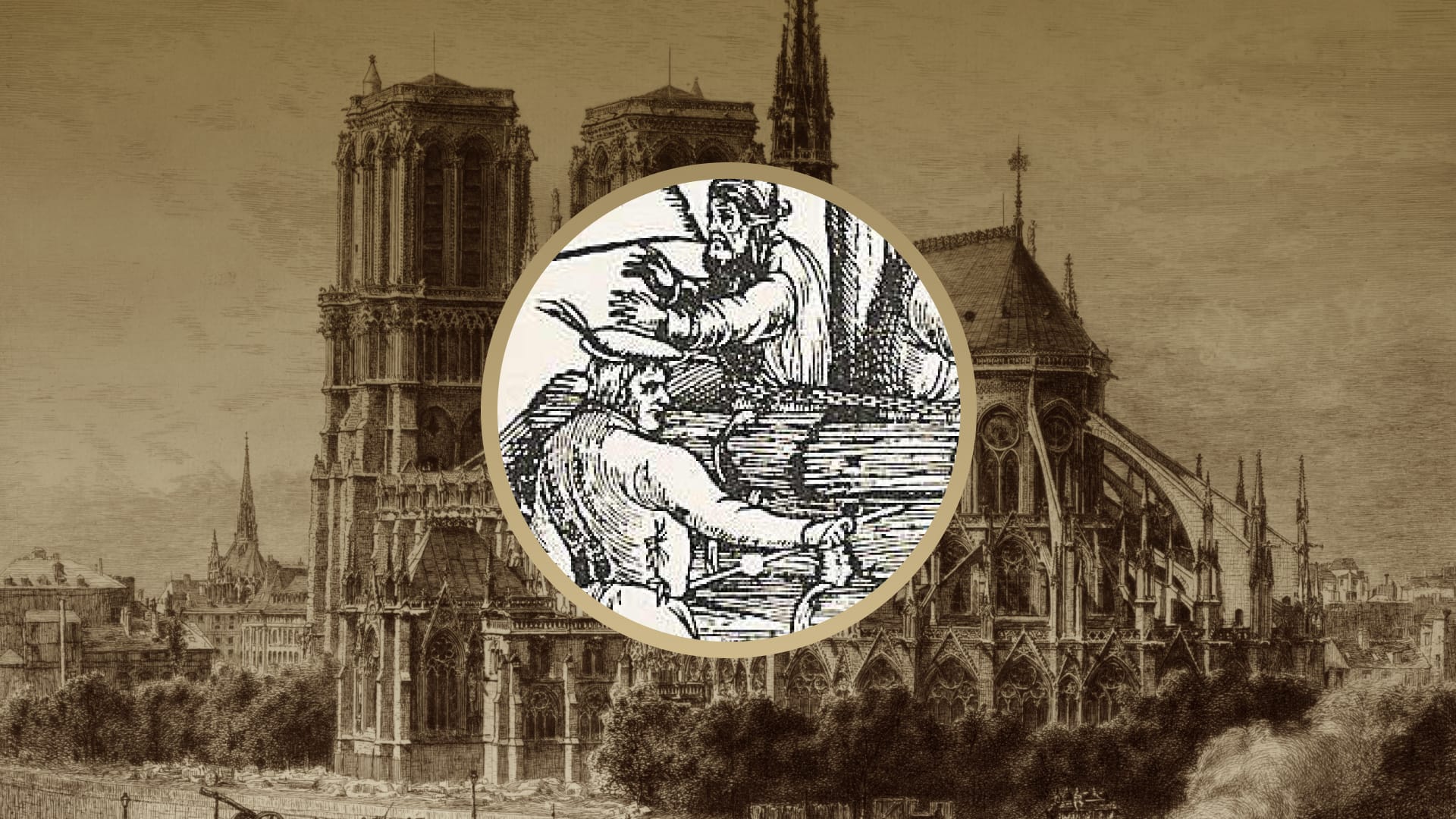
Bartholomew Milon was a hunchback who lived in the city of Paris. He spent his days racked by pain. The man hated life and cursed the God that allowed his injury. Yet, this is not the end of his story but rather the beginning! The story of his conversion and transformation into a patient and longsuffering follower of Jesus is remarkable.
Milon had not always been a hunchback. In fact, in his late teens and early twenties, he was known as one of the strongest and most handsome men in Paris. The young man was the center of the social whirl among the lower classes, with his life consumed in festive balls, drinking parties, music concerts, and dramatic comedies. D’Aubigné, the historian of the French Reformation, says of Milon, “He followed his impassioned disposition and launched into life, indulging in all the lusts of youth, in foolish amours and other kinds of irregularities with which young folks willingly defile themselves.”
One day, while foolishly sporting with his friends, the young Milon fell heavily and broke several of his ribs. He possibly injured his spine also. This injury brought his entire life crashing down upon him. The bones never healed properly. Over the course of several agonizing weeks, Milon became entirely crippled, paralyzed in his legs.
The result of the fall and broken bones left Milon in a life marked by pain every moment, both day and night. Due to the damage to his spine, the young man’s back grew incorrectly—into a disproportionate lump—and the city’s children who saw him called him “the hunchback.”
The once flamboyant, life-of-the-party Milon hated life, now that he was crippled. He hated God Who had allowed this calamity. Rather than humbling himself, he continued to ridicule religion. Spending his days propped up in the door of his father’s shoemaking shop, he watched the world go by. Oftentimes, he would often amuse himself by mocking those who passed by his door.
One day, a Huguenot (French Protestant) was walking down the street. Milon shouted at the man in scornful derision. Upon hearing the taunting words, the Huguenot stopped. He turned and walked to the shoemaker’s door. The hunchback stared back at the man. With eyes full of compassion, the Christian asked Milon, “Poor man, why do you mock at the passers-by? Do you not see that God has bent your body in this way in order to straighten your soul?”
These words penetrated deeply into Bartholomew Milon’s heart. He had never considered that his soul was as ugly as his crooked body. The Huguenot handed him a copy of the newly translated French New Testament and urged him to read it, promising to visit him again. But no teacher was needed. The Gospel touched the heart of the hunchback. Milon later wrote of his first reading of the New Testament, “Mercy has been shown me, in order that the love of God which pardons the greatest sinners should be placed as on a hill and be seen by all the world.”
Instantly, Bartholomew Milon was a changed man. He was still hunchbacked and his life was still racked by constant physical pain. Whenever his family moved him, he would have to bite down on a cloth wad to keep from screaming from the pain. But in his soul there was no pain! The joy of the Lord filled his soul. He was pardoned!
Milon began to seek out ways to serve the gracious God Who had saved him. D’Aubigné wrote, “He devoted entirely to God the restless activity which he had lavished on the world.” Bartholomew Milon invited all the young children of his neighborhood to come into his room for schooling. Little boys and girls, sons and daughters of common city workmen, would gather around his bed. From there he would teach them how to read and write, and even to sing from the French psalter. These children brought joy to the heart of the bent, crippled hunchback. The historian recorded, “In short, his room was a true school of piety, day and night, re-echoing with the glory of the Lord.”
Milon also dispelled idleness by learning metal engraving. He was soon known by all the goldsmiths throughout Paris. They would come to him for their fine detail work. Milon would do the work while in his bed, although the movement cost him much pain. The proceeds of his labor went to support Huguenot pastors, among whom was a young preacher named John Calvin.
An ardent believer, Bartholomew Milon became involved in the “Placard Affair.” This event was a concerted effort by the Protestants of Paris to publish tracts and handbills. These items were then placed in prominent places throughout the city. A placard was even placed in King Francis’ bedchamber!
Eventually, the ministry of Milon attracted the attention of the enemies of the Reformation. After the Placard Affair, the enemies of the Reformation began to persecute the Huguenots. One of their earliest victims was Milon.
The young man was suspected to be a part of the Placard Affair. While Milon could not have traveled about and put up placards, enemies still searched his place and found forbidden tracts in his room, along with a French New Testament. They seized the crippled Milon from his bed and carried him out into the streets. The cruel man who came to arrest the hunchback shouted at him, “Get up!” In spite of the threat of death, the angry commands brought a smile to the face of the cripple. Milon calmly replied, “Sir, it would take a greater lord than you to make me rise up and walk.”
The king’s advocate condemned Milon, along with six other victims, to death by burning over a slow fire. Three days after the sentence, on November 13, 1535, Bartholomew Milon looked out the barred window at the rising sun for the last time. The turnkeys (those holding the keys to the jail cells) entered his cell and lifted him from the stone floor. They carried him roughly, but Milon felt not even a pang. Miraculously, he was free of the painful agony that had racked him since his accident.
The hunchbacked Milon was carried toward the church of Notre Dame where he was to be executed. As he passed along the street where his father’s shoemaker shop was, he recalled that this was the same street where he had once rained insults upon the passers-by. Now the street was lined with people who had come to see the Huguenots die.
Among the people lining the streets for a view were many sympathizers. Milon’s eyes met the eyes of the young children he had taught in his little room. Little girls dressed in neat white aprons, their eyes brimming with tears, clasped their mothers’ hands as they gazed for the last time at the teacher they loved. Little boys looked affectionately at the young man who had taught them by words how to live and was now teaching them by example how to die.
Milon was suspended by chains and then swung out over a mild fire. After several hours, the soul of Bartholomew Milon departed his crippled body, now more greatly deformed and flame-charred. His redeemed spirit entered into the presence of his Redeemer. The weak was made strong again. Without a doubt, the hunchback entered into the presence of Christ. Freed from his mortal body and clothed in his immortal one, he was most likely “walking and leaping and praising God”!
The burnings did not have the intended effect. Rather than deterring people from the teachings of the Reformation, instead crowds of people openly avowed the Huguenot faith and stopped going to Mass. Truly, God had chosen “the weak things of the world to confound the wise.”
The sterling example of the hunchback Bartholomew Milon was never forgotten among the true believers in France. Those boys and girls grew up to become Godly men and women. Only thirty-seven years later following the martyrdom of Milon, many of those believers would meet death also at the fateful massacre of the Huguenots in Paris in 1572. Bravely they followed the example of their crippled yet fervent teacher.
Sources and Further Reference:
D’Aubigné, J. H. Merle. History of the Reformation. Harrisonburg, VA: Sprinkle Publications, 2003.

 21:37
21:37